- Corporate videography is an enterprise communications discipline combining video production, compliance workflows, brand governance, and technical infrastructure.
- Corporate video functions as a scalable business asset within integrated content ecosystems across internal communications, external messaging, and regulated stakeholders.
- Effective corporate videography relies on repeatable systems for planning, approvals, production, localization, distribution, and long-term asset management.
Corporate videography is a complex and specialized communications function that integrates production skills, organizational alignment, and technical infrastructure. At this level, it’s no longer about just creating visuals; it’s about enabling clarity, trust, and alignment across a business’s critical touchpoints. Whether used to deliver a CEO’s strategy message, explain an internal process, or convey investor narratives, video has become one of the most effective tools for high-impact corporate communication.
From my experience, successful corporate videography requires fluency in more than just cameras and edits. It demands a working knowledge of compliance workflows, brand governance, multi-tier stakeholder environments, and enterprise-wide systems. When done right, corporate video becomes part of a scalable, repeatable content ecosystem. We’re not just visual technicians. We’re strategic operators embedded in the business.
 The Role of Corporate Videography in Enterprise Communications
 The Role of Corporate Videography in Enterprise Communications
Strategic Integration with Business Messaging
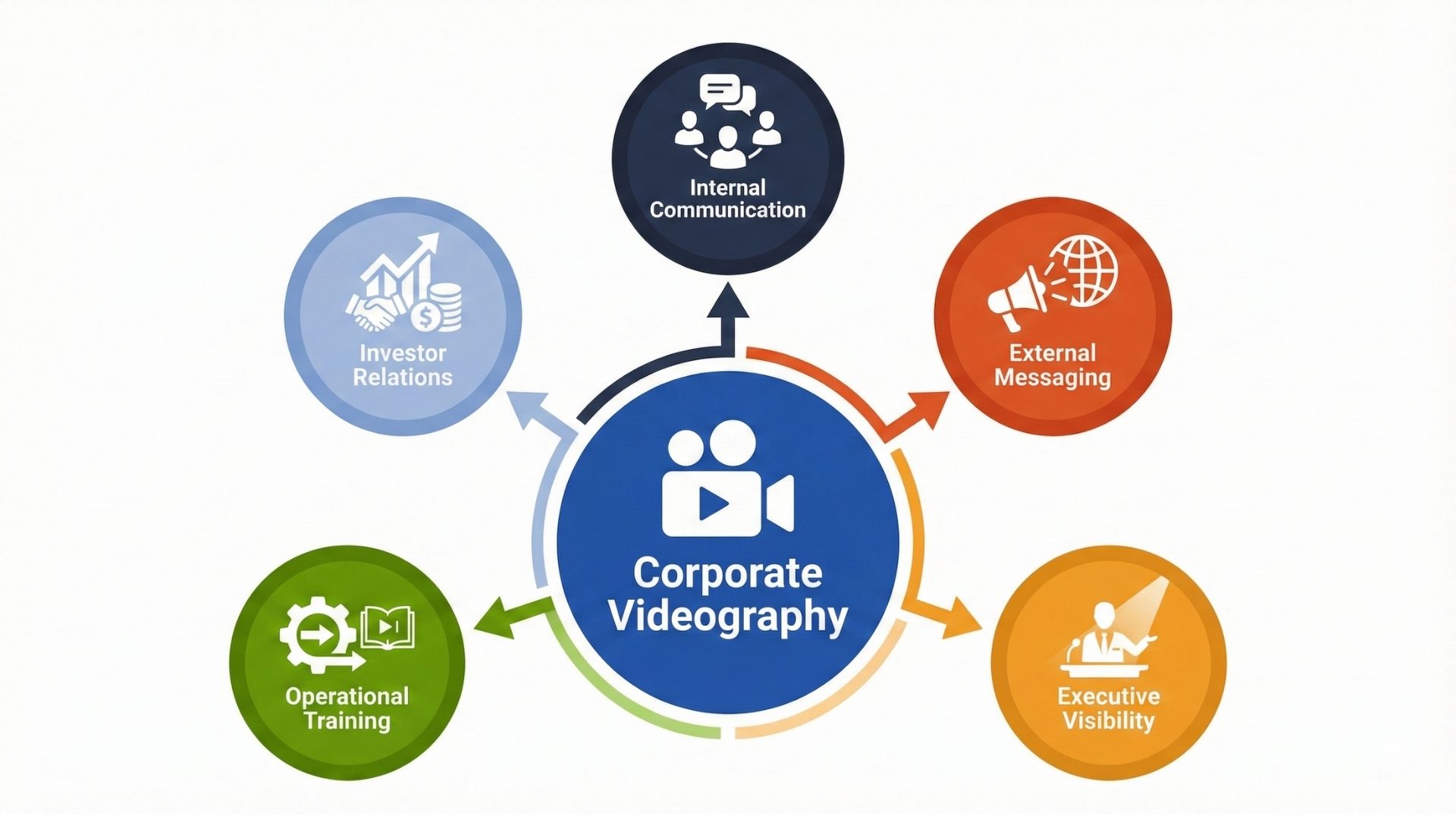
Corporate video is a medium that communicates on behalf of the company, not just on behalf of the marketing team. It supports internal communication strategies, operational transparency, and external reputation management. In many cases, video is the only format that can bridge cross-cultural, cross-lingual, and hierarchical gaps within global organizations.
Some of the core roles it plays include:
- Supporting internal alignment through executive messages and departmental updates
- Helping external stakeholders understand complex corporate initiatives
- Extending thought leadership and brand visibility through social and event-driven platforms
Positioning within Content Ecosystems
Video does not live in isolation. It must be positioned within a broader communications framework that includes written content, data visualization, PR, and digital campaigns. A well-designed corporate video is created with its supporting materials and context already defined.
Considerations at this level include:
- How the video complements other campaign assets like infographics, press kits, or investor presentations
- Where the video will be distributed and how that impacts its runtime, resolution, and delivery format
- The cadence of content, e.g., one-off versus episodic versus evergreen series
Understanding this integrated ecosystem is fundamental if we want our content to be more than just “a nice video.” It must move within the enterprise like an asset with purpose.
Operational Objectives of Corporate Video Content
Internal-Facing Applications
A large portion of corporate video production happens behind the scenes, supporting internal stakeholders. These videos often function as force multipliers for organizational communication.
Examples include:
- Change management explainers
- Systems training and onboarding content
- Culture and values reinforcement videos
- CEO and leadership updates during moments of transition
Each of these deliverables is designed with functional utility in mind. They’re not about entertainment. They’re about clarity, repeatability, and reducing friction across dispersed teams.
External and Hybrid Use Cases
On the external side, corporate video plays a visible role in shaping brand perception, market positioning, and investor relations. These are high-stakes communications that often go through rigorous review.
Examples include:
- ESG and CSR impact videos for shareholders and media
- Product walkthroughs or event highlights aimed at B2B partners
- Livestreams of earnings calls or shareholder meetings
- Branded case studies featuring client success stories
Hybrid content often walks the line between internal value and external promotion. For example, a conference highlight video may serve both as a recap for attendees and a promotional piece for next year’s event. Every video must be built with its audience, timing, and purpose in mind, this is the operational mindset we bring to every engagement.
Pre-Production: Alignment With Corporate Structures
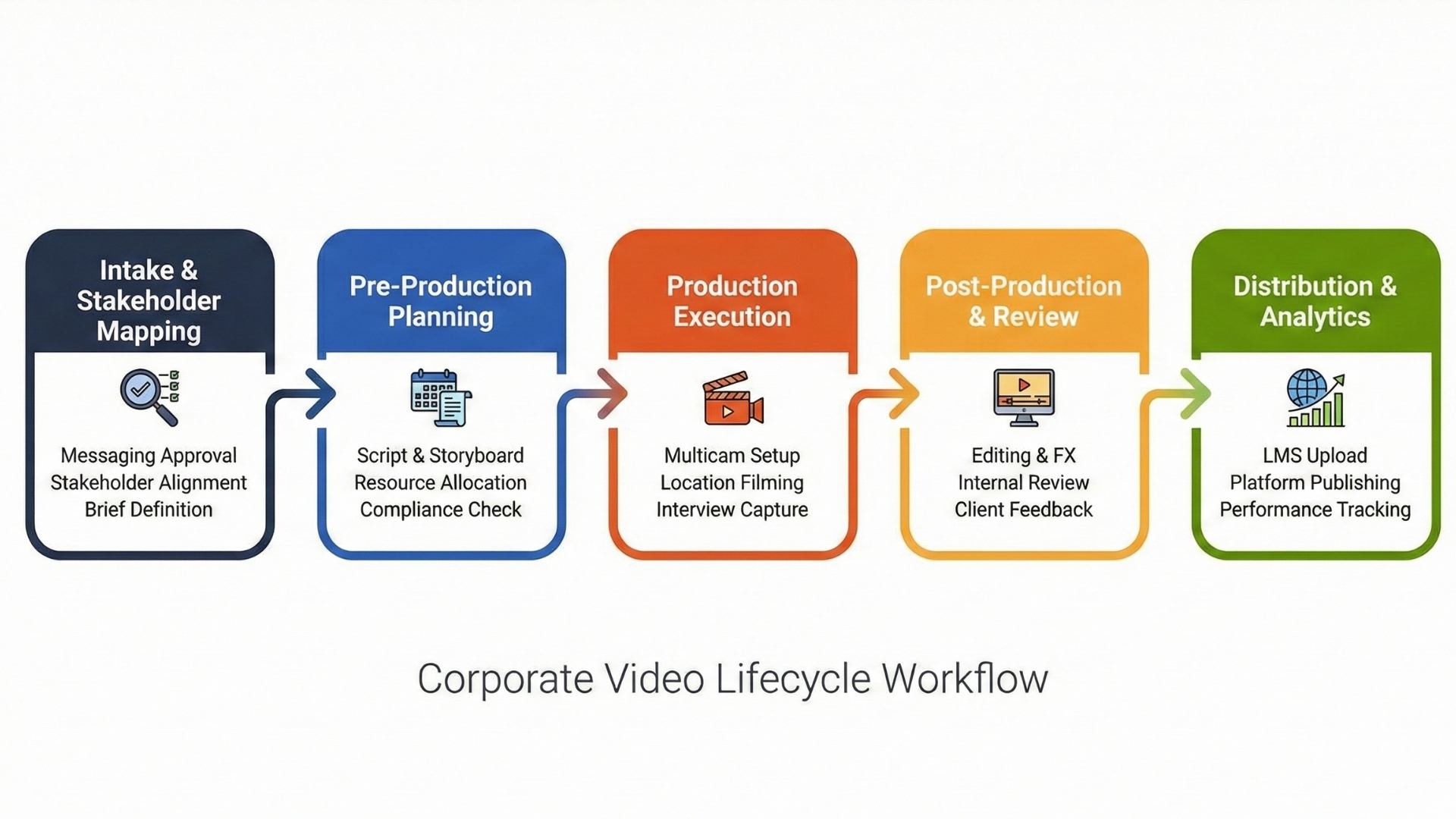
Stakeholder Mapping and Intake Processes
Pre-production in corporate videography starts with understanding the political and operational landscape. Unlike agency or entertainment shoots, the brief doesn’t always come from creative directors, it often originates from department heads, HR, Legal, or Comms. Each comes with unique expectations, timelines, and non-negotiables.
Key pre-production considerations include:
- Identifying who owns the message and who has final sign-off
- Assessing how many review layers the video must go through
- Determining approval timelines across compliance, branding, and comms
Without clear intake processes, projects can stall or misfire entirely. I’ve implemented standardized forms and approval trees to solve this exact problem and to keep projects from becoming endless revision cycles.
Scheduling and Legal Coordination
Unlike commercial shoots, production calendars in corporate environments must account for:
- Executive availability across time zones
- Company-wide blackout dates (e.g., earnings release weeks, board meetings)
- Legal and PR embargoes on sensitive topics
- Site access permissions, including safety briefings and clearance badges
Pre-production is where we design for success. If we overlook these logistical and legal dimensions, we end up with footage we can’t use or messaging that doesn’t pass muster. The best corporate videos often begin as carefully orchestrated internal collaborations long before any footage is captured.
Corporate Video Production Methodologies
Shooting in Active Corporate Environments
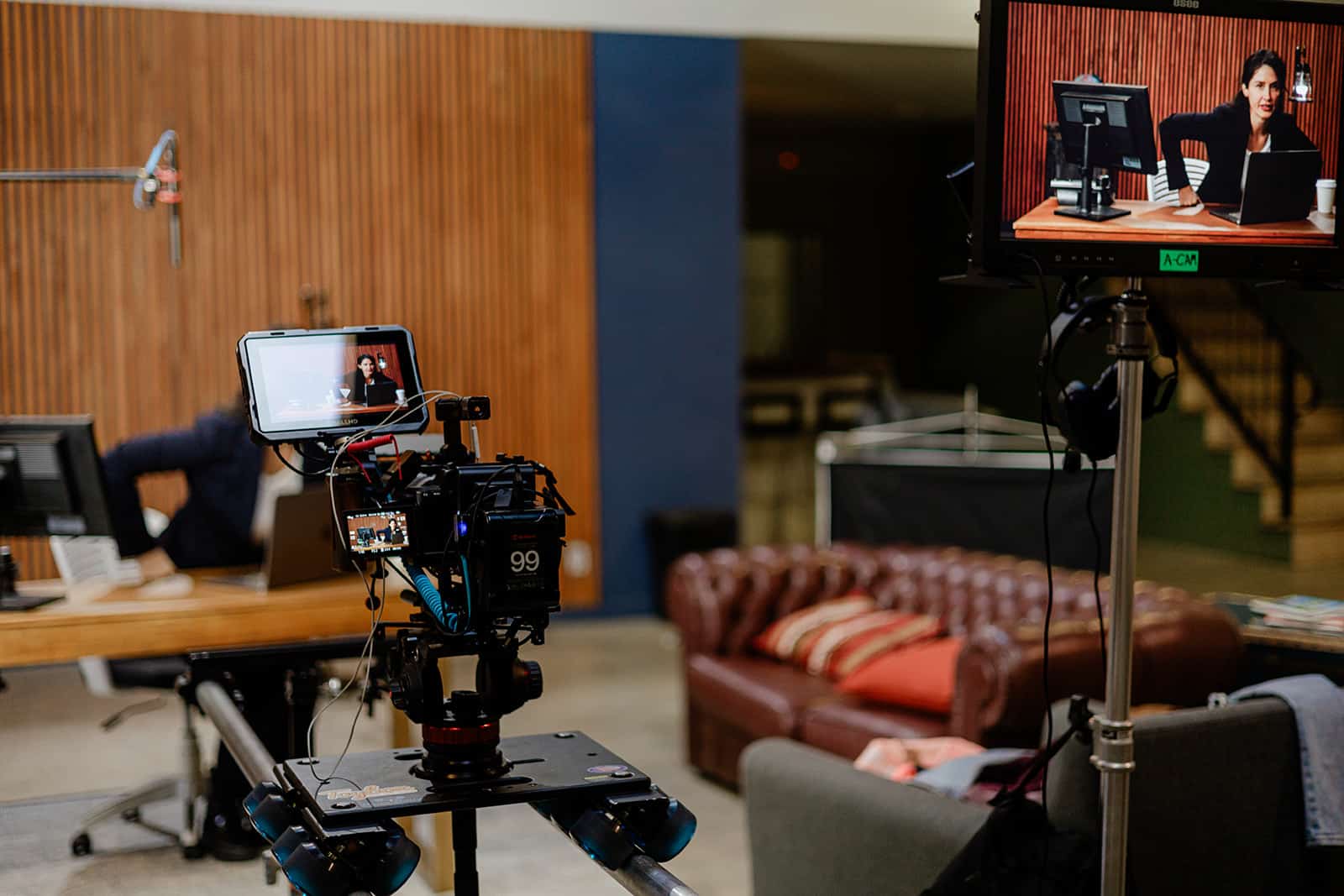
Filming in active office spaces, industrial sites, or R&D labs means adapting to conditions that are not controlled sets. We often have minimal space, tight timeframes, and live business activity all around us.
Best practices in these environments include:
- Using compact gear to reduce footprint
- Capturing clean audio in echo-prone or noisy environments
- Working discreetly to avoid disrupting workflows
- Ensuring zero visibility of confidential data, screens, or individuals without releases
Productions in these contexts are often “surgical”, planned down to the minute, with fallback locations and time slots built into the call sheet.
Directing Non-Professional Talent
Most of our on-camera talent are not actors. They are executives, engineers, researchers, or sales leaders. Getting strong performances from them is about creating comfort and giving them tools they can work with.
Tactics I regularly use:
- Pre-interview calls to build comfort and clarify talking points
- Teleprompters for scripted content
- Prompted interviews with controlled question pacing
- Real-time feedback through split-monitor review if time allows
These individuals may only give you one or two takes, so we have to be ready to capture quality content immediately. That means framing, lighting, and audio must be locked in before they walk on set.
Technical Specifications & Infrastructure Considerations
Choosing the Right Equipment for the Corporate Context
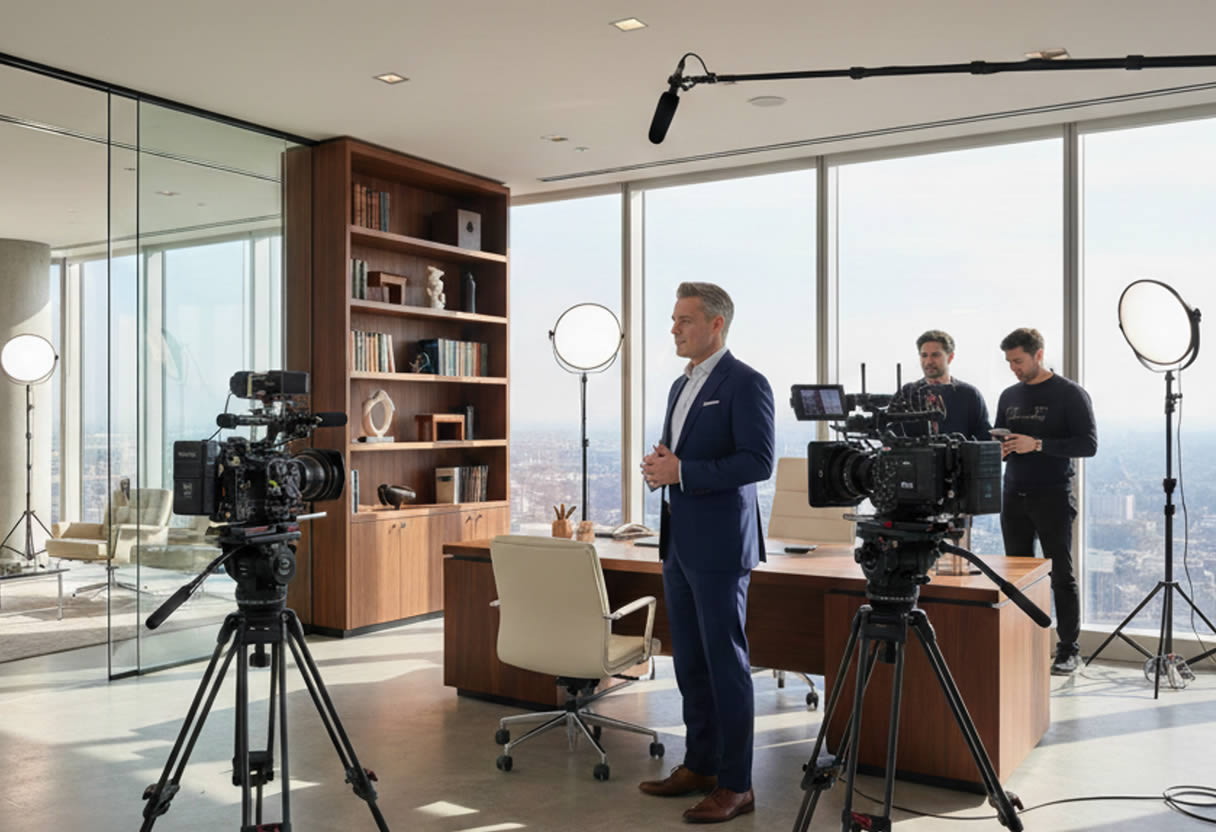
Unlike commercial sets where style drives gear selection, corporate videography must balance image quality with practicality. Many locations require compact setups due to space constraints, security policies, or discretion needs.
My go-to configurations often include:
- Mirrorless cameras with clean HDMI out and log capture
- Wireless lavaliers with dual redundancy
- Compact LED lighting panels with color temperature control
- Monitors and field recorders for on-the-fly adjustments
We also need to think about compatibility with internal infrastructure. If we shoot in 4K 10-bit log but the internal platform compresses to 720p H.264, we have to build that into our export and delivery logic.
Encoding, Redundancy, and Data Protection
Everything we shoot must be archived, traceable, and version-controlled. We’re operating within environments that may need the footage re-used years later or repurposed for litigation, compliance audits, or historical reference.
Our standard workflow includes:
- Dual card in-camera recording
- Backup audio recorders running parallel
- Immediate DIT process with RAID 1 local drives and cloud sync
- File naming conventions tied to project codes, departments, and legal archiving guidelines
There’s no room for lost files or corrupt proxies. The integrity of our media assets is as important as the message itself, especially in publicly traded or heavily regulated organizations.
Post-Production Workflows in a Corporate Environment
 Post-Production Workflows in a Corporate Environment
Managing Reviews Across Departments
Post-production in a corporate context is an editorial, logistical, and political process rolled into one. Once the first cut is delivered, the review path typically spans multiple functions: brand, comms, legal, and often executives. Each stakeholder views the content through a different lens, brand checks for consistency, legal checks for risk, and execs check for narrative tone or technical accuracy.
To manage this efficiently, we establish:
- Clear review windows and deadlines for each stakeholder
- Version tracking systems using Frame.io or similar tools
- Watermarked rough cuts where needed to protect pre-release footage
- Lock dates for visual and audio to avoid endless iterations
Without structure, post can become the most time-consuming phase. I’ve found that pre-agreeing on messaging frameworks and including stakeholder quotes in scripting significantly reduces revisions downstream.
Editorial Infrastructure and Localization
Beyond stakeholder management, we must also maintain robust editorial systems that support repeatable, scalable output. That includes creating template-based approaches for lower thirds, intro/outro animations, and branded transitions, all tied to internal style guides.
Other key considerations include:
- Subtitling workflows for multiple regions
- Audio mastering profiles for corporate sound standards
- Alternate exports for platforms with different aspect ratios (16:9, 9:16, square)
- Internal VO recording protocols or outsourcing to agency VO banks
When you’re working across a multinational organization, localization becomes a core requirement, not an afterthought. We often deliver six to ten language variants for global rollouts, with corresponding regional sign-offs baked into the schedule.
Enterprise-Grade Video Delivery & Distribution
Internal Channels and Compliance Gating
Corporate video rarely ends on public platforms alone. Much of it is distributed internally across secure platforms such as:
- Microsoft Stream or SharePoint Video
- LMS platforms like SAP SuccessFactors, Workday Learning, or Docebo
- Custom SSO-protected intranet portals
- Internal newsletters and executive comms dashboards
Each of these channels has strict upload requirements. Some limit file sizes, some transcode files automatically, and others demand closed caption files for accessibility compliance. Delivery must be planned with these limitations in mind.
We also implement viewership tracking where possible. For example, HR training modules are often tied to learning completion metrics. Security is another layer; some videos are tagged as “internal only” with expiration dates and watermarking to prevent leakage.
External Distribution and Multi-Format Deployment
Public-facing content typically lives across a combination of:
- Corporate YouTube or Vimeo Enterprise accounts
- Microsites for PR or investor relations
- Event platforms for virtual conferences or product reveals
- Email marketing systems (e.g., Marketo or HubSpot) with video embeds
To serve these use cases, we provide multi-resolution, multi-format outputs:
- H.264 MP4s at 1080p for general use
- WebM or MOV variants for platform compatibility
- GIF loops for microsite banners
- SRT caption files for international accessibility
Asset management continues post-distribution too. We tag, archive, and index deliverables in the company’s DAM or cloud repository with metadata for easy retrieval, whether for legal inquiries or future campaign reuse.
Cross-Departmental Collaboration and Governance
Functional Roles in the Video Lifecycle
Corporate videography lives within a highly cross-functional ecosystem. Without alignment across functions, even the best-produced video can fall flat or be blocked entirely. Each department plays a different role in the lifecycle of a video.
For example:
- Comms/PR manages messaging tone and aligns with broader campaigns
- Legal ensures language, representations, and compliance standards are met
- Brand/Design checks visuals, fonts, colors, and animation against the company’s identity system
- IT/InfoSec ensures platforms used for distribution meet internal security protocols
These aren’t optional approvals. They’re mandatory steps. To function effectively, we build relationships in each of these departments and co-develop playbooks and workflows that streamline the approvals process.
Creating Repeatable Governance Systems
We standardize intake and delivery with governance tools:
- Project request forms embedded in internal portals
- Creative brief templates with review deadlines and approval checkpoints
- Master Service Agreements (MSAs) with external vendors tied to brand policy
- SOPs for video request triage, production tiering, and budget approvals
This governance isn’t about red tape. It’s about speed and reliability. The more structure we build into the request-to-distribution pipeline, the less we rely on ad hoc heroics. Teams know what to expect, and we avoid repeated negotiation of the same constraints.
Budgeting, Resourcing, and ROI in Corporate Videography
Positioning Video as a Strategic Investment
Budgeting conversations often begin with pushback. “Why is this so expensive?” or “Can’t someone just shoot it on their phone?” We must be able to articulate the business value of professional production. That value might lie in risk mitigation, brand perception, training efficiency, or stakeholder engagement, all of which are real and measurable.
For example:
- A professionally produced onboarding video may reduce in-person training time by 60%
- A high-quality investor video could improve clarity on complex financial strategies, reducing misinterpretations
- A repeatable internal training series helps ensure regulatory compliance across international teams
Once stakeholders see the impact, the conversation shifts from cost to impact. We help them understand that video is not a luxury asset, but a scalable tool for operational performance.
Resourcing Models and Content Velocity
Depending on the organization’s size and content cadence, we help clients structure resourcing models that fit their needs:
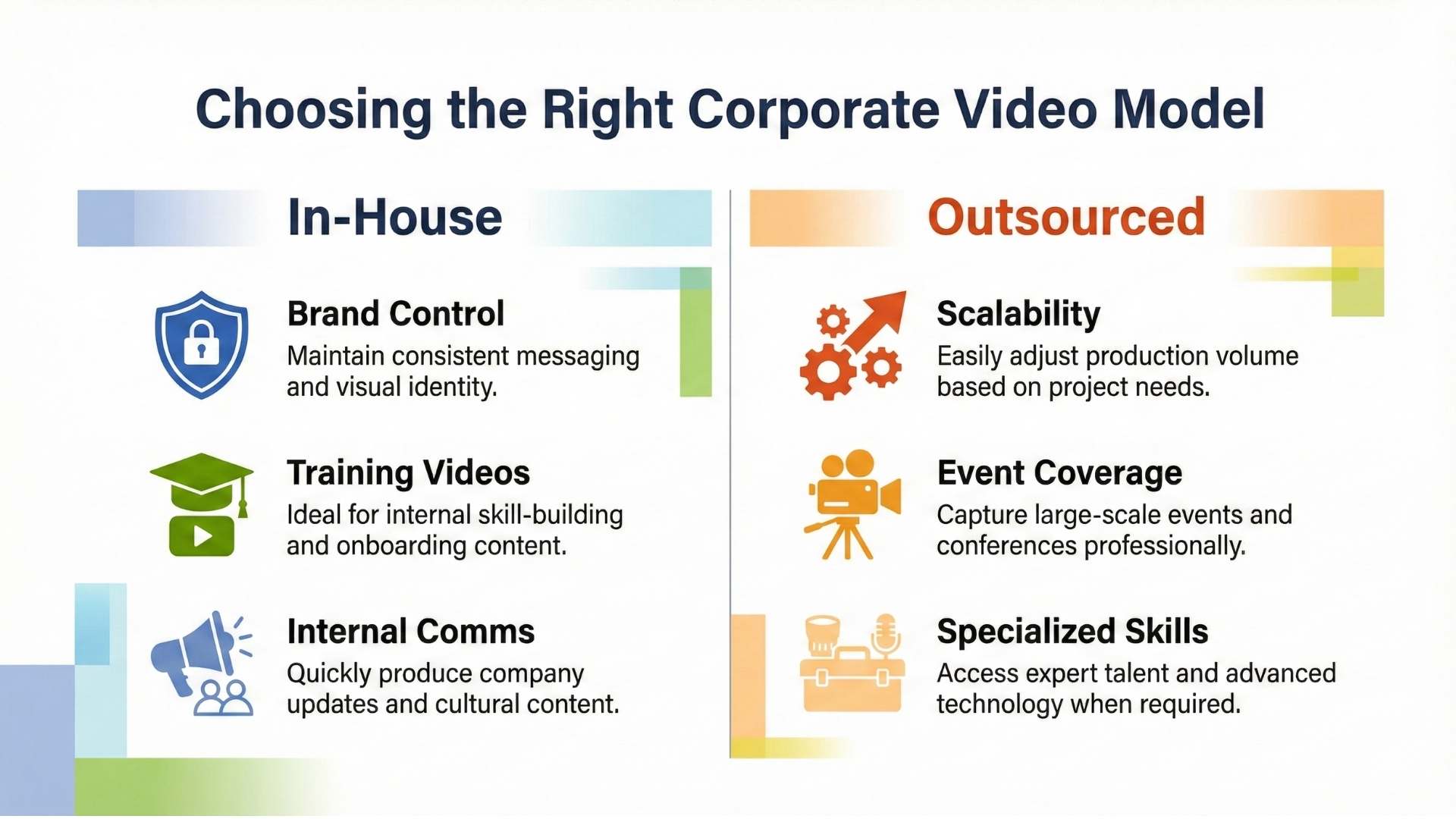
- In-house teams for always-on content like leadership updates or product tutorials
- Agency partnerships for high-end projects such as event films or rebranding assets
- Hybrid models where central teams create templates and regional teams execute localized content
Budgets are structured to account for:
- Production tiers (bronze, silver, gold)
- Pre-production hours
- Editing time and stakeholder review windows
- Localization, captioning, and distribution efforts
We also budget not just for production, but for the ongoing lifecycle: updates, re-cuts, and campaign extensions. The goal is to treat content as a living asset, not a one-time deliverable.
Scaling Corporate Video Across Global Operations
Building Global-Ready Systems
As organizations expand across geographies, their video needs evolve. A single branded message must now support 12 time zones, 6 language markets, and 3 levels of compliance oversight. You cannot meet that complexity with one central production team alone. You need frameworks.
We deploy:
- Centralized brand kits with templates, LUTs, B-roll packages, and motion graphics
- Training programs for regional teams on using branded tools and video best practices
- Localization workflows that include region-specific content, VO talent, and legal review
This enables local content production that still aligns globally. Instead of enforcing brand rules reactively, we give teams what they need to succeed within the system.
Cloud Collaboration and Asset Management
The backbone of scaling is cloud infrastructure. We manage:
- Cloud storage with role-based access for creative assets
- Review platforms for asynchronous feedback across time zones
- Metadata-rich archiving for future retrieval and audits
- Shared calendars for content release timing to avoid internal message conflicts
When done right, corporate video can function as a federated system: unified in voice, distributed in execution. That’s what global scalability actually looks like in the enterprise video space.
Challenges and Mitigation Strategies
Navigating Bureaucracy and Bottlenecks
One of the most consistent challenges in corporate video is not technical, it’s procedural. Stakeholder indecision, unclear ownership, or changing messaging can slow a project to a crawl. We often encounter situations where:
- Final messaging isn’t locked before production starts
- Legal introduces last-minute objections post-shoot
- Executive stakeholders demand reshoots due to brand sensitivity
To manage this, we implement:
- Messaging lock deadlines before filming
- Review matrices that clarify who signs off on what
- Pre-approved visual storyboards and scripts to reduce ambiguity
The goal is to minimize reactive pivots and protect the schedule and budget. Having written escalation protocols and pre-set decision trees goes a long way in maintaining momentum.
Technical and Environmental Limitations
We also encounter on-the-ground challenges like:
- Incompatible AV systems during executive interviews
- Sites that require PPE or special safety training for crew access
- Poor lighting or audio conditions in older buildings
- Firewalls that block cloud review tools
To mitigate these, we scout locations virtually or in-person, carry mobile kits for lighting and sound control, and preload all tools locally in case of restricted internet. We also keep physical release forms, battery backups, and redundant audio workflows at every shoot. Preparedness is non-negotiable at this level.
Final Thoughts
Corporate videography is a high-stakes, high-discipline function that sits at the center of modern enterprise communication. It is not just about producing content. It’s about enabling action, consistency, and impact across diverse audiences and business objectives. As professionals, our role is to orchestrate the creative, technical, and organizational components required to deliver video at scale, not just with flair, but with reliability.
When I create or lead a corporate video project, I treat it like infrastructure. Like an engineered system that supports clarity, authority, and agility across an organization. When the message matters, when timing matters, and when stakeholders expect excellence, corporate videography becomes more than production. It becomes essential.
How We Approach Corporate Videography at LocalEyes
 How We Approach Corporate Videography at LocalEyes
At LocalEyes, we approach corporate videography the same way this article does: as a disciplined, strategic function that has to work inside real organizations with real constraints. Over the past several years, we have built our production model specifically to support enterprise-grade corporate video, not just one-off shoots. With more than 3,900 videos produced for over 300 clients, we have refined the systems, workflows, and governance structures required to deliver consistent, high-quality corporate video at scale. Our Emmy Award-winning production quality is paired with a national footprint that allows us to operate locally while maintaining enterprise-level standards across every market we serve.
What’s new for us is a continued focus on helping organizations operationalize corporate video, not just produce it. From our headquarters in California and our full-service offices across major U.S. cities, we work closely with communications, marketing, HR, and executive teams to build repeatable video frameworks that align with internal processes, compliance requirements, and distribution realities. Whether it’s leadership messaging, internal communications, training, or external corporate storytelling, we design video programs that integrate cleanly into how companies actually function.
If you’re looking to elevate corporate videography from a reactive service into a strategic capability, we’d love to talk. Reach out to the LocalEyes team to explore how we can support your corporate video initiatives with the structure, quality, and national reach required to drive real business impact.

Founder at LocalEyes Video Production | Inc. 5000 CEO | Emmy Award Winning Producer