
- A video marketing strategy must align every video to specific business goals, funnel stages, and revenue-linked KPIs rather than vanity metrics.
- High-performing video programs use behavioral audience segmentation and buyer-journey mapping to deliver the right message at the right moment.
- Video marketing at scale requires modular content design, tiered production, integrated tools, governance, and continuous optimization based on performance data.
A strong video strategy isn’t about volume. It’s about creating high-impact assets aligned with business goals, channel behaviors, and audience intent. In today’s performance-driven landscape, video only works when backed by the right system. This guide offers a strategic blueprint for marketers, creative leads, and content ops leaders building scalable, measurable video programs that actually move the needle.
We’ll explore how to operationalize video from concept through distribution and optimization. The focus is on advanced execution: aligning with business goals, audience segmentation, content mapping, tech integration, and internal governance. Each section translates strategic thinking into action-ready guidance. The result is not just more video, but better, more accountable video that drives measurable business impact.
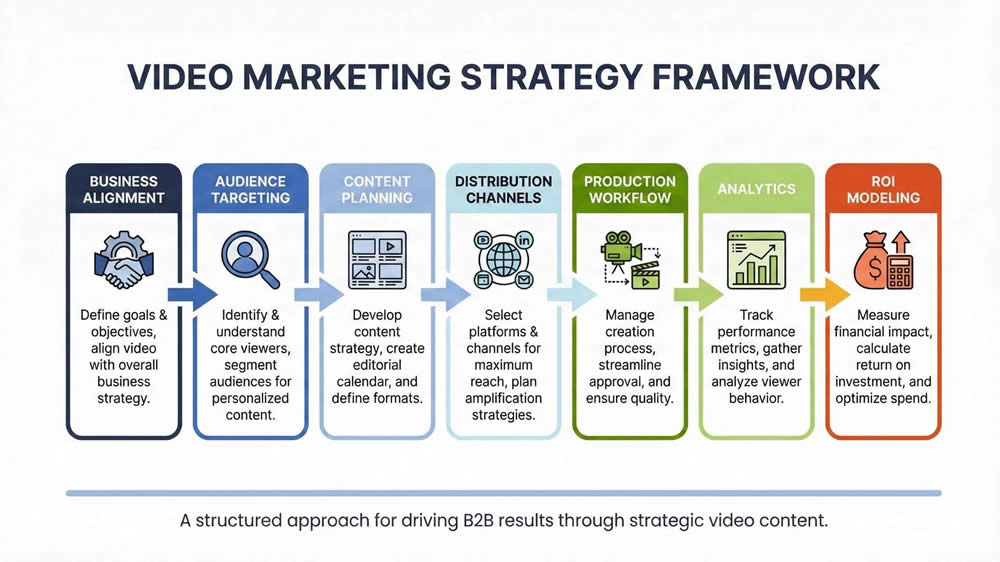
Strategic Alignment with Business Objectives
Why You Need a Video Marketing Strategy Today
Video is no longer a “nice-to-have”; it’s a core pillar of modern marketing. According to Wyzowl’s 2024 State of Video Marketing report, 91% of businesses now use video as a marketing tool, and 89% of marketers report a positive return on investment (ROI) from video marketing. But performance doesn’t happen by accident. Without a defined strategy, even high-production videos can get lost in the noise when execution isn’t tied back to clear performance and growth objectives.
A strong video marketing strategy isn’t about volume. It’s about creating high-impact assets aligned with business goals, channel behaviors, and audience intent across every stage of the buyer journey. It ensures your videos are working together across the funnel, educating, converting, and retaining your audience at every stage. Whether you’re a startup or a scaled enterprise, building your strategy intentionally is how you get measurable business impact from every video investment.
Mapping to Business Goals
A mature video marketing strategy starts with business alignment. Every video initiative must support quantifiable business outcomes, whether that’s accelerating the pipeline, boosting product adoption, or improving net revenue retention. Videos should be tied to specific initiatives, such as:
- New product launches
- Customer onboarding
- ABM campaign support
- Post-sale education and enablement
Rather than tracking vanity metrics like views or likes, I focus on how each video drives outcomes that matter to the business. This requires syncing video planning with quarterly OKRs, campaign roadmaps, and GTM motions across departments.
Strategy Tiering by Intent
To create structure, I divide video content into three strategic tiers:
- Brand-led: Top-of-funnel video like vision films, thought leadership, and employer branding.
- Product-led: Mid-funnel content like how-to demos, feature explainers, and webinars.
- Performance-led: Bottom-funnel assets like case studies, ROI calculators, and direct-response ads.
Each tier has different creative needs, distribution paths, and production models. This segmentation helps manage priorities, allocate resources, and align stakeholders around purpose-driven content creation.
Advanced Audience Segmentation & Journey Mapping
Behavioral Segmentation and Persona Enrichment
Surface-level personas aren’t enough for effective video targeting. I use behavioral and psychographic data from CRMs, CDPs, and web analytics to define audiences based on:
- Buying role and decision authority
- Preferred content format and consumption habits
- Historical interaction with past video content
- Buying stage and funnel velocity
This insight helps us go beyond titles like “Marketing Manager” to target “Mid-market buyer with 30-day sales cycle, prefers mobile video, and consumes competitor content.”
Mapping Content to Buyer Journey Stages
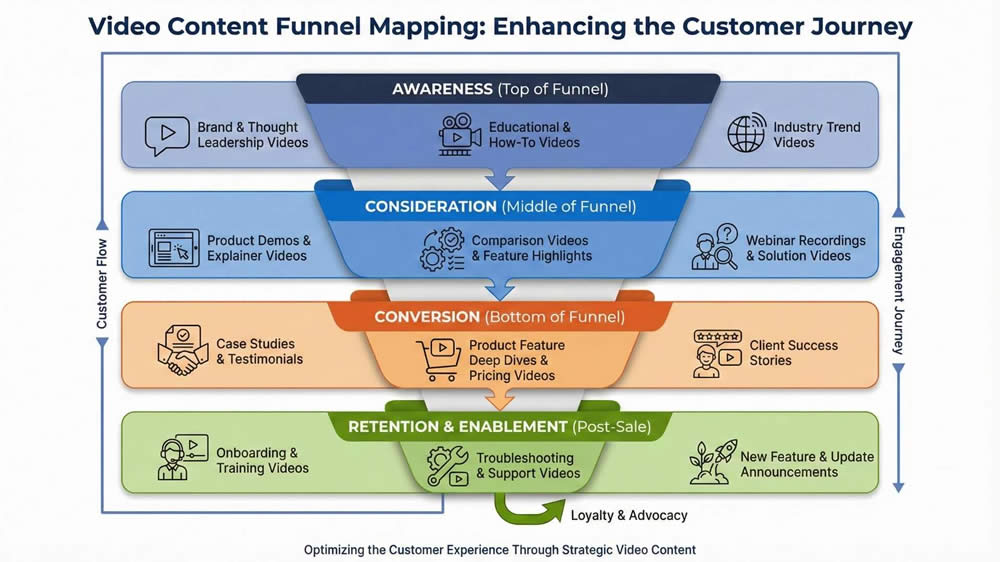
Each video asset should have a clear role in the customer journey. I map video content to three primary stages:
- Top of Funnel (TOFU): Brand stories, explainer animations, thought leadership
- Middle of Funnel (MOFU): Product demos, testimonial interviews, webinar highlights
- Bottom of Funnel (BOFU): Case studies, ROI comparisons, objection-handling clips
An effective strategy accounts for both timing and context. A sales enablement video used during an open renewal discussion will have more impact than when sent cold. Journey mapping ensures the right message lands at the right moment.
Video Content Strategy Architecture
Thematic Systems and Storytelling Frameworks
Content strategy begins with choosing a scalable architecture. While the Hero-Hub-Help model is a solid base, I often evolve that into more modular systems. These frameworks allow for both serialized narratives and atomized assets. I typically build content libraries around:
- Hero: Big-splash, emotionally-driven narratives
- Hub: Episodic, repeatable formats for mid-funnel education
- Help: Utility-focused videos like FAQs, tutorials, and feature explainers
These categories help stakeholders understand why a video exists and how it fits into the broader narrative.
Evergreen vs. Campaign-Based Video
There’s a strategic tradeoff between evergreen and campaign-specific content. I recommend maintaining a portfolio of both:
- Evergreen content builds long-term ROI and includes onboarding videos, explainer walkthroughs, and support tutorials.
- Campaign-specific content supports product launches, time-bound promotions, or seasonal events and requires higher velocity and adaptability.
I plan production calendars with separate swim lanes for both types. This prevents gaps in coverage and enables more consistent asset availability across buyer journey stages.
Multichannel Video Distribution Strategy
Owned, Paid, and Embedded Channels
A video strategy without a distribution plan is like a billboard in the desert. I map distribution into four categories:
- Owned: Websites, blogs, email campaigns, LMS platforms
- Paid: YouTube Ads, LinkedIn campaigns, retargeting
- Earned: PR syndication, influencer shares, industry partnerships
- Embedded/Internal: Sales tools, product onboarding flows, support hubs
Each path requires tailored formatting, CTA design, and campaign planning. The distribution strategy should be defined before production begins, so assets are built fit for purpose.
Platform-Specific Optimization
Each platform demands its own creative and technical considerations. For example:
- YouTube: Prioritize custom thumbnails, SEO-optimized titles, and end-screen CTAs
- LinkedIn: Hook viewers in the first 2 seconds, use native upload, and keep under 60 seconds
- Email embeds: Use GIF previews and fallback images for rendering issues
- Internal use: Ensure SCORM compliance for LMS, or track metrics in onboarding tools like Appcues or WalkMe
Platform-aware execution improves both reach and ROI. I don’t believe in one-size-fits-all deployment. Distribution must be contextual.
Production Planning & Creative Operations
Tiered Production Models
To avoid bottlenecks, I organize production into three tiers:
- Tier 1: High-budget brand content, often externally produced, used across multiple campaigns
- Tier 2: Mid-range content like product walkthroughs or founder interviews, handled by internal teams
- Tier 3: Lightweight social content, user-generated testimonials, or quick-turn updates
Each tier has predefined SLAs, briefing templates, and QA standards. This structure helps set stakeholder expectations and ensures consistent velocity across teams.
Workflow and Process Management
Efficient creative operations reduce chaos and burnout. I implement standardized workflows using tools like:
- Pre-production: Notion or Milanote for briefs, Frame.io for storyboarding
- Production: Shared asset libraries, reusable templates
- Post-production: Review and approval stages mapped in Trello or Asana
A clear RACI matrix defines who owns each stage. Our goal isn’t just to make videos faster, but to reduce rework, meet deadlines, and deliver brand-consistent work every time.
Technology Stack for Strategy Execution
Tool Categories by Function
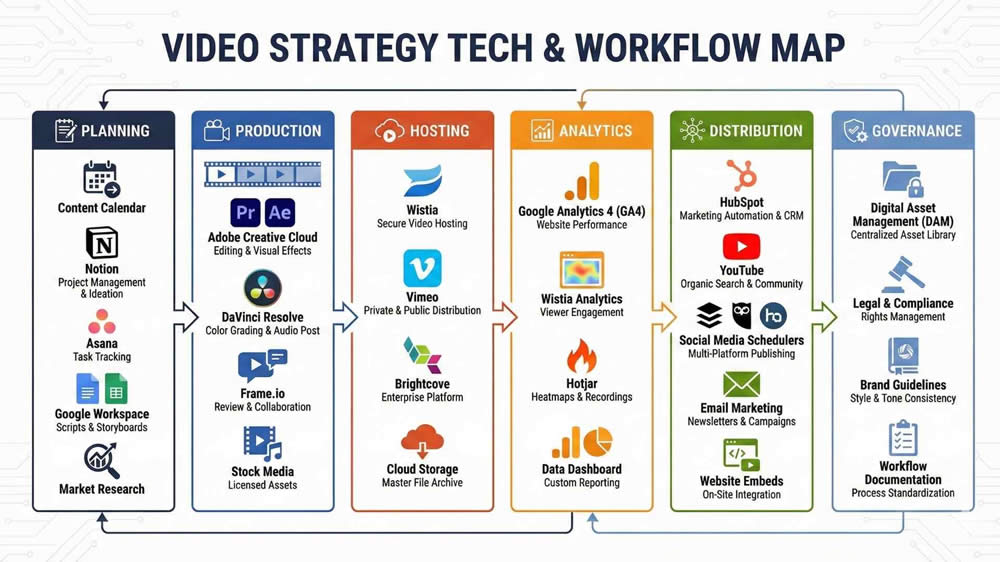
Video marketing requires a full-stack approach. Here’s how I group tools by stage:
- Planning & Collaboration: Notion, Trello, Airtable
- Production & Editing: Adobe Premiere, DaVinci Resolve, Descript, CapCut
- Hosting & Publishing: YouTube, Wistia, Vidyard, Vimeo OTT
- Analytics & BI: Google Analytics, HubSpot, Looker, TubeBuddy
Each layer must integrate smoothly with the rest of the marketing stack. A disconnected video toolchain limits visibility, slows workflows, and undermines performance measurement.
CMS, DAM, and Integration Strategy
At scale, asset management becomes a bottleneck without the right architecture. That’s why I prioritize:
- Video CMS: Wistia or Vidyard for gating, tagging, and lead capture
- Digital Asset Management (DAM): Ensures version control, governance, and searchability
- MAP/CRM integration: Syncs engagement data with customer records and campaigns
Integration isn’t a luxury. It’s fundamental. With the right architecture, we eliminate silos, improve personalization, and track performance with precision.
Video SEO, Metadata, and Discoverability
Optimizing for Search Engines and Internal Discovery
Discoverability is a core pillar of video performance, not a post-production afterthought. To ensure your content ranks in both public and internal search ecosystems, we optimize across three fronts:
- Transcripts and captions: Improve accessibility and create keyword-rich text for crawling.
- Structured data markup: Schema.org’s VideoObject schema and JSON-LD are essential for rich snippets in Google search results.
- Video sitemaps: Ensure your video pages are indexed by search engines using XML sitemaps.
I also recommend publishing transcripts as standalone pages when possible to drive organic traffic. These can often outperform the video page itself in search, especially for technical or how-to content.
Metadata Management and Tagging Systems
Metadata is critical not just for SEO but for internal organization and campaign performance. Each video should be tagged based on:
- Funnel stage
- Audience segment
- Product line
- Distribution channel
- Region/language
We implement a consistent taxonomy in our CMS or DAM to enable search, filtering, and reuse. I often set up automated tagging workflows using metadata extraction tools to reduce manual effort. When metadata is clean and consistent, discoverability improves across every surface area, from YouTube search to internal knowledge hubs.
Video Analytics and Performance Optimization
KPI Frameworks by Video Intent
Measuring performance starts with understanding the intent of each video. I segment KPIs by funnel stage:
- Top-of-funnel: Reach, impressions, view-through rate (VTR), average watch time
- Mid-funnel: Click-through rate, session duration, conversion assist
- Bottom-funnel: Form fills, influenced opportunities, pipeline velocity
Avoid aggregating these metrics into generic dashboards. Instead, contextualize them by objective. For example, a brand video with a high VTR but low click-through may still be a success. A product demo, however, needs a clear conversion path to be considered effective.
Tracking Infrastructure and Iteration Loops
Our analytics stack combines:
- Native video platform data: YouTube Studio, Wistia analytics
- Marketing automation systems: HubSpot, Marketo for lead attribution
- BI tools: Looker, Tableau for cross-channel analysis
We set up UTM tracking, custom events, and video engagement scoring that syncs with CRM records. Beyond tracking, I emphasize testing. Every month, we test:
- Thumbnails and titles
- CTA placement and timing
- Video length and segment drop-off
This data feeds back into both creative and distribution strategies. Optimization is not a quarterly task. It’s an operating rhythm.
Scaling with Modular Content and Repurposing
Modular Video Design
Scaling video without burning out your team requires a modular design that allows teams to extend the lifespan of core creative assets. That means building core content that can be atomized across formats, platforms, and campaign types. For example, from a single product video, we might derive:
- 3 short-form teasers for social
- 2 GIFs for email
- 1 behind-the-scenes reel
- 5 quote cards or audiograms
This is only possible when modularity is planned from the start. We script modular lines, shoot with alternate angles, and design visuals that work out of context. Each module serves a unique role in the marketing mix, reducing waste and maximizing impact.
Repurposing Workflows
Repurposing needs to be operationalized with workflows and ownership. We use:
- Tagging systems to identify repurposable content
- Automated notifications when assets hit usage thresholds
- Templates for consistent post formats (e.g., teaser cuts, square vs. vertical)
I recommend setting repurposing KPIs alongside production KPIs. If your Tier 1 videos aren’t yielding at least 5-10 downstream assets, there’s likely a planning issue upstream. Modular execution is one of the fastest ways to increase ROI per asset.
Globalization and Localization
Subtitle, Translation, and Dubbing Strategy
Global teams often default to simple translation, but that can result in videos that feel sterile or disconnected. Instead, I treat localization as a storytelling challenge. Depending on the market, we apply one of three approaches:
- Subtitling: Fastest and most scalable; best for highly technical or educational content
- Voiceover dubbing: More immersive, especially for product demos and executive messages
- Regional reshoots: Used selectively for hero content in top-tier markets
Tools like Subtitle Horse can help accelerate workflows, but every localization effort requires human QA to ensure nuance is preserved.
Market-Specific Adjustments
Different regions have different expectations when it comes to:
- Video length and pacing
- Humor and emotional tone
- Visual storytelling norms
- Compliance with regional data regulations
We coordinate with regional marketing leads to adjust scripts, visuals, and CTAs. We also maintain a localization checklist to ensure quality control before publishing. Localization isn’t a post-process. It’s a strategic investment in relevance.
Internal Video Governance and Workflow
Brand and Legal Compliance
As video content scales across departments and regions, governance becomes a necessity. I implement strict brand guidelines for video, including:
- Intro/outro templates
- Typography, color grading, LUTs
- Logo placement and animation rules
- Music licensing and usage policies
Legal review processes are equally important. Every video goes through a rights audit for footage, music, and talent releases. I also include data usage disclaimers in applicable regions to ensure compliance with GDPR and similar laws.
Approval Processes and Content Calendars
Governance extends to workflows. We define approval paths based on the video tier:
- Tier 1: Requires cross-functional sign-off from brand, legal, and executive teams
- Tier 2: Reviewed by campaign leads and brand managers
- Tier 3: Self-service publishing with templates and pre-approved assets
All video projects are tracked on a centralized calendar linked to campaign launches, product roadmaps, and event timelines. Governance is not a blocker. It’s an accelerator when implemented well.
Video Budgeting and ROI Modeling
Tier-Based Budget Allocation
Budgeting starts with knowing the true cost and value of each video type. I break it down like this:
- Tier 1 (Hero): $10k–$100k+ per video, used across multiple quarters
- Tier 2 (Hub): $3k–$10k per asset, supporting key launches or product lines
- Tier 3 (Help): <$2k, often created in-house, high volume
We align budget allocation to business impact. If bottom-funnel videos are driving the most revenue per view, we increase Tier 3 investment even if they’re not flashy or attention-grabbing. Budgeting is about outcomes, not aesthetics.
Attribution and ROI Reporting
To measure ROI, we model:
- Influenced pipeline: Leads or opportunities with video touchpoints
- Conversion lift: Deals closed faster or at a higher value with video support
- Support deflection: Reduced ticket volume after help videos are published
ROI models are imperfect, but directional data builds trust. I also track cost-per-minute and cost-per-lead to compare video against other content formats. When you show that video drives revenue and efficiency, budget growth follows.
Operationalizing the Strategy: Team, Process, and Execution
Team Structures at Scale
Video strategy execution depends heavily on team design. In large orgs, I recommend a pod-based structure:
- Content Strategist: Owns narrative alignment and mapping
- Video Producer/Editor: Manages execution, timelines, and production
- Campaign Integrator: Ensures coordination with paid, email, and web teams
- Analytics Lead: Tracks performance and optimization
These pods are supported by centralized creative ops and brand governance teams. Clear role separation prevents bottlenecks and confusion.
Agile Execution Models
We operate on sprint-based cycles with weekly standups and monthly retros. Each sprint includes:
- Ideation and storyboarding
- Production or repurposing
- QA and publishing
- Performance review and iteration
We maintain a backlog of content ideas mapped to funnel gaps, product updates, and campaign themes. Agile execution allows us to stay responsive without sacrificing quality. Video becomes an operational engine, not a creative experiment.
Common Mistakes When Developing a Video Marketing Strategy (and How to Avoid Them)
Even highly experienced teams run into avoidable challenges when building out their video marketing systems. Here are a few of the most common traps we see, and how to sidestep them:
- Focusing on volume over value: Producing more content doesn’t guarantee better results. Strategy must drive production, not the other way around.
- Misalignment with the buyer journey: Videos that aren’t tailored to funnel stages often lack context and are less relevant.
- Underestimating distribution: A great video that lives in a content silo won’t perform. Distribution must be engineered just as thoughtfully as production.
- Lack of performance tracking: Without KPIs tied to real business outcomes, it’s impossible to optimize or prove ROI.
Avoiding these missteps is not just about damage control; it’s about building a scalable system that evolves with your brand and consistently delivers results.
Final Reflections: Strategic Maturity Framework
Building a mature video marketing strategy is a progressive journey. I use a four-level maturity model to guide self-assessment and planning:
- Ad Hoc: No documented strategy, inconsistent production, and little measurement.
- Tactical: Video supports campaigns but lacks integration or attribution tracking.
- Strategic: Content is mapped to funnel stages, performance is measured, and operations are standardized.
- Scalable: Modular content, global governance, automated workflows, and clear ROI reporting.
Each level requires investment in tools, people, and processes. To move from one level to the next, I recommend:
- Auditing your current video library by funnel stage and persona
- Documenting workflows and governance rules
- Centralizing hosting and metadata
- Setting KPIs tied to business outcomes
Video marketing is not about volume. It’s about precision, repeatability, and impact driven by systems that consistently convert attention into action. When you treat video as a strategic asset rather than a creative accessory, the returns compound quickly.
About LocalEyes: Strategic Video Production that Performs
At LocalEyes, we know that developing a high-performing video marketing strategy is only as effective as the team you trust to bring it to life. As one of America’s leading video production companies, we’ve partnered with over 300 brands and delivered more than 3,900 videos across nearly every industry. Our recognition on the Inc. 5000 list for three consecutive years is a testament to the results we help our clients achieve, not just the videos we produce.
We take a comprehensive approach to every project, combining Emmy Award-winning production quality with deep strategic understanding and nationwide market coverage. Whether you’re looking to create targeted testimonial content for your ABM campaigns, launch a full-scale product video series, or build a scalable video content system aligned with your customer journey, we’ve done it. And we can help you do it too. With offices across the U.S. and local expertise in major cities like New York, Austin, San Diego, and Chicago, we’re built to move fast and deliver world-class video solutions wherever your business grows.

Founder at LocalEyes Video Production | Inc. 5000 CEO | Emmy Award Winning Producer