
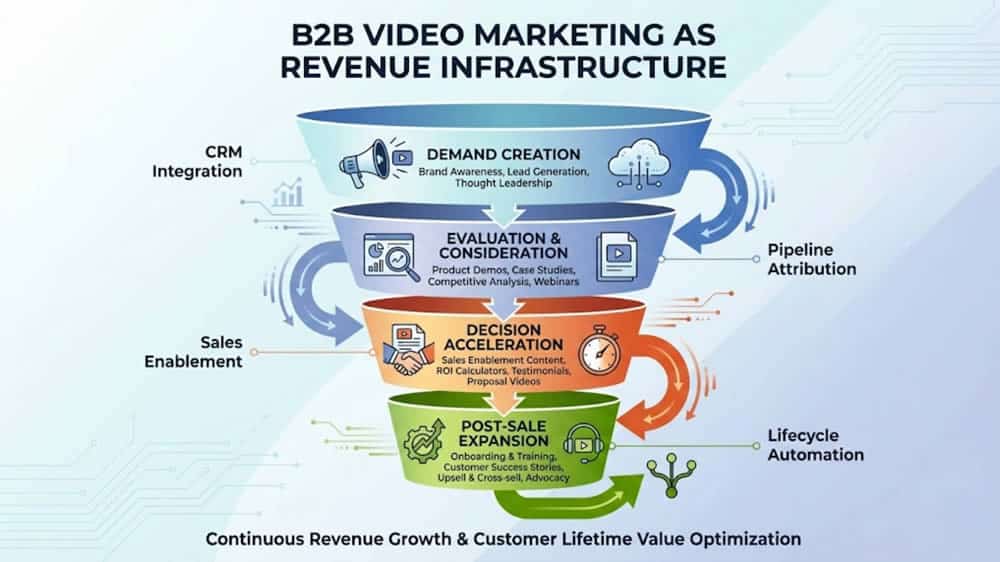
- B2B video functions as a revenue infrastructure when it is operationally integrated across demand generation, sales enablement, customer onboarding, CRM systems, and marketing automation platforms.
- B2B video accelerates trust and shortens complex sales cycles by being deliberately structured around buyer-journey stages and distinct stakeholder personas.
- The effectiveness of B2B video should be evaluated using revenue-centric metrics such as pipeline contribution, sales velocity, and win-rate impact, rather than surface-level engagement metrics alone.
I have worked with B2B organizations long enough to see video move from experimental line item to strategic growth lever. What separates high-performing teams from everyone else is not production quality or budget size. It is architectural thinking. When video is designed as part of the revenue system, it compounds. When it is treated as isolated content, it fades into the noise.
This reflects how I structure B2B video programs for sophisticated teams. I am not addressing first-time marketers. I am speaking to professionals who understand pipeline modeling, lifecycle automation, stakeholder segmentation, and financial accountability. The question is not whether video works. The question is how to design it so that it meaningfully influences revenue, efficiency, and positioning.
The Strategic Role of Video in the Modern B2B Revenue Engine
Structural Shifts in B2B Buying
The modern B2B buying process is self-directed and committee-driven. Buyers complete a significant portion of their research before engaging a sales representative. By the time sales enters the conversation, mental models have already formed. Video influences those models early because it communicates authority, clarity, and conviction in ways static content often cannot.
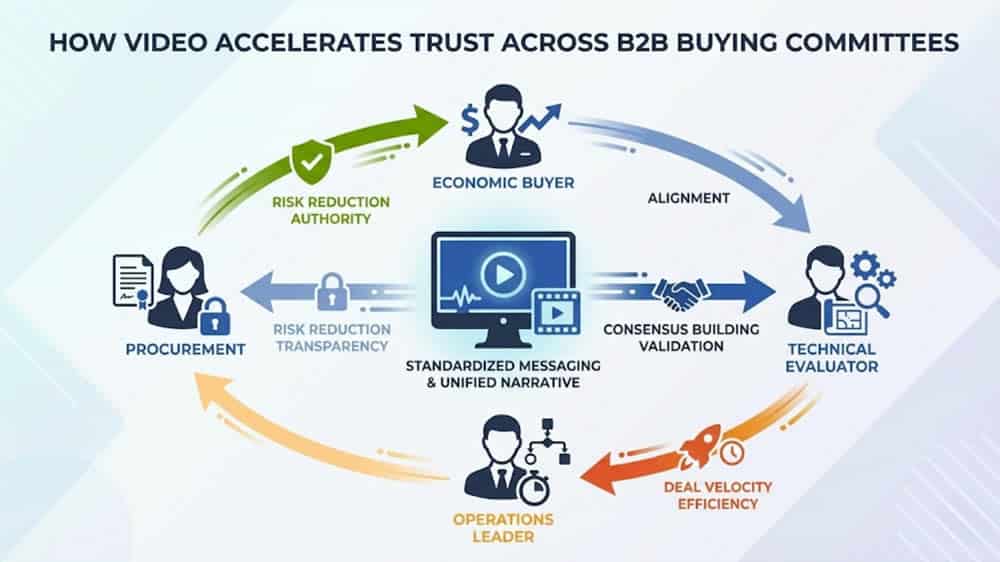
Buying committees further complicate this environment. A single deal may involve economic buyers, technical evaluators, operational stakeholders, and procurement. Video becomes a transferable internal artifact that circulates among these stakeholders. It standardizes messaging and reduces distortion as information passes between departments. In that sense, video is not just marketing content. It is a shared communication tool inside the prospect organization.
Video as Revenue Infrastructure
I design video as infrastructure embedded across the revenue engine. Infrastructure implies systemization, governance, and integration with operational platforms. Platforms such as HubSpot demonstrate how video engagement data can be captured inside CRM records, influencing lead scoring, lifecycle segmentation, and opportunity prioritization.
A revenue-aligned video system typically spans:
- Demand creation and category positioning
- Evaluation-stage product education
- Sales enablement and objection handling
- Post-sale onboarding and expansion
When these layers are deliberately mapped, video compounds in value. Assets support multiple teams and reduce repeated explanation cycles. Over time, this reduces friction across the acquisition and retention stages.
The Economics of B2B Video Marketing
Capital Allocation and Cost Structures
Professional video programs require disciplined capital allocation. I evaluate investments based on asset lifespan, reuse potential, and revenue alignment. A core product explainer may support website conversion, paid distribution, outbound sales, and onboarding. Its cost must be analyzed against the total deployment surface area rather than single-channel performance.
Operational structures influence cost efficiency:
- In-house teams provide velocity and lower marginal cost but require management oversight.
- Agency partnerships provide specialized expertise but may reduce agility.
- Hybrid models combine internal strategic ownership with external production execution.
Each structure carries implications for throughput, quality control, and budget predictability. The right model depends on growth velocity and internal capability maturity.
ROI Modeling Beyond Surface Metrics
Views and engagement metrics are insufficient for executive-level evaluation, particularly when compared to structured methods for measuring revenue impact from video initiatives. I anchor ROI discussions in pipeline contribution and revenue velocity. That requires integrating video engagement data into CRM and marketing automation systems.
Advanced modeling approaches include:
- Multi-touch attribution weighting for video engagement
- Opportunity-level engagement scoring
- Sales cycle compression analysis
- Conversion rate comparison between exposed and unexposed cohorts
Perfect attribution is unrealistic in complex buying journeys. Directional evidence is sufficient if it informs smarter capital allocation. When video demonstrably accelerates deal velocity or increases win rates, its role shifts from experimental to strategic.
Funnel Architecture and Video Mapping
Demand Creation and Market Framing
Funnel-mapped video architecture accelerates trust, reduces sales friction, and improves deal velocity across complex buying committees when aligned to a structured buyer journey video framework. Strong demand creation video does not push product. It establishes intellectual leadership.
Effective top-of-funnel assets typically:
- Clarify structural industry shifts
- Challenge outdated assumptions
- Elevate strategic risk or opportunity
- Introduce distinctive language and framing
These elements influence how buyers define their evaluation criteria later. If you shape the problem definition, you indirectly shape the solution selection process.
Consideration and Evaluation Layer
Mid-funnel video must translate strategic positioning into operational credibility. Buyers at this stage evaluate architecture, integration, scalability, and workflow compatibility. I design modular libraries that address discrete concerns so stakeholders can self-educate without friction.
High-performing evaluation-stage libraries include:
- Architecture overviews for technical validation
- Integration walkthroughs for ecosystem alignment
- Use-case specific demonstrations
- Security and compliance briefings
Precision reduces uncertainty. Uncertainty prolongs sales cycles. When prospects can independently validate technical fit, deal progression accelerates.
Decision Acceleration Layer
At the bottom of the funnel, video addresses risk mitigation and consensus building. Objection-handling assets reduce repetitive explanation during late-stage discussions. Executive-facing summaries help internal champions articulate business impact to senior stakeholders.
Strategic assets at this layer may include:
- ROI modeling explainers
- Competitive differentiation briefings
- Implementation timeline walkthroughs
- Executive summaries tailored to economic buyers
These assets equip prospects to advocate internally. They shorten the time between proposal and approval.
Narrative Engineering for Advanced B2B Video
Messaging Architecture and Positioning Discipline
Strong video begins with disciplined messaging architecture. Before scripting, I clarify category positioning, differentiation logic, and value hierarchy. If messaging lacks clarity, no level of production quality can compensate.
Narrative construction typically involves:
- Defining the competitive frame
- Articulating the cost of inaction
- Structuring escalating tension
- Delivering resolution grounded in capability
This structure maintains intellectual rigor while sustaining attention. Even sophisticated audiences respond to narrative clarity when it respects their expertise.
Authority Signaling and Trust Acceleration
Authority is communicated visually and structurally. Executive presence, clarity of articulation, and contextual depth signal competence. Production standards must align with brand positioning, but substance remains paramount.
Trust acceleration mechanisms include:
- Acknowledging complexity rather than oversimplifying
- Presenting evidence with specificity
- Demonstrating operational fluency
- Maintaining consistent visual and verbal identity
In enterprise environments, perceived risk often outweighs perceived opportunity. Video that systematically reduces perceived risk materially influences buying decisions.
Video Format Strategy by Use Case
Executive Thought Leadership Systems
Executive-led video, when structured properly, compounds authority. Sporadic commentary fails to generate momentum. Instead, I recommend consistent thematic alignment with broader strategic initiatives.
Effective executive systems often combine:
- Long-form strategic analysis
- Short-form topical breakdowns
- Commentary aligned with industry shifts
- Cross-posting across owned and social channels
This structure reinforces positioning while humanizing leadership. Over time, executive presence becomes an intangible but powerful asset in competitive markets.
Product-Led Video Architecture
Product-focused video must demonstrate technical competence. Feature lists are insufficient. Buyers expect architectural clarity and integration depth.
Layered product libraries may include:
- Orientation-level overviews
- Deep technical walkthroughs
- Configuration and customization guides
- API and integration demonstrations
When these assets are easily accessible, they reduce dependency on sales calls for basic education and allow conversations to focus on strategic alignment rather than functional explanation.
Production Systems and Operational Design
Building an Internal Video Engine
If video is going to function as infrastructure, it must be supported by operational rigor. I treat video production as a managed pipeline rather than a creative side project. That means clearly defined ownership, documented processes, and predictable throughput. Without these elements, quality degrades as output scales and messaging becomes inconsistent across departments.
A functional internal engine typically includes:
- Strategic brief templates aligned with positioning pillars
- Defined script review stages involving subject matter experts
- Cross-functional approval workflows with controlled turnaround times
- Asset tracking systems connected to CRM and marketing automation
These systems reduce friction between marketing, product, and sales. They also ensure that each asset maps back to a measurable business objective. Creative excellence without operational discipline rarely sustains momentum in B2B environments.
Pre-Production Discipline and Strategic Control
Pre-production is where strategic clarity is won or lost, which is why disciplined strategic planning before filming begins is essential. I insist on investing disproportionate time in narrative structuring and message validation before cameras turn on. Once production begins, changes become expensive and politically complicated. Strategic ambiguity at this stage leads to compromised output and diluted authority.
Effective pre-production processes often involve:
- Message hierarchy documentation
- Audience persona validation
- Objection mapping and response structuring
- Technical accuracy review
This phase ensures that what is communicated is both strategically aligned and operationally accurate. In complex industries, credibility can erode quickly if nuance is mishandled. Pre-production rigor protects authority and reduces downstream inefficiency.
Scaling Without Strategic Drift
As video volume increases, coherence becomes harder to maintain. Teams may produce content rapidly but lose narrative alignment and positioning clarity. I address this by anchoring production to defined content pillars tied directly to strategic objectives.
Scaling frameworks typically require:
- Quarterly content planning aligned with pipeline priorities
- Pillar-based categorization to prevent thematic dilution
- Version control and metadata tagging
- Periodic performance audits to retire underperforming assets
A mature video library resembles a knowledge system rather than a content archive. It is structured, searchable, and intentionally aligned with revenue goals.
Distribution Infrastructure and Channel Strategy
Owned Media Integration
Video distribution begins with owned assets. Your website is not a passive repository. It should reflect intentional placement based on buyer intent and page objective. Complex product pages benefit from embedded demonstrations that reduce abstraction. High-level thought leadership pages benefit from executive commentary that reinforces positioning.
Search visibility also requires technical optimization grounded in advanced search-focused video optimization practices. I ensure:
- Structured data markup for video indexing
- Accurate transcripts to support keyword relevance
- Alignment between video titles and search intent
- Integration with related long-form content
Video and text reinforce each other. When structured correctly, they improve both engagement and discoverability. The objective is not to replace written content but to amplify comprehension and retention.
Paid Amplification Architecture
Paid distribution requires disciplined creative sequencing. I rarely deploy single isolated ads. Instead, I design multi-step exposure strategies that mirror the buyer journey. Initial ads introduce problem framing. Subsequent retargeting assets deepen product understanding or address specific objections.
A structured paid video funnel may include:
- Awareness-level narrative videos
- Consideration-focused product demonstrations
- Decision-stage validation or ROI explainers
This layered structure improves efficiency because it matches content depth to audience readiness. It also allows more precise budget allocation across stages.
Sales-Embedded Distribution
Video becomes particularly powerful when embedded into sales workflows supported by intentional sales enablement video systems designed for stage-specific deployment. I integrate curated video assets into CRM templates so representatives can deploy them at precise moments in the buying journey. Personalized video outreach can increase response rates and differentiate communication in competitive markets.
Effective sales integration requires:
- Training on when and how to deploy assets
- Clear tagging by persona and funnel stage
- Feedback loops between sales and marketing
- Measurement of opportunity-level engagement
When sales teams trust and use the video library consistently, its impact extends far beyond marketing campaigns.
Measurement, Attribution, and Optimization
Stage-Based Metric Framework
Measurement must reflect funnel context. Awareness-stage assets are evaluated primarily on reach quality and engagement depth. Mid-funnel assets are evaluated on progression metrics such as demo requests or content downloads. Bottom-of-funnel assets are evaluated against opportunity advancement and close rate improvement.
To maintain clarity, I categorize metrics into four tiers:
- Attention indicators, such as qualified impressions
- Engagement depth, such as completion rate
- Behavioral triggers, such as form submissions
- Revenue outcomes such as pipeline contribution
This structured approach prevents teams from overvaluing superficial engagement at the expense of business impact.
Diagnostic and Optimization Systems
Optimization is not reactive experimentation. It is a systematic analysis embedded in quarterly review cycles. I examine drop-off patterns to identify messaging weaknesses. If viewers consistently disengage at specific points, narrative structure must be refined.
Additional optimization practices include:
- Hook testing within the first fifteen seconds
- Thumbnail and title experimentation on search platforms
- Segmented performance analysis by persona
- Creative refresh cadence for paid campaigns
Creative fatigue degrades performance over time. A disciplined refresh schedule protects efficiency and prevents diminishing returns.
Video in Complex Sales Environments
Enterprise Buying Committee Mapping
Enterprise deals rarely hinge on a single decision maker. I map video assets to distinct personas within the buying committee. Economic buyers require strategic and financial framing. Technical evaluators require architectural validation. Operational leaders require workflow alignment clarity.
Persona-mapped libraries typically include:
- Executive briefings focused on strategic alignment
- Technical architecture walkthroughs
- Operational use-case demonstrations
- Procurement-stage validation materials
When stakeholders can access relevant material independently, internal consensus forms more efficiently. Video reduces misinterpretation and accelerates alignment across departments.
Long Sales Cycle Sequencing
Long procurement cycles often introduce momentum loss. Strategic video sequencing sustains engagement between meetings. Rather than relying solely on email summaries, I deploy targeted assets that reinforce key themes and address emerging concerns.
A sequencing framework might involve:
- Post-meeting recap videos
- Targeted deep dives aligned with expressed objections
- Roadmap updates that signal product evolution
- Executive-level strategic briefings during late-stage review
These touchpoints maintain visibility and reinforce perceived responsiveness. Over time, this consistency strengthens trust and improves the close probability.
Video Integration Across the Marketing Ecosystem
Integration with Content Marketing
Video should integrate seamlessly with pillar and cluster strategies. Long-form written analysis can be converted into executive discussions or technical breakdowns. Conversely, high-performing video themes can inform deeper written exploration.
An integrated system ensures:
- Thematic alignment across formats
- Reinforcement of core positioning language
- Cross-linking between video and text assets
- Compounded search authority
When content ecosystems are cohesive, authority strengthens. Fragmented systems dilute brand clarity and reduce long-term impact.
Integration with Marketing Automation
Automation amplifies video precision. Behavioral triggers can activate tailored video sequences aligned with user interest. For example, repeated visits to pricing pages may initiate ROI explainer distribution. High engagement with technical documentation may trigger architecture deep dives.
Lead scoring models should incorporate video engagement depth. High completion rates on advanced assets often indicate strong purchase intent. When these signals feed into CRM systems, sales prioritization becomes more intelligent and timely.
Designing a Mature B2B Video Program
Maturity Model
I conceptualize maturity across four stages:
- Tactical experimentation with isolated assets
- Campaign integration tied to specific initiatives
- Funnel integration spanning lifecycle stages
- Revenue engine integration is embedded in forecasting and planning
Most organizations plateau between campaign integration and funnel integration. Advancing requires executive sponsorship and operational sophistication. When video performance influences budget planning and revenue projections, maturity has been achieved.
Implementation Roadmap
A practical implementation roadmap balances ambition with operational feasibility. Initial efforts focus on foundational assets that support high-impact stages of the funnel. Subsequent phases emphasize systemization and measurement refinement.
A phased approach may include:
- First ninety days focused on strategic asset creation
- Six months dedicated to cross-functional integration
- Twelve months centered on optimization and scaling
Throughout this process, alignment between marketing, sales, and leadership remains essential. Video strategy cannot operate in isolation from broader revenue objectives.
Common Structural Failures in B2B Video Strategy
Production Without Strategic Anchoring
One of the most common failures I encounter is disproportionate focus on production aesthetics without positioning clarity. Cinematic quality cannot compensate for ambiguous differentiation or weak narrative structure. When strategic anchors are absent, assets fail to accumulate value over time.
Another recurring issue involves misaligned performance metrics. Teams celebrate view counts while the pipeline remains unaffected. Without revenue-aligned KPIs, decision-making becomes distorted. Strategic discipline prevents video from devolving into vanity-driven output.
Disconnected Workflows and Underutilization
Even well-produced assets underperform when disconnected from sales workflows. If sales teams lack visibility into available content or do not understand the deployment context, video remains underutilized. Embedding assets into CRM templates and providing usage guidance resolves this gap.
Inconsistent distribution infrastructure also undermines effectiveness. Exceptional content requires systematic amplification. Cohesion across creation, distribution, measurement, and refinement transforms video from an isolated asset to a competitive advantage.

About LocalEyes: Video Production That Drives Real Business Results
At LocalEyes Video Production, we operate at the intersection of strategy and execution. Everything discussed in this article, from revenue-aligned video architecture to operational scalability and distribution discipline, reflects how we approach our client partnerships every day. We are not simply a production vendor. We function as a strategic video partner for organizations that need content designed to influence the pipeline, accelerate sales cycles, and reinforce brand authority at scale.
Over the past seven years, we have produced more than 3,900 videos for over 300 clients across the United States. Our work has earned more than 500 five-star reviews across platforms including Clutch, DesignRush, and Google. We have also been recognized by Inc. 5000 as one of the fastest-growing companies in America for three consecutive years. What differentiates us is not only our Emmy Award-winning production quality, but also our national footprint combined with local execution expertise. With headquarters in California and full-service offices in Atlanta, Austin, Boston, Chicago, Dallas, Denver, Los Angeles, Miami, New York City, and San Diego, we deliver testimonial, product, brand, corporate, explainer, educational, promotional, event, and animation video production services nationwide.
If your organization is ready to move beyond isolated video projects and build a structured, revenue-aligned video strategy, we would welcome the conversation. Whether you are refining your positioning, scaling production, or integrating video into your full revenue engine, our team is built to support that evolution. Connect with us to explore how a strategically designed video program can drive measurable business results for your organization.

Founder at LocalEyes Video Production | Inc. 5000 CEO | Emmy Award Winning Producer