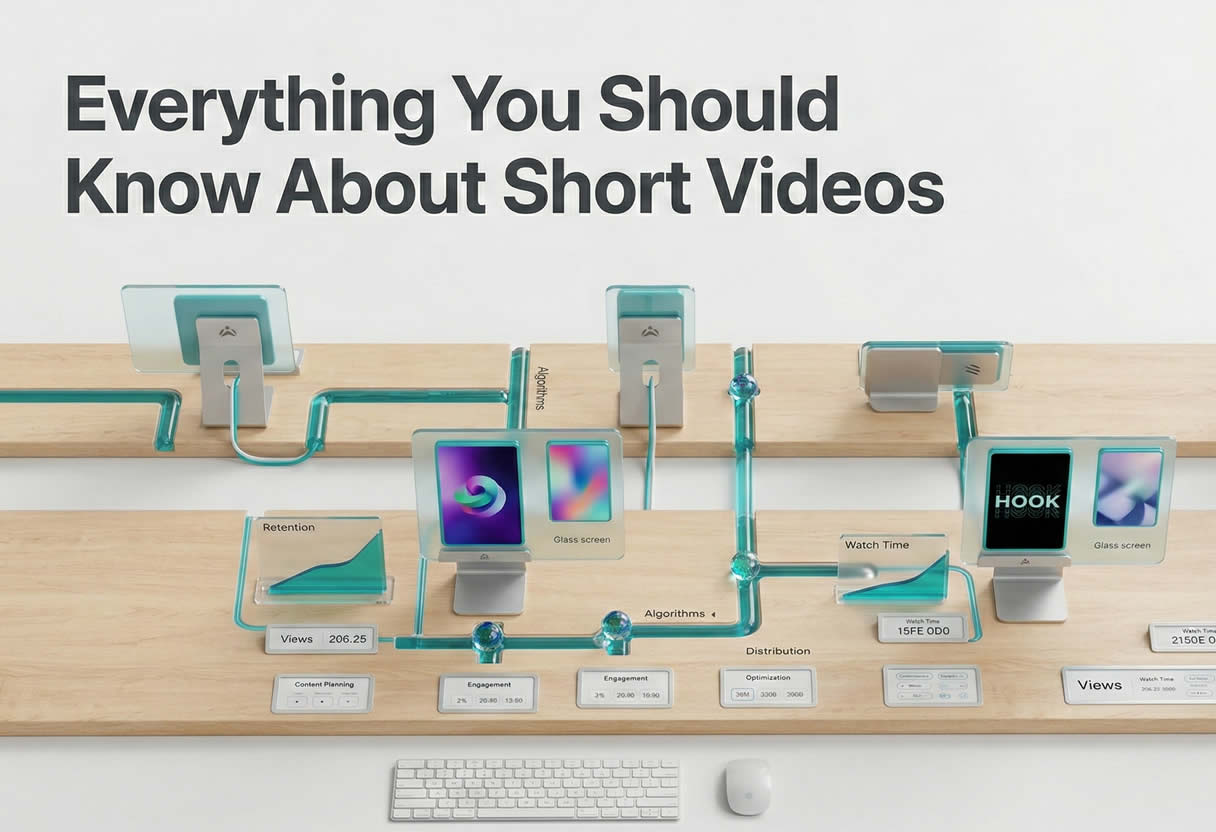
- Short-form video is a primary digital infrastructure that shapes audience discovery, platform competition, and brand growth through algorithmic distribution.
- Short-form video performance is driven by immediate hooks, efficient narrative structure, retention metrics, and platform-specific ranking signals.
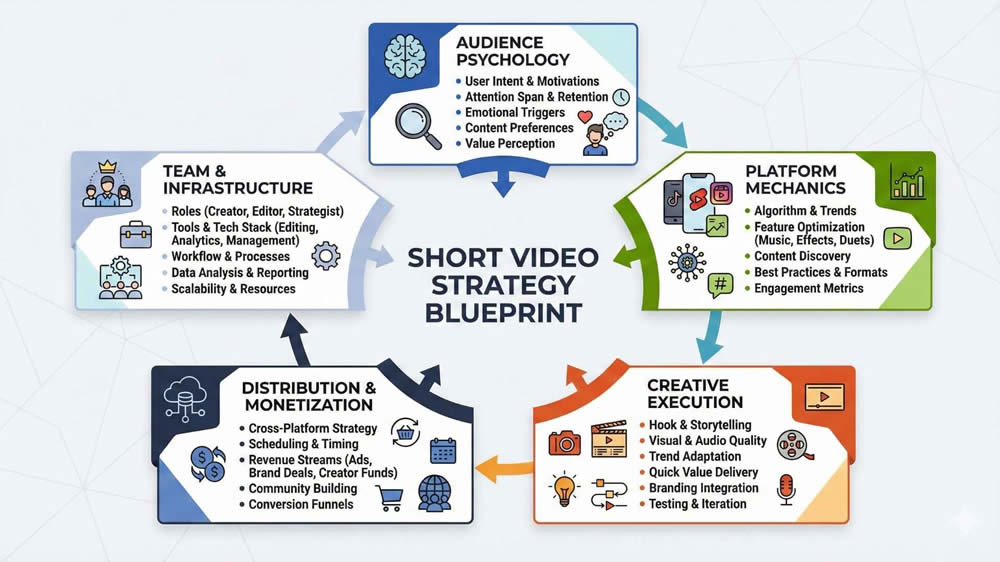
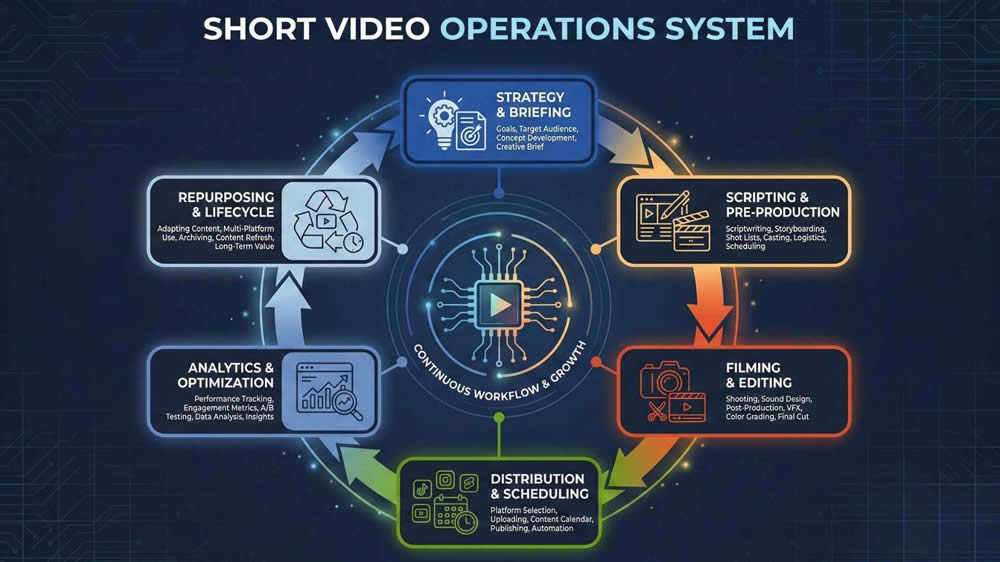
- An effective short-form video strategy requires scalable systems for content pillars, distribution lifecycle management, analytics, and cross-functional team execution.
Short-form video is a core format in modern digital ecosystems, shaping discovery, brand visibility, and platform competition. It connects content, distribution, data, and user behavior, making it essential for professionals in strategy, growth, media, and branding. Visibility and momentum are increasingly built through short-form systems rather than traditional channels.
This article examines short-form video at a strategic and operational level. It analyzes platform distribution mechanics, audience consumption patterns, performance-driven creative design, and scalable team structures. The focus is on building structured systems, not surface-level tactics.
The Evolution of Short-Form Video
From Constraint to Dominant Format
Short-form video emerged from constraint, not abundance. Vine’s six-second limit forced creators to compress ideas into tight loops. Snapchat added ephemerality and context-driven consumption. These early platforms trained users to accept brevity as a feature rather than a limitation. When TikTok entered the market, it combined these behavioral lessons with powerful recommendation systems and native creation tools, effectively industrializing short-form video.
What followed was rapid format convergence. Platforms that once resisted video pivoted aggressively once audience behavior proved durable. Instagram deprioritized photos in favor of Reels. YouTube introduced Shorts to defend top-of-funnel attention, intensifying the competitive dynamics between platforms and reshaping short-form platform comparison strategies. The result is that short-form video is now a standardized format across ecosystems, even though distribution mechanics differ.
Strategic Implications of Format Standardization
The standardization of short-form video has several implications for professionals:
- Short video is no longer experimental inventory
- Creative differentiation now matters more than format adoption
- Strategy must account for platform-specific behavior within a shared format
The challenge today is not whether to use short video, but how to design it as a repeatable and defensible system rather than a reactive tactic.
Audience Psychology and Behavior
Attention Compression and Reward Loops
Short-form video aligns tightly with how attention operates under cognitive load. Users are not sitting down to consume content intentionally. They are filling gaps between tasks, moments, and obligations. Short videos succeed because they deliver perceived value quickly and repeatedly, reinforcing scroll behavior through micro-rewards.
The key behavioral drivers include:
- Novelty seeking
- Pattern interruption
- Fast feedback through visual or emotional payoff
This creates an environment where attention is earned second by second, not minute by minute. If a video fails to justify its presence immediately, it is discarded without friction.
Passive Consumption Versus Active Engagement
Not all viewers engage with short videos in the same way. A large percentage are passive scrollers who rarely like, comment, or share. Yet they still influence performance metrics like watch time and completion rate. Others are active participants who comment, remix, and follow creators.
From a strategic perspective, this means:
- You cannot rely on engagement signals alone to assess resonance
- Content must be designed to satisfy both silent viewers and active participants
- Call-to-action design should not assume intent
Understanding these layers helps explain why some videos perform exceptionally without visible engagement and why others generate conversation but limited reach.
Platform-Specific Mechanics and Differentiators
TikTok’s Interest Graph and Velocity Model
TikTok operates primarily on an interest graph rather than a social graph. Distribution is based on content performance signals more than account authority. Early velocity matters, particularly within the first hour of posting. Videos are tested in small batches, and successful ones are expanded outward.
Key factors that influence TikTok distribution include:
- Completion rate and rewatch behavior
- Early engagement velocity
- Audio relevance and trend alignment
- Text overlays that reinforce topical clarity
Follower count plays a limited role compared to behavioral response. This is why new accounts can still generate massive reach.
Instagram Reels and Relationship Weighting
Instagram Reels places more weight on account history and relationship signals. Consistency, audience overlap, and prior engagement patterns influence reach. While Reels can surface to non-followers, distribution is more conservative than TikTok.
Strategically, this means:
- Account health and consistency matter more
- Repurposed TikToks may underperform without native adaptation
- Visual polish and brand alignment are more heavily rewarded
YouTube Shorts as a Funnel Mechanism
YouTube Shorts functions as a discovery layer for the broader YouTube ecosystem. Shorts are often evaluated not only on performance, but on how they contribute to subscriptions and long-form engagement.
For professionals, Shorts should be viewed as:
- A top-of-funnel acquisition channel
- A testing ground for long-form concepts
- A bridge between casual discovery and intentional viewing
Discovery and Algorithmic Mechanics
How Short Videos Are Evaluated
Algorithms are not looking for quality in a human sense. They are looking for predicted session values. Each video is evaluated based on how likely it is to keep users engaged on the platform.
Core evaluation signals typically include:
- Average watch time relative to length
- Completion rate
- Replays and loops
- Shares and saves
- Early performance velocity
Importantly, these signals are weighted dynamically depending on platform goals and user context.
Metadata and Content Clustering
Metadata helps algorithms understand what a video is about and who it should be shown to. This includes captions, hashtags, audio selection, and on-screen text. However, metadata alone does not drive reach. It supports clustering.
Effective clustering allows your video to be placed alongside similar high-performing content. This increases relevance and reduces friction for viewers. Professionals should think of metadata as a classification tool rather than a growth hack.
Creative Structure and Technical Execution
Engineering the Hook and Narrative Arc
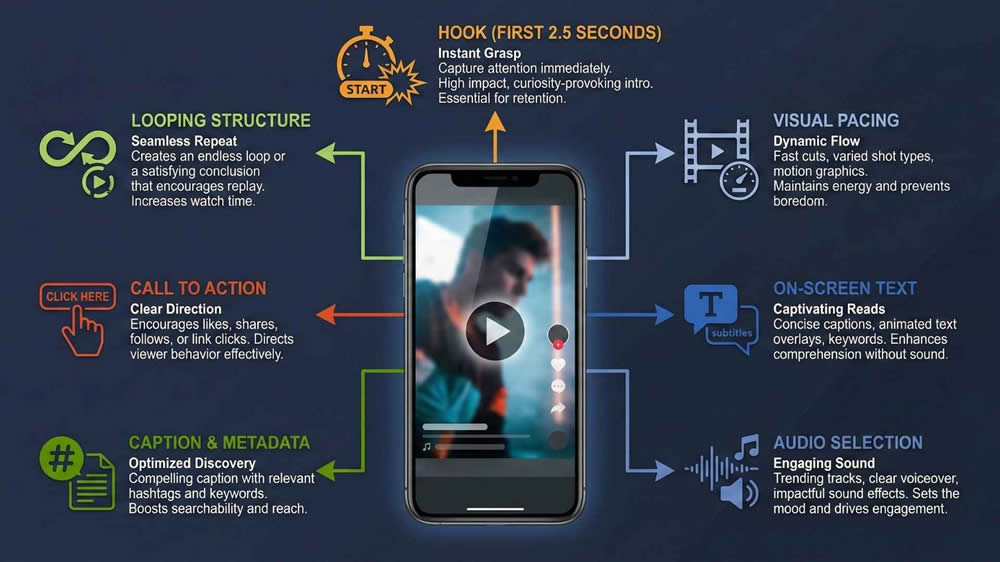
Short videos require aggressive prioritization. You cannot afford slow builds or abstract openings. The hook must communicate value immediately, even if the payoff comes later.
Effective hooks often include:
- Direct statements of value
- Visual disruption
- Questions that imply resolution
Once attention is captured, the narrative arc must be linear and efficient. Every second should advance the message or reinforce interest.
Visual Grammar and Editing Discipline
Vertical video changes composition rules. Eye-line positioning, text placement, and pacing must account for thumb-driven consumption, especially when optimizing for a mobile-first vertical content strategy where framing and clarity directly affect retention. Overly complex visuals often reduce clarity.
From an execution standpoint, high-performing teams focus on:
- Tight edits and minimal dead space
- Consistent visual language
- Reusable editing frameworks
- Audio that complements pacing rather than overwhelms it
Efficiency in production enables frequency without sacrificing quality.
Content Strategy and Typology
Defining Content Pillars
A sustainable short-form strategy requires clear content pillars. These pillars act as guardrails that maintain coherence while allowing creative variation.
Common pillar categories include:
- Educational or instructional content
- Entertaining or humorous content
- Relatable or emotionally resonant content
- Authority or perspective-driven content
Each pillar serves a different role in audience development and should be measured differently.
Balancing Virality and Brand Equity
Not all high-performing content is strategically valuable. Viral moments can drive reach while eroding clarity if they do not align with brand positioning.
Professionals should ask:
- Does this content reinforce who we are
- Is the attention earned relevant to our goals
- Can this format be repeated without dilution
Strategic restraint is often more valuable than chasing every trend.
Distribution, Scheduling, and Lifecycle Optimization
Programming Versus Posting
Posting content is tactical. Programming content is strategic. Programming accounts for cadence, timing, and narrative continuity across posts.
Effective programming considers:
- Platform-specific peak activity windows
- Content fatigue and spacing
- Campaign sequencing rather than isolated posts
Consistency builds algorithmic trust and audience expectation.
Extending the Life of High-Performing Content
High-performing videos should not be treated as one-time assets. With minor adaptations, they can be redistributed multiple times.
Lifecycle extension tactics include:
- Reposting with new captions
- Cropping or reframing for different platforms
- Sequencing content with follow-ups or clarifications
This approach increases return on creative investment.
Monetization and Performance Modeling
Short Video as a Revenue Lever
Monetization in short-form is often indirect. While platform payouts exist, most value is created through influence on downstream behavior.
Short videos commonly support:
- Affiliate sales
- Brand partnerships
- Product discovery
- Lead generation
Understanding this indirect value is essential for proper evaluation.
Modeling Impact Beyond Views
Performance modeling should align with business objectives. Views alone are insufficient.
More meaningful indicators include:
- Cost per qualified view
- Click-through efficiency
- Assisted conversions
- Audience growth quality
Short video should be evaluated as part of a system, not a silo.
Analytics and Optimization
Interpreting Retention and Drop-Off
Retention graphs reveal where attention is lost. Sharp early drop-offs indicate weak hooks. Gradual declines suggest pacing issues.
Professionals should analyze:
- First three seconds
- Midpoint engagement
- End-of-video completion
These insights inform creative iteration.
Iterative Testing and Feedback Loops
Optimization is an ongoing process. Small changes compound over time.
Effective teams test variables such as:
- Hook phrasing
- Video length
- Caption structure
- Visual pacing
Data should guide decisions, but not replace creative judgment.
Organizational Integration and Team Structures
Building a Pod-Based Team Architecture
As short-form video operations scale, the need for clearly defined roles and responsibilities becomes unavoidable. Traditional content teams often lack the structure to support rapid production cycles and iterative testing, which are core to short-form success. The most efficient structure I’ve worked with is a pod-based architecture: a small, multi-functional team responsible for strategy, execution, and analysis within its scope.
A typical short-form content pod might include:
- Strategist: Defines objectives, audience, and distribution logic
- Creator or Producer: Owns ideation, scripting, and on-camera work
- Editor: Handles post-production, visual polish, and format adaptation
- Performance Analyst: Interprets data and recommends optimization
This approach ensures speed, accountability, and creative ownership. Pods can operate independently or in coordination, depending on brand size and scale.
Systematizing Briefs and Approval Workflows
Too many organizations rely on ad-hoc briefs and informal approval chains. These bottlenecks creative speed and invite brand inconsistency. To operate effectively, short-form teams need a repeatable briefing and governance system that balances flexibility with brand control.
Essential briefing components include:
- Clear objective (brand lift, conversion, awareness)
- Primary audience segment
- Core message or CTA
- Creative references or tone guidelines
- Platform-specific notes (length, features to use, publishing time)
Approvals should follow a lightweight structure. Over-engineering this step kills momentum. Approvals work best when they are framed as “green-lighting frameworks,” not micromanaged reviews. Empower teams to ship quickly with alignment rather than perfect control.
Short-Form as a System: Infrastructure Thinking
Modular Content as a Scalable Framework
To scale short-form video efficiently, you must think modularly. Treat every piece of content not as a one-time asset but as a component that can be restructured, remixed, or refactored. This is a shift from campaign-thinking to system-thinking. Your goal is to build an inventory of creative units that can be reused across time and context.
For example, a 45-second thought-leadership video can yield:
- A 15-second teaser clip for Instagram
- A subtitled quote snippet for LinkedIn
- A vertical punch-in edit for YouTube Shorts
- A GIF for email or Stories
By systematizing asset extraction, you reduce the pressure to constantly generate new content while maintaining freshness in execution.
Connecting Creative to Marketing Stack
Short-form video should not live in isolation. It can and should feed into other systems: email marketing, paid media, CRM pipelines, and even SEO strategies through embedded media. I’ve worked with teams that use short video clips as onboarding micro-content, sales enablement touchpoints, or product walkthroughs.
Ways to operationalize this include:
- Embedding Shorts in email nurture sequences
- Retargeting video viewers with mid-funnel offers
- Integrating short videos in product landing pages
- Using video comments as insight channels for product R&D
When you connect short-form video to the broader marketing and product stack, it shifts from entertainment to infrastructure.
Strategic Planning and Playbook Design
From Goals to Content Architecture
Strategic planning begins with defining the function of your short video operation. Is it top-of-funnel awareness? Community building? Product education? The answer dictates the types of content you produce, the cadence you follow, and the KPIs you prioritize.
I recommend creating a short video matrix that maps:
- Audience segments to messaging
- Platforms to content formats
- Goals to performance metrics
- Pillars to video styles
This matrix becomes the blueprint for campaign design and helps avoid reactive content decisions. When every video fits a box in your architecture, you can analyze performance and adjust without losing strategic clarity.
Modular Playbooks for Different Scenarios
Playbooks are living documents that define how your team approaches different content scenarios. For example, a product launch may require teaser videos, influencer amplification, and educational explainer clips. A seasonal campaign might need user-generated content, remixable templates, and cross-posting strategies.
Each playbook should define:
- Creative formats to use
- Publishing rhythm and timing windows
- Hashtag sets or metadata norms
- Cross-functional dependencies
- Testing and measurement plans
These playbooks reduce ambiguity, accelerate alignment, and increase creative throughput. They also act as training tools when onboarding new team members or agency partners.
Risks, Limitations, and Operational Challenges
Creative Burnout and Algorithm Dependency
Operating at high frequency brings fatigue, both for the creators and the audience. If you’re not careful, teams fall into the trap of publishing for the sake of consistency rather than resonance. Creators get stretched thin, audiences become numb, and engagement deteriorates.
To mitigate this, I suggest:
- Building rest periods or creative sprints into your schedule
- Rotating content types to reduce production strain
- Documenting idea backlogs and batch-producing when energy is high
Algorithm dependency is another major risk. Relying on platform distribution to carry your content every time is dangerous. The rules change. Organic reach fluctuates. You must diversify platforms and build opt-in communities (email, Discord, Slack) to hedge volatility.
Trend-Driven Drift and Brand Erosion
There’s also a subtle but dangerous risk of brand dilution. Trend culture moves fast, and not every brand is built to run alongside it. Jumping on viral sounds or formats without alignment creates confusion, not connection.
As professionals, we need to ask:
- Does this trend serve our positioning?
- Are we adding value or just mimicking?
- Will this content age well in three months?
The long-term strength of the short-form video strategy lies in coherence, not just immediacy. Protecting the brand while staying culturally relevant is a balancing act that requires judgment and restraint.
Final Thoughts
Short-form video is no longer a trend or an add-on. It is the media foundation of the current internet. It shapes discovery, drives narrative, and accelerates community. To treat it as a lightweight tactic is to ignore its influence on the digital behavior stack.
What separates top-performing professionals in this space is not just creative skill or platform fluency. It’s the ability to design systems, think cross-functionally, and operationalize creative ideas into repeatable value. This article has laid out not just what short videos are, but how to make them work inside real organizations, across real teams, and toward real objectives.
About LocalEyes
At LocalEyes, we know firsthand what it takes to create short-form video content that doesn’t just look great, but actually performs. With over 3,900 videos produced for more than 300 clients nationwide, we’ve been at the center of the shift toward fast, agile, and scalable video strategies for years. This article reflects the same perspective we bring to every project: an expert understanding of platforms, storytelling, creative structure, and performance-driven production.
Our Emmy Award-winning team builds short-form video campaigns that convert, whether you’re launching a product, building a brand, or driving demand. From California to New York and every major business hub in between, we help clients own their message with clarity, consistency, and quality. If your brand is ready to level up its short video presence with high-performing content and a partner that understands both the creative and strategic layers, we’re here to help.
Let’s talk about how LocalEyes can bring your short-form video strategy to life. Get in touch with us.

Founder at LocalEyes Video Production | Inc. 5000 CEO | Emmy Award Winning Producer