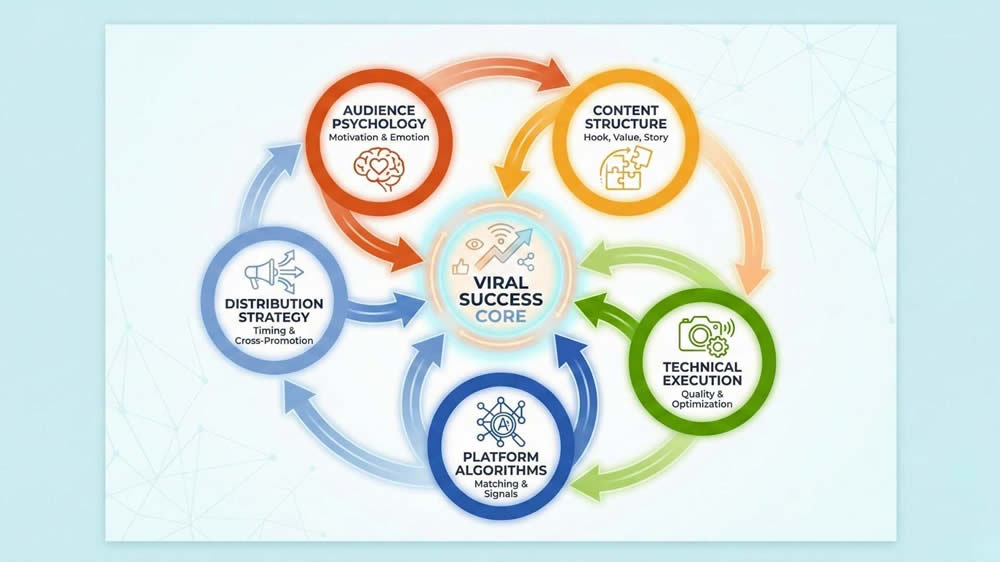
- Viral video success is the result of a repeatable system built on four core components: a deep understanding of human psychology, platform-specific algorithm dynamics, intentional content structure, and strategically designed distribution.
- To determine whether a video has achieved virality, performance should be evaluated using measurable indicators such as early view velocity, engagement-to-view ratios, and long-term decay patterns that reflect sustained audience demand.
- A video spreads widely when it triggers high-arousal emotions, aligns with audience identity, captures attention with a strong opening hook, and maintains retention through deliberate pacing. These factors significantly increase sharing behavior and algorithmic amplification.
Viral video success is driven by a structured strategy, not luck. It requires deliberate content architecture, emotional engineering, strong production, and precise distribution. Results come from aligning psychological triggers with platform ranking signals and amplification systems. Viral performance is built through repeatable systems that integrate content design, data signals, and cross-channel reach.
This focuses only on performance variables that matter. It covers emotional trigger design, algorithm-aware strategy, paid amplification, and meaningful metrics. The emphasis is on execution, optimization, and measurable outcomes for professionals working across content, data, and growth.
Defining Virality in Context
Platform-Specific Definitions
Virality doesn’t mean the same thing on every platform. On YouTube, a video might qualify as viral if it exceeds 1 million views in under 7 days with strong watch time metrics. On TikTok, virality could be triggered by 100,000 views in 24 hours if the rewatch rate and sharing ratio are well above baseline. Instagram Reels and Facebook have different thresholds and content lifespans, which makes using a universal metric misguided.
Each platform has its own baseline for expected velocity. These differences mean that what’s “viral” for a 50k-subscriber YouTube channel is fundamentally different from what’s viral on a TikTok account with no followers. The platform’s algorithmic environment defines what speed and scale of growth constitute a breakout event.
Core Metrics of Virality
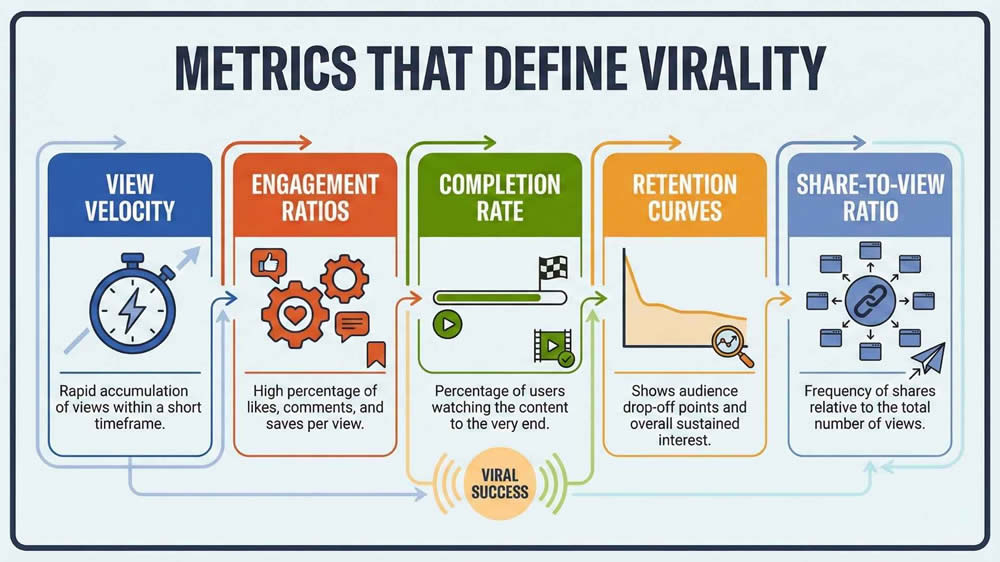
To measure virality accurately, I rely on three principal metrics:
- View Velocity: How fast the video accumulates views in its first 1–24 hours.
- Engagement Ratio: Shares, comments, and likes as a percentage of total views.
- Decay Profile: The longevity of viewership after the initial spike, often referred to as its half-life.
Crucially, we must separate organic virality from content that benefits from heavy paid promotion. A viral video spreads through networked sharing and platform recommendation systems, not just spending. Without this distinction, campaign performance gets misdiagnosed.
Human Behavior and Psychodynamics of Viral Spread
Emotional Triggers
Successful viral videos nearly always activate emotional response systems. The most effective videos evoke high-arousal emotions such as:
- Awe (e.g., mind-blowing facts or visuals)
- Laughter (comedic reversal or unexpected payoff)
- Anger (social injustice, personal betrayal)
- Surprise (twists, shock elements)
These emotions don’t just help videos get watched; they help them get shared. Emotional intensity boosts memorability and stimulates dopamine pathways linked to social bonding and sharing behavior.
Identity and Social Sharing
Virality is just as much about why people share as it is about what they watch. Content often becomes viral when it enables users to signal something about themselves, aligning with familiar brand archetypes that shape audience perception. In my analysis, people share for one or more of the following reasons:
- Identity reinforcement: “This video reflects who I am.”
- Altruistic utility: “This might help my friends.”
- Conversation starters: “This will spark discussion or debate.”
Designing for shareability means crafting content that maps to one or more of these sharing motivations. The more your video aligns with a viewer’s desire to signal identity, the higher the share potential.
Platform-Specific Algorithmic Mechanics
YouTube Mechanics
On YouTube, three ranking factors dominate:
- Click-through Rate (CTR): The percentage of people who click your thumbnail after seeing it.
- Average View Duration (AVD): The average time people spend watching.
- Session Time: How much longer the viewer stays on YouTube after watching your video.
CTR gets your video tested. AVD determines how long it stays in rotation. Session time rewards creators who improve overall platform stickiness. Neglecting any one of these metrics leads to diminishing returns.
TikTok and Reels Mechanics
TikTok is more watch-loop-centric, particularly when contrasted with how YouTube Shorts and TikTok surface content differently. The platform pays closer attention to:
- Completion Rate: Percentage of users who finish the video.
- Rewatches: How often a viewer replays the content.
- Engagement Velocity: How quickly likes, comments, and shares stack up.
Instagram and Facebook Reels prioritize dwell time and share ratio. Private shares (DMs, saves) carry heavy weight even if they don’t show up publicly. Knowing how each algorithm prioritizes signals helps tailor edits and call-to-action placements accordingly.
Content Architecture of Viral Videos
Hook Design and Pacing
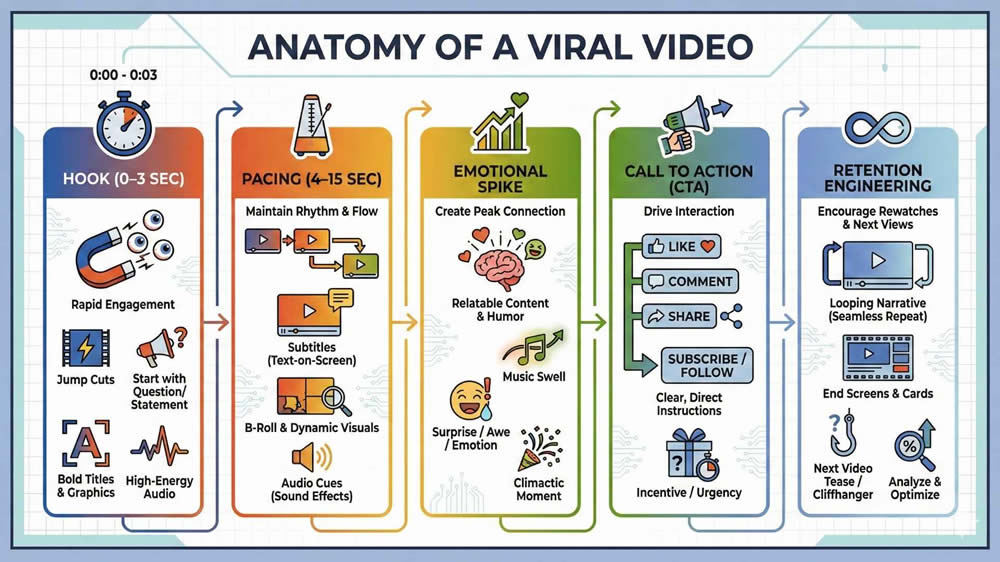
You have about 1.7 seconds to capture attention in most feed-based environments, which is why vertical video formats optimized for social feeds perform so strongly. That’s why the opening hook is critical. Viral videos often deploy one of the following hooks:
- Shock statement: A provocative line or claim
- Visual anomaly: Something confusing or out-of-place
- Question-based open: Pulling the viewer into a mystery
Beyond the opening, pacing determines retention. I recommend editing with a “value-per-second” mindset. Think in 5- to 8-second content blocks, each delivering new information, emotional payoff, or visual novelty.
Narrative Compression
Traditional storytelling has a beginning, middle, and end, but modern formats increasingly rely on short-form versus long-form video dynamics. Viral video structure compresses these into micro-moments. Instead of a 20-second setup, we aim for a 3-second problem presentation followed by immediate escalation or surprise.
Modular storytelling is another high-leverage tactic. When each section of a video can stand alone or be repurposed, you not only increase watchability but also future content versatility across formats and platforms.
Technical Production Factors
Video Encoding and Visual Design
High-quality resolution matters. Even though platforms compress uploaded files, starting with a high-resolution master gives more flexibility in post-production. Shoot in 4K when possible, export in 1080p with optimized bitrate settings. Color plays a psychological role as well, vivid, saturated visuals outperform desaturated looks on mobile platforms.
Captions are non-negotiable. Many users browse without sound, especially on mobile. Use bold fonts, shadow layering, and high-contrast color schemes. On-screen text should follow reading eye-path logic, often tracking from top-left to bottom-right in western audiences.
Audio and Motion Elements
Sound is half the experience. Use audio cues to mark emotional transitions or punchlines. Incorporating popular music or meme sounds can boost discoverability on TikTok and Reels, where audio indexing contributes to reach.
Motion graphics and jump cuts should serve rhythm, not just style. Videos with cuts every 2 to 4 seconds tend to hold attention better. Just be cautious not to disorient, transitions should feel natural and deliberate, not frenetic.
Distribution Engineering and Seeding Tactics
Launch and Initial Engagement Strategy
The first 60 minutes after publishing are often the most critical. Platform algorithms test new videos with small user samples and monitor interaction signals. That’s why I build launch strategies with a “seeding circle”:
- Share internally with a curated group (team, influencer network)
- Activate audience lists via newsletters or messaging groups
- Push out to subreddit or Discord channels aligned with the content theme
These early signals help the algorithm decide whether your content deserves broader exposure.
Cross-Platform Tailoring
Don’t post the same cut across platforms without adaptation. Each has unique norms:
- TikTok favors quick, raw edits and trend-jacking language.
- YouTube Shorts allows for slightly more narrative structure.
- Instagram Reels benefits from polished visual overlays and more aspirational tones.
Use staggered publishing schedules when possible. Launching the same video across all platforms at once can dilute performance by cannibalizing share signals or timing peaks.
Engagement Loop Design
Embedding CTAs Without Disrupting Flow
Effective engagement design doesn’t hinge on asking users to “like and subscribe” in a generic way. Those calls to action, while widespread, often underperform in high-intent or professional content categories. Instead, I recommend embedded CTAs that appear contextually, within narrative peaks or emotional inflection points. These perform significantly better because they’re aligned with the viewer’s state of mind.
For example:
- Prompting a question right after an insight triggers comments.
- Using an unfinished comparison (“X is like Y, but with…”) keeps viewers engaged longer.
- Placing subtle CTA banners that blend into the design avoids visual resistance.
It’s important to test CTA placement and format. In some videos, an early CTA increases engagement velocity. In others, a delayed or mid-video CTA retains more viewers without disrupting the experience.
Designing Native Engagement Behavior
You can engineer content to drive native platform behaviors. This includes likes, shares, comments, and saves. These behaviors don’t happen automatically, they are the result of deliberate editing choices and scripting that primes users to take action.
Here’s how I approach it:
- Insert ambiguity or tension to drive comments (e.g., “Some people think this is unethical, what do you think?”).
- Include frames with tap-targets or prompts for actions that are native to the UI (swipe-up, double-tap, hold-to-read).
- Build “interactive beats” every 10–15 seconds, visual or verbal cues that renew attention and encourage input.
The best engagement loops make the user feel like they’re participating, not just consuming. That sense of participation is what transforms a passive viewer into an active spreader.
Advanced Performance Analytics
Key Metrics Beyond Surface-Level Views
Professionals tracking viral performance need more than view counts. I divide metrics into three tiers:
- Primary Virality Indicators
- View velocity (first 1–24 hours)
- Share-to-view ratio
- Save-to-view ratio
- Retention Signals
- Average watch time
- Drop-off timestamps (frame-level precision)
- Percentage completion rate
- Engagement Quality
- Comment density (comments per 1,000 views)
- Comment diversity (unique threads vs. replies)
- Sentiment distribution (positive, negative, mixed)
These metrics give me a complete picture of not just if a video went viral, but why. They also identify which segments within the video are pulling the most weight.
Diagnostic Analysis of Retention Curves
Retention curve analysis is one of the most overlooked yet high-leverage tools in a performance audit. When mapped precisely, the curve tells you:
- Where viewers drop off
- Where they skip ahead
- Where engagement spikes happen (rewatches or shares)
This data enables surgical improvements:
- If a spike occurs at a particular timestamp, that moment can be used as the opening hook in future edits.
- If a sharp drop occurs after a visual or tonal shift, it signals a mismatch with audience expectations.
I recommend pairing retention curves with comment timestamps when available. This helps correlate viewer feedback with actual behavior data, forming a closed loop for content refinement.
Post-Mortem Systems for Viral and Non-Viral Content
Post-Viral Success Audits
Analyzing viral success is about reverse-engineering the actual driver. That means ignoring vanity metrics and asking sharper questions:
- Did the hook align with audience expectation?
- Was there a specific edit, frame, or line that triggered sharing?
- Did a micro-community or unexpected influencer accelerate reach?
Post-viral audits should result in documentation, not just reflection. I maintain internal success maps: annotated timelines of high-performing content detailing what was tested, what worked, and what variables were likely responsible.
This transforms isolated wins into replicable strategies across teams.
Diagnosing Failure with Precision
When a video fails, I treat it like a product defect. Not emotionally, but analytically. Here’s how I break it down:
- Input Audit: Was the topic or format fundamentally misaligned with the target audience?
- Execution Audit: Did the visuals, pacing, or audio fail to match intent?
- Distribution Audit: Was the video published at the wrong time, or seeded poorly?
Sometimes, failure is algorithmic, publishing just outside peak engagement windows or failing to get indexed in interest clusters. Other times it’s human, a weak hook, misleading title, or simply poor resonance.
Failure analysis should always include counterfactuals: What could have been tested differently? What would a B-variant have looked like? This feedback loop is where professional creators earn their edge.
Frameworks for Repeatability and Scale
Building a Viral Playbook
Sporadic success is easy. Repeatable success is a system. For each client or internal content team I work with, I build a Viral Playbook that includes:
- Winning hooks by vertical or niche
- Thumbnail and title patterns that outperform the baseline
- Retention-optimized pacing maps (frames per edit, segment lengths)
- CTAs that convert by platform
This playbook acts as an internal toolkit for briefing writers, editors, and creative directors. It reduces guesswork and speeds up production cycles without stifling creativity.
More importantly, it creates a consistent testing environment. Instead of reinventing the wheel, teams can iterate on proven structures and push innovation where it matters most.
Operationalizing the Creative System
To scale viral content, the organization must treat creativity as a workflow, not just inspiration. That includes:
- Version control and asset libraries
- Dedicated seeding and launch checklists
- Real-time feedback loops from analytics to scripting
- A/B testing infrastructure at the content level
Additionally, cross-functional alignment is essential. Creative, data, and distribution teams need shared goals and synchronized workflows. When creative leads know what metrics matter, and analysts understand emotional arcs, the entire system gets smarter.
Viral success at scale isn’t about working harder. It’s about reducing waste, accelerating iteration, and treating the creative process like a growth engine.
Final Thoughts
Viral videos don’t happen by accident. They are the result of precise decisions made at every level, from the script and editing timeline to launch windows and audience dynamics. This isn’t a world of guesswork. It’s a discipline that combines storytelling, platform fluency, and analytical feedback into a performance system.
For professionals operating in this space, the real challenge is not whether virality is achievable. The challenge is whether your team has the infrastructure, alignment, and creative clarity to achieve it consistently. The difference between content that spikes once and content that becomes a category leader is often operational, not creative.
In my work with clients, I’ve seen firsthand that the highest-performing teams aren’t the most creative; they’re the most structured in how they channel creativity. With the frameworks detailed in this guide, you now have the tools to turn occasional wins into repeatable outcomes. The next step is building your own system around them.
About LocalEyes: Strategic Video That Drives Results
At LocalEyes, viral strategy is embedded into every project. With 3,900+ videos produced and 300+ client partnerships, the team understands what differentiates average content from high-performing assets. From testimonials to product launches and corporate storytelling, each production combines award-winning quality with data-driven execution to maximize reach and impact.
For teams ready to prioritize engineered performance over guesswork, LocalEyes offers full-service production across 10 major U.S. cities. With scalable systems and a proven track record, the company delivers content designed for measurable growth and sustained visibility.

Founder at LocalEyes Video Production | Inc. 5000 CEO | Emmy Award Winning Producer