- High-performing video ads require alignment between business objectives, audience targeting, creative execution, and media platform-specific constraints.
- Scalable ad production depends on modular asset design, streamlined pre-to-post workflows, and proactive planning for localization, testing, and compliance.
- Ongoing optimization uses creative performance metrics, rapid refresh cycles, and integration between production teams, media buyers, and attribution frameworks.
Video advertising has transformed over the last decade, shifting from linear broadcast workflows to a dynamic, cross-platform discipline. It now sits at the intersection of creative, data, technology, and performance, requiring production systems that are strategic, technically strong, and scalable.
This article outlines what senior professionals need to operate at a high level in video ad production. Built for strategists, producers, creative directors, and media leaders, it provides a framework for aligning in-house, external, or hybrid teams with modern advertising realities.
 Strategic Foundations
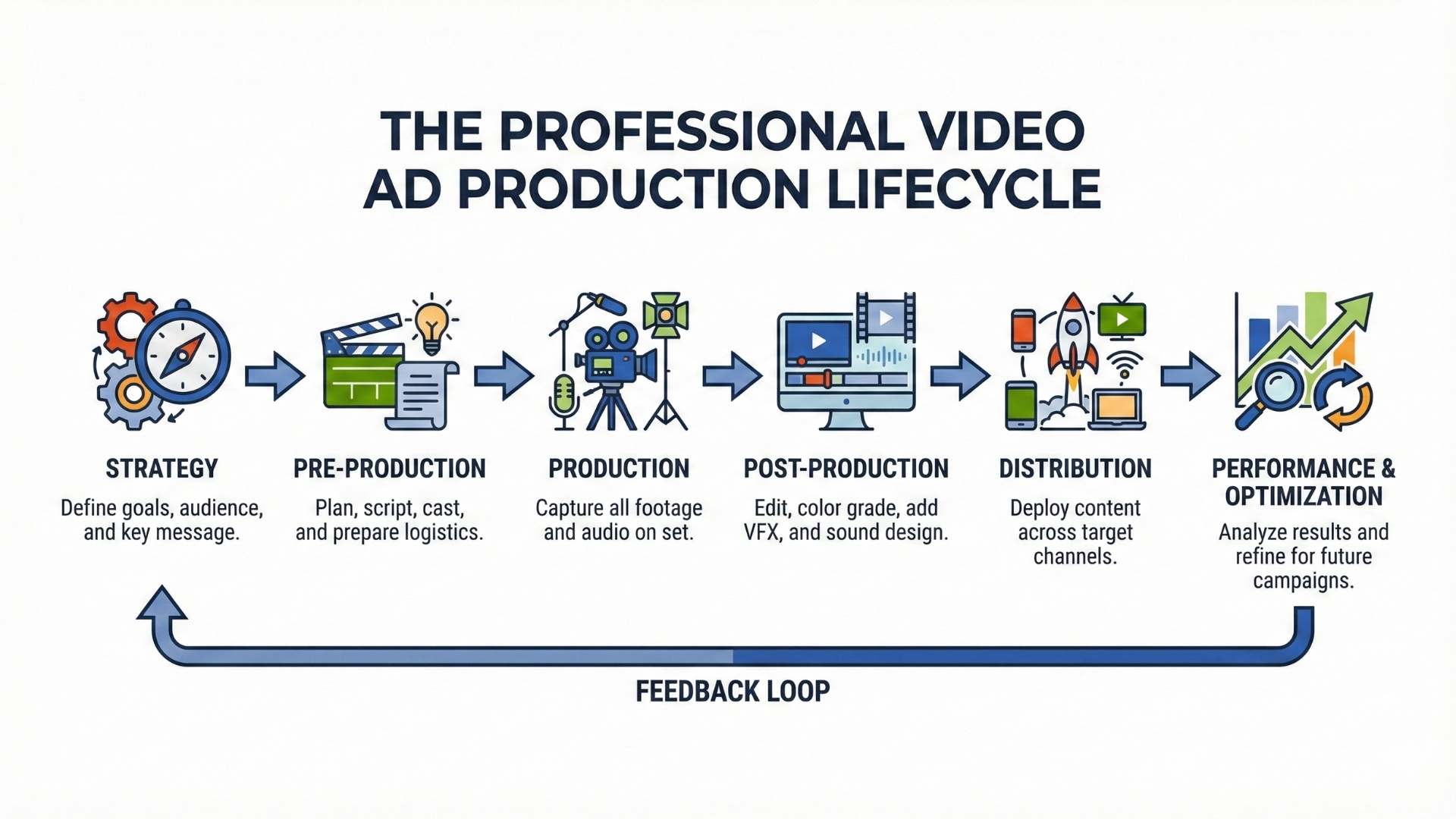 Strategic Foundations
Business Objectives and Funnel Alignment
Every video asset should begin with a clearly defined business objective. Whether the goal is top-of-funnel awareness or last-click conversion, creative decisions must align with where the viewer sits in the customer journey and what the business is trying to achieve.
That objective determines critical production choices, including:
- Creative approach and tone
- Runtime and pacing
- Narrative structure
- CTA design
Performance creative only works when it is anchored in strategy. A 6 second bumper built ad for brand recall will be structured very differently from a 60 second direct-response asset optimized for conversion, and each must ladder into broader campaign goals rather than exist in isolation.
Audience Research and Targeting Strategy
A technically sound production without a matching audience strategy is wasted effort. Sophisticated audience segmentation, behavioral, contextual, or psychographic, should directly inform tone, casting, messaging, and ad length. Personalization at scale only works when creative teams understand and apply segmentation logic from the start.
Early audience decisions typically include:
- Segmentation model (behavioral, contextual, psychographic)
- Level of addressability (deterministic vs. probabilistic)
- Degree of creative specificity versus broad resonance
These upstream choices shape far more than media strategy. They influence how assets are structured, how many versions are required, how production days are planned, and how post-production workflows are designed to support scalable personalization.
Media Platform Considerations
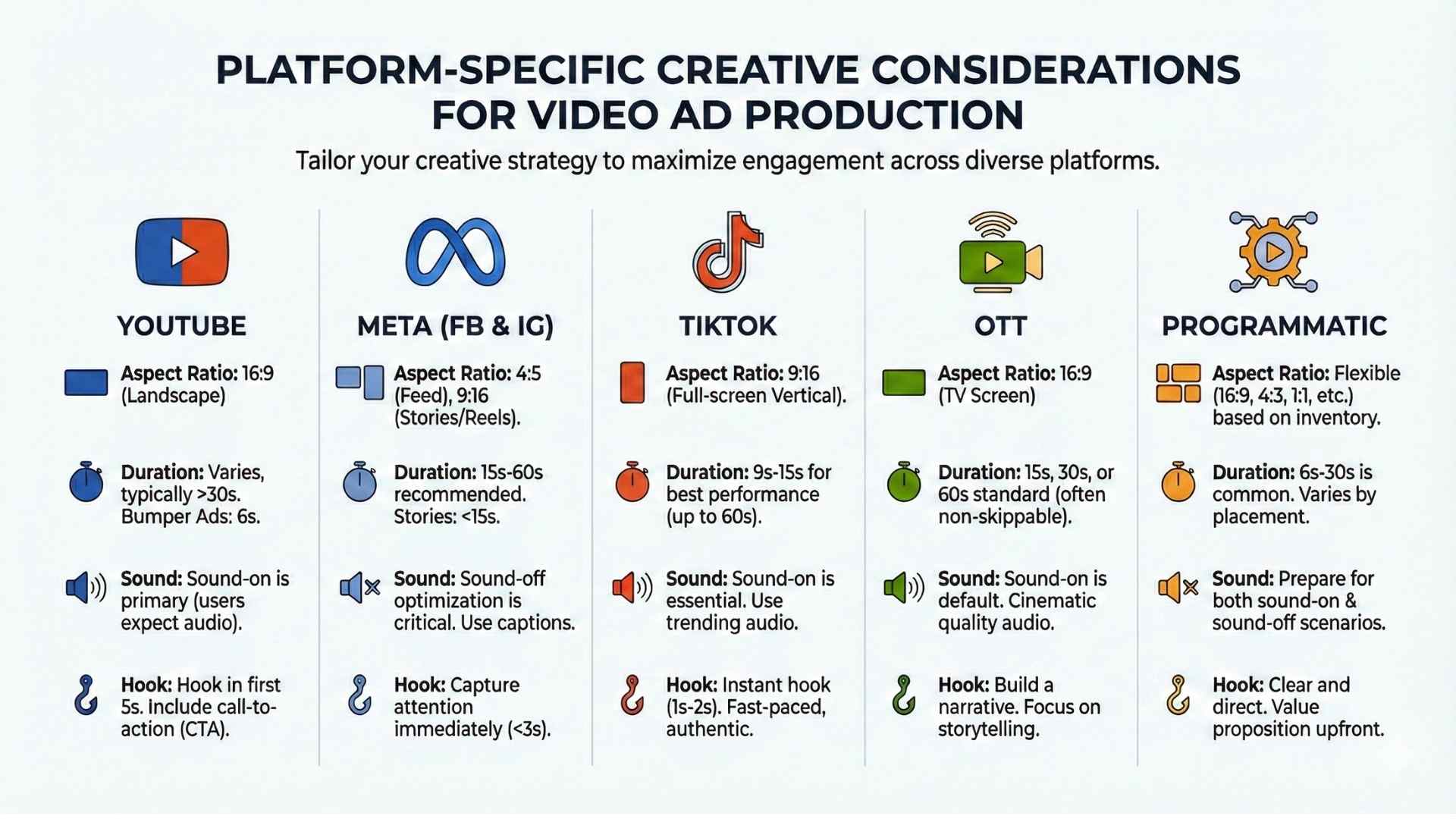
Every platform imposes constraints and opportunities that creative and production teams must consider early. Meta’s autoplay-without-sound environment has different narrative implications than YouTube pre-roll, where users expect and tolerate longer ads. TikTok, with its native-first aesthetic, has its own language and norms that dictate the rhythm, casting, and visual grammar of your video.
It’s not enough to shoot once and crop. The top 5 considerations I run through when planning cross-platform assets include:
- Aspect ratio (16:9 vs 1:1 vs 9:16)
- Duration constraints per placement
- Text-safe zones and burned-in captions
- Sound-on vs sound-off environments
- Engagement expectations (passive scroll vs active opt-in)
Planning for these from pre-production saves hours of versioning and prevents compromised storytelling later.
Regulatory and Brand Safety Constraints
If you’re producing ads in regulated sectors like healthcare, finance, education, or eCommerce, compliance must be built into creative planning. This includes early legal review, proper disclosures, substantiated claims, and ensuring regulations like GDPR or COPPA guide both targeting and content.
Brand safety is equally critical on UGC-heavy platforms. This may require network pre-clearance or strict alignment with platform ad policies. Teams should be trained to identify risks like unlicensed music or unsupported medical claims before assets are flagged mid-campaign.
Pre-Production Planning
Creative Development
The creative brief is the most undervalued asset in high-performance ad production. An effective brief connects strategy, insights, and execution. It defines not just messaging but tone, references, mandatory inclusions, and creative constraints. If you can’t reverse-engineer your asset back to a strategic brief, something went wrong. At this level, briefs should come with reference cuts, audience personas, and even platform-specific creative considerations baked in.
Scriptwriting should be modular and built for performance. I structure ads with the following logic:
- Hook (first 3 seconds)
- Value proposition
- Social proof or demonstration
- CTA (direct or implied)
Storyboarding, moodboarding, and animatics are essential for client or stakeholder alignment. These tools help translate abstract concepts into visual direction, reducing friction on set and in post.
Casting and Talent Strategy
Casting choices carry weight far beyond aesthetics. For performance-focused campaigns, we often prioritize relatability and authenticity over traditional beauty standards. That might mean leaning into UGC-style spokespersons or recruiting real users instead of actors. On higher-budget shoots, SAG-AFTRA vs. non-union decisions influence budget, rights usage, and turnaround times.
Casting intersects with diversity and inclusion. For global campaigns, I work with cultural consultants to avoid tokenism or bias. For long-running ads, talent usage rights must be clearly defined by geography, platform, and duration to prevent legal disputes or takedowns.
Location Scouting and Permits
Shooting on location introduces a number of variables, lighting, sound, pedestrian traffic, and legal exposure. I always advocate for location scouts with the DP and producer present, and I work with location managers to ensure permits, insurance, and liability waivers are secured. Urban shoots in high-traffic areas require even more lead time and coordination with city film offices.
In some cases, a hybrid approach works best: build controlled sets that mimic natural environments, allowing for consistent lighting and audio while minimizing external risks. This is especially valuable when time is constrained and the creative must be replicated across multiple regions or talent groups.
Budgeting and Scheduling
A well-scoped budget isn’t just about estimating line items. It’s a strategic tool to inform what’s possible in production. Every producer should build three tiers of budget scenarios: ideal, conservative, and contingency. These are not static documents. They should evolve as casting decisions, locations, and deliverable lists solidify. Build in buffers for revisions, reshoots, or licensing shifts.
On the scheduling front, I push for master calendars that align scripting, shooting, post-production, and delivery with the media launch date. This ensures no part of the process becomes a bottleneck. Using cloud-based tools like StudioBinder or Wrike for scheduling allows for better visibility across departments and external partners.
Production Execution
Crew and Equipment
Every shoot hinges on crew chemistry and format-specific experience. Social-first productions require different instincts than traditional commercial work, making role clarity and early access to scripts and treatments essential for smooth execution.
Key decisions include:
- Crew experience aligned to the format
- Clearly defined on-set roles
- Camera selection based on budget and delivery needs
- Codec choice balancing quality, post time, and storage
Camera systems should serve speed and scale. While ARRI and RED remain industry standards, compact options like the Canon C70 are increasingly favored for fast-turnaround content without sacrificing performance.
Lighting and Sound
Lighting and sound decisions must match the type of content being produced. Cinematic work relies on motivated lighting and depth, while eCommerce or product content requires high-key setups with clean detail. Locking lighting diagrams in pre-production is essential when running multiple setups on tight timelines.
Key technical considerations include:
- Content-specific lighting approach
- Pre-approved lighting diagrams
- Professional location sound with lav and boom redundancy
Sound issues can undermine even the best visuals. Real-time audio monitoring and advance planning for noisy environments or post-production pickups help protect quality without slowing down production.
Live Action vs. Motion Graphics/Animation
Choosing between live action and animation comes down to audience, timeline, and message complexity. Live action excels at emotional resonance and human connection, while animation is ideal for abstract ideas or iterative product features. Some campaigns benefit from a blend, a live spokesperson integrated into an animated explainer.
If animation is chosen, we define the visual style early, whether 2D vector or 3D realism, to match brand tone. For execution, tools like After Effects, Cinema 4D, and Blender are part of the standard stack. Production timelines for animation can be longer, so I build extra review time into our delivery windows.
Remote/Virtual Production Considerations
Remote production isn’t a COVID-era holdover; it’s become an operational necessity. I’ve run shoots where the agency, client, and even the director were remote, with real-time feedback via Evercast and frame-specific annotation using Frame.io. This reduces travel costs and enables faster decision-making.
Virtual production is also rising, especially for branded content and automotive ads. LED volume stages and Unreal Engine allow for photoreal environments without the overhead of travel. While setup costs are still high, the flexibility and speed are game-changing for teams with recurring campaigns or localization needs.
Post-Production Process
 Post-Production Process
Editing Workflow
Post-production begins with clear media management. Every project we run uses a standardized folder structure and proxy workflow. Editors receive labeled bins, organized by scene, slate, or camera, and a clear edit brief with the narrative arc. For performance-focused work, I build modular timelines with interchangeable sections for faster testing later.
We define narrative structure before editing. YouTube often uses a strong hook followed by branding, proof, and CTA, while Meta performs better with early product benefits and motion. Premiere Pro and DaVinci Resolve handle editing and color, with Frame.io supporting collaborative reviews.
Color Grading and Visual Consistency
Color grading shapes emotional tone, brand consistency, and compliance, not just aesthetics. We create custom LUTs for recurring clients to maintain continuity. In performance ads, clarity and product accuracy matter most, but thoughtful grading still boosts engagement.
We also follow delivery specs carefully. Color spaces like Rec.709 or P3 must be respected, especially for broadcast or CTV. On platforms like YouTube or TikTok, mismatched profiles can cause shifts, so we QC across multiple devices, especially mobile.
Audio Post
Audio mixing and mastering typically run through multiple passes. The process starts with dialogue cleanup, EQ, compression, and de-noising, followed by voiceover treatment and music placement. Mixes are checked in both mono and stereo to ensure clarity across devices and platforms.
Key audio standards and practices include:
- Platform-specific loudness targets (-14 LUFS digital, -23 LUFS EBU R128 broadcast)
- Mono and stereo compatibility checks
- Retaining audio stems for rapid reversioning
Licensing is equally critical. Royalty-free does not guarantee proper usage rights across platforms or regions. For long-running campaigns, original composition often offers greater emotional control and long-term flexibility than stock music libraries.
Localization and Versioning
When campaigns scale globally, versioning becomes a production pipeline of its own. Subtitles and voiceover must be professionally translated and localized for cultural nuance, not machine-generated. Transcreation ensures that humor, idioms, and CTA phrasing remain effective while preserving brand intent across markets.
Effective global versioning typically accounts for:
- Professional translation and transcreation
- Language-specific review and approval workflows
- Centralized asset libraries for version control
- Visual adjustments for regional sensitivities (wardrobe, settings, color symbolism)
Localization cannot be an afterthought. Planning for regional variables during scripting and pre-production reduces asset sprawl, minimizes compliance risk, and results in a more efficient, scalable global rollout.
Platform Optimization
Deliverables must match both technical and strategic specifications. A 60-second YouTube TrueView pre-roll and a 15-second Instagram Reel are not just different in length but in format, pacing, and framing. We create deliverable matrices by platform, including:
- Aspect ratio
- Duration
- File size limits
- Safe zones
- Format (e.g., MP4, ProRes, etc.)
For campaigns using dynamic creative optimization (DCO), we also deliver assets in modular form: opening hooks, product shots, CTAs, and VO lines as swappable layers. This allows media teams to run permutations without new edits. Clear file naming conventions and metadata tagging are mandatory for this level of scale.
Distribution and Delivery
Ad Ops and File Delivery
Handing off final assets to media teams isn’t as simple as uploading to Dropbox. Each platform has distinct requirements, and many campaigns involve dozens of assets, each with variants for language, platform, and audience. We build ad delivery kits with:
- Master assets (HQ files)
- Compressed assets (platform-ready)
- Thumbnail images
- Scripts and captions
- Usage rights documents
For high-volume campaigns, we use ad ops platforms like Jivox or Celtra that integrate directly with DSPs. These allow for auto-tagging, bulk uploads, and structured naming. I always schedule buffer time post-delivery for last-minute re-exports or compliance flags.
Integration with Media Buying
Creative must work hand-in-hand with media from the outset. Asset mapping should align with media strategy on day one, defining which creative serves which audience, on which platform, and at what stage of the funnel. This alignment allows runtime, CTA tone, and visual approach to be decided during production, not retrofitted later.
That integration typically includes:
- Asset-to-audience and platform mapping
- UTM, A/B, and variant naming conventions
- Flight schedules and delivery logic
- Programmatic decision trees based on signals like scroll behavior, location, or product affinity
When creative and media teams operate in a tight feedback loop, campaigns become more agile. The result is faster optimization, cleaner performance data, and creative systems that scale efficiently across platforms and audiences.
A/B Testing Infrastructure
Testing is not a luxury; it’s a necessity. But to get statistically significant results, you need testing baked into the campaign architecture. That starts in post. We export creative variants with specific hypotheses: hook order, CTA placement, music type, VO gender, etc. Each is tagged for performance tracking in-platform.
Testing should not be random. I define control and variables clearly for each test, and run it long enough to eliminate noise. For multivariate testing, we often use tools like Google Ads Experiments or TikTok Creative Center to monitor drop-offs and engagement deltas in real time.
Performance Analytics and Optimization
Creative Metrics Analysis
We don’t just look at CTR or impressions. True performance analysis examines engagement curves, drop-off points, and brand lift signals. On YouTube, for instance, we study:
- Hook retention (first 3–5 seconds)
- Absolute retention at CTA
- Clickthrough segmentation by device
In Meta Ads Manager, we focus on thumb-stop ratio, hold duration, and outbound CTR. All of this is fed back into a creative performance dashboard we maintain for our clients. When available, we pair platform data with first-party site behavior to track on-site conversion post-ad exposure.
Attribution Models and Limitations
Attribution is a persistent challenge. While last-click still dominates, it rarely reflects true influence. We use multi-touch attribution (MTA) when possible, and media-mix modeling (MMM) for large-scale clients with offline conversion paths. Each has its flaws, MTA is limited by cookie deprecation, MMM can be too coarse.
Privacy changes (like Apple’s ATT) have further weakened attribution chains. That’s why we push clients toward holistic measurement, using brand lift studies, geo-lift experiments, and CRM matchbacks where possible. Attribution is never perfect, but triangulating from multiple signals gives us a clearer picture of creative impact.
Creative Refresh Cadence
Ad fatigue sets in faster than many clients expect. On Meta, performance creatives can begin to fatigue within 4–5 days, making weekly refresh cycles essential. To support this pace, creative assets should be designed as modular systems that allow hooks and CTAs to be refreshed without rebuilding everything from scratch.
Common fatigue signals and refresh levers include:
- Declining CTR
- Rising CPMs
- Flat or falling ROAS
- Updating the opening 3 seconds
- Swapping CTA copy or voiceover
- Adjusting edit rhythm or pacing
Refreshing creative doesn’t always require a re-shoot. With pre-planned B-roll coverage and alternate VO takes, teams can streamline updates in post-production and maintain performance without disrupting production timelines.
Scaling Video Ad Production
In-House vs. Outsourced vs. Hybrid Teams
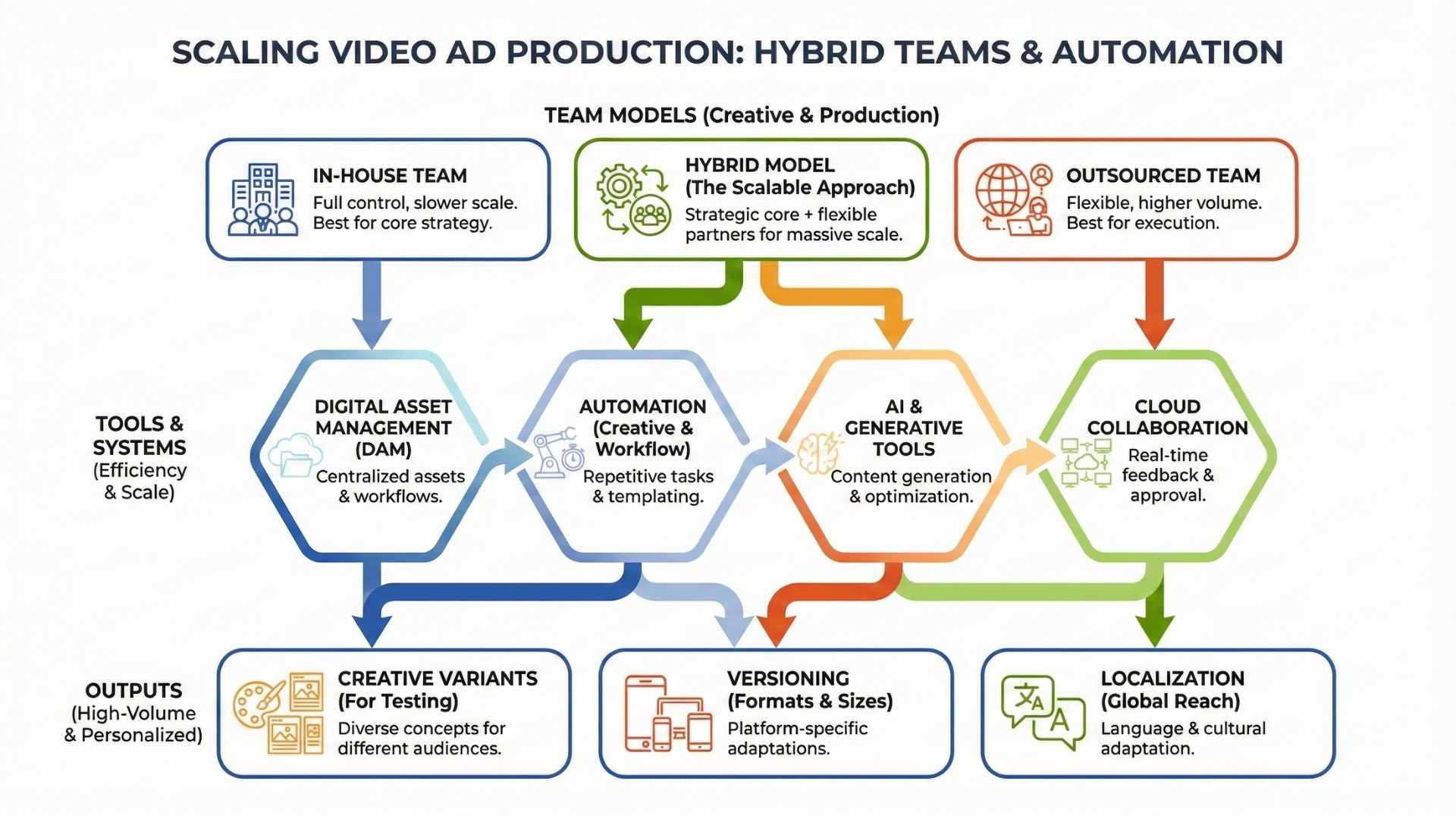
There’s no one-size-fits-all solution here. In-house teams offer speed and alignment, but they require significant investment in talent, gear, and process. Outsourced teams offer expertise and scale but often lack day-to-day brand intimacy. Hybrid models, where in-house manages strategy and post, and external teams handle execution, strike a balance.
I advise clients to evaluate based on:
- Frequency of creative needs
- Complexity of assets
- Internal approval velocity
- Media budget to production budget ratio
If you’re running multiple campaigns per month, consider building an in-house studio with a lean freelance bench to support overflow.
Systems and Automation
Scalability is not just about headcount, it’s about systems. We automate repetitive processes using tools like:
- Premiere Productions for shared editing environments
- Adobe Team Projects for collaborative post
- Airtable for asset tracking and version control
DAM (digital asset management) systems like Frame.io or Bynder help maintain asset libraries across regions and brands. For large clients, we’ve built DCO (dynamic creative optimization) pipelines where templates are auto-populated with different VO, text, and B-roll for hundreds of variants.
Managing Brand Consistency Across Variants
With creative versioning at scale, brand consistency can suffer. We solve this through creative QA checklists, brand-specific LUTs and SFX packs, and centralized brand guidelines accessible to all vendors. Every variant is reviewed against tone, messaging, and visual fidelity.
We also establish internal reviewers who act as brand guardians, ensuring no asset drifts off-tone or off-message. For global campaigns, we build style guides that include region-specific adaptations without compromising core identity.
Emerging Trends and the Future of Video Ad Production
AI and Generative Video
AI is already changing how we work. We’re testing tools like Runway for text-to-video ideation, ElevenLabs for synthetic VO, and Descript for automated editing. While these tools aren’t yet replacing expert editors or directors, they’re enabling faster prototyping and versioning at lower cost.
We also use AI for script suggestions, subtitle generation, and facial tracking for automated compositing. The risk, of course, is brand dilution, so we deploy AI inside tight creative frameworks, not as a free-form solution. The technology is a force multiplier, not a substitute for strategy or taste.
Shoppable Video and Interactive Formats
Video is becoming transactional. Platforms like Instagram, TikTok, and Amazon now enable native checkout directly from video ads, requiring tighter integration between product feeds, creative execution, and landing environments. To drive engagement and conversion, interactive elements must be designed directly into the video experience.
Common transactional video elements include:
- Clickable product hotspots
- Live countdown timers
- Interactive polls or prompts
The production challenge is largely technical, syncing inventory with visuals, tracking in-player interactions, and measuring post-click attribution. Despite the added complexity, shoppable video is already delivering stronger ROAS than static formats for many eCommerce brands..
Privacy-Driven Creative Strategy
As targeting shrinks due to privacy regulation, creative has to pick up the slack. We’re seeing a return to broad storytelling and psychographic targeting. Instead of relying on granular behavioral data, we’re building narratives that resonate universally or by context, using cultural references, situational humor, or shared pain points.
Contextual targeting is also making a comeback. We’re aligning creative with the environment where the ad will appear: pairing calm meditative videos with wellness apps or energetic testimonials with fitness content. The shift demands smarter upfront creative strategy and tighter media alignment.
Sustainability in Production
Sustainable production is no longer optional. Brands and agencies are increasingly adopting green practices, from minimizing travel and on-set waste to using digital sets and virtual production. Working with vendors that track and offset carbon emissions, and making practical shifts like LED lighting and battery-powered gear, can significantly reduce environmental impact.
Common sustainability practices include:
- Reducing travel and on-set waste
- Using digital sets or virtual production environments
- Partnering with vendors who track and offset carbon output
- Switching to LED lighting and battery-powered equipment
Sustainability also drives operational efficiency. Consolidating shoots to capture assets for multiple platforms in a single cycle lowers costs, increases output, and supports broader ESG commitments without compromising creative quality.
Final Thoughts
Video ad production today requires mastery across disciplines. It’s not just about craft. It’s about integrating strategy, creative, operations, compliance, and analytics into a seamless workflow that drives real performance. Our job isn’t simply to make videos. It’s to solve business problems through highly tuned, scalable, and measurable storytelling.
I’ve built this guide to share what works, not just in theory but in practice. Whether you’re scaling an in-house team, refining your vendor processes, or rethinking your creative pipeline, I hope this serves as a reference point and catalyst. The best producers aren’t just makers. They’re architects of systems, translators of strategy, and stewards of brand impact. That’s what this craft truly demands.
Unlocking the Future of Video Advertising with LocalEyes
 Unlocking the Future of Video Advertising with LocalEyes
Everything outlined above reflects how we approach video ad production every day at LocalEyes. What is new is how intentionally we are unifying strategy, production, and performance into a single, scalable system for our clients. As an Emmy Award–winning production company with a national footprint, we are not just producing high-quality video. We are building performance-ready creative frameworks that align with media strategy, platform behavior, and real business outcomes.
With more than 3,900 videos produced for over 300 clients, and recognition as one of Inc. 5000’s fastest-growing companies for three consecutive years, we have seen firsthand that the difference between a good video and a high-performing video is process. Our teams across the country collaborate using standardized workflows that support modular creative, rapid versioning, localization, and testing at scale. This allows us to deliver video assets that are not only beautifully crafted but also engineered to adapt, optimize, and perform across channels.
If your organization is ready to move beyond one-off video projects and toward a smarter, more integrated approach to video advertising, we would love to talk. Reach out to LocalEyes to explore how our nationwide production capabilities and performance-driven mindset can support your next campaign and help turn video into a true growth engine.

Founder at LocalEyes Video Production | Inc. 5000 CEO | Emmy Award Winning Producer