- YouTube functions as a search and recommendation engine where corporate performance depends on optimizing discovery, retention, and session watch time signals.
- Corporate YouTube success requires mapping every video to a funnel stage and optimizing keywords, metadata, thumbnails, and structure to match viewer intent.
- Scalable YouTube performance relies on governance, analytics integration, localization workflows, and coordinated paid–organic strategies tied to business KPIs.
When companies treat YouTube as a true performance channel, the gains can be exponential, not incremental. Yet, many organizations fall into the trap of treating it like a dumping ground for videos instead of optimizing it as a high-value owned platform. YouTube is not just a place to host videos. It is a dynamic search engine, a recommendation engine, and an algorithmically-driven discovery platform. Understanding how all of those functions work together is the difference between visibility and irrelevance.
What sets corporate YouTube optimization apart from individual creator strategy is scale, governance, and integration. We’re not just optimizing for a single video to go viral. We’re aligning dozens, sometimes hundreds of assets, across global markets, to support product launches, campaigns, and long-tail discoverability. Our job is not only to hit KPIs, but to build a system where the platform works with us, surfacing the right content to the right audience at the right time.
Content Strategy Mapping to the Marketing Funnel
Funnel Alignment for Video Content
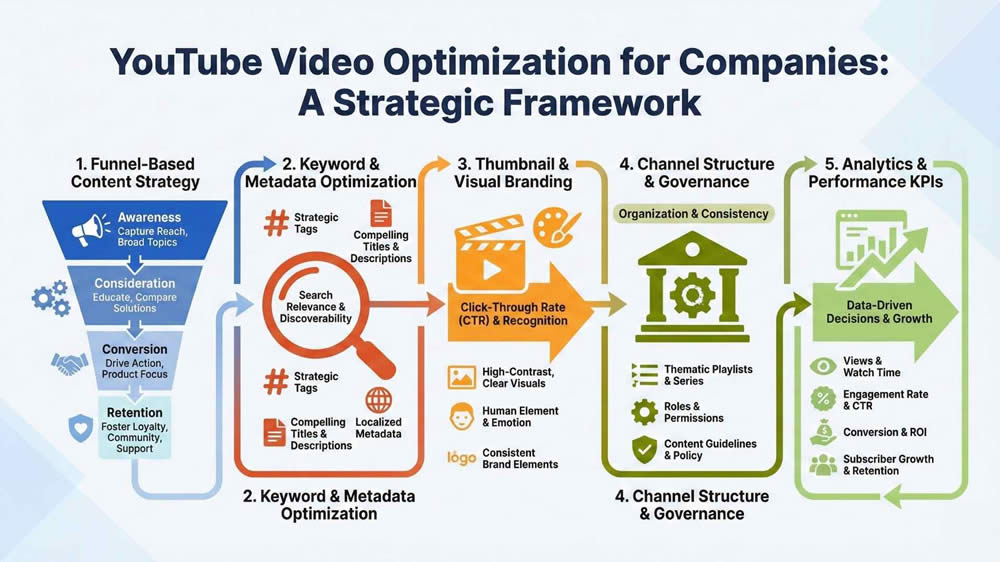
Every video published on a company channel should serve a defined purpose and align with a specific stage of the customer journey. Broad awareness content has different goals, formats, and optimization strategies than middle- or bottom-of-funnel assets. Mapping content correctly across the funnel ensures each asset is pulling its weight and contributes to strategic outcomes rather than serving as passive collateral.
To make this actionable, I typically recommend defining content categories along the following lines:
- Awareness: Brand storytelling, company culture, thought leadership
- Consideration: Product walkthroughs, webinar excerpts, use cases
- Conversion: Tutorials, pricing breakdowns, product comparisons
- Retention: Support videos, update briefings, customer community highlights
This framework helps avoid publishing random, disconnected videos and ensures every upload fits into a strategic narrative. When we approach optimization with funnel logic in mind, we can tailor metadata, scripting, and promotion tactics accordingly.
Video Purpose Drives Optimization Tactics
Optimizing a product demo video is a completely different exercise from optimizing a CEO thought-leadership clip. Each serves a different function in the buyer journey and therefore has distinct requirements. For instance, a top-of-funnel video should prioritize CTR and discoverability, while a retention video might focus on in-video navigation and clarity.
By tagging content internally with its funnel stage and strategic objective, we gain the ability to A/B test performance patterns, create better reporting structures, and improve cross-functional alignment. A well-labeled YouTube content library becomes a strategic asset rather than just a list of uploads.
Advanced Keyword Research & Intent-Based Targeting
Understanding Viewer Intent on YouTube
YouTube search intent behaves differently than traditional web search. Instead of text-heavy information seeking, users often look for visual explanations, reviews, or solutions to immediate problems. For companies, this means keyword research must reflect the visual format and intent of the user; simply targeting high-volume terms from Google won’t work, especially without a clear video SEO plan.
I break down YouTube search intent into categories like:
- Instructional (“how to”)
- Comparative (“best CRM for enterprise”)
- Exploratory (“what is zero trust security”)
- Branded (“[company name] onboarding”)
Using tools like Ahrefs (with YouTube filters), TubeBuddy, and Google Trends with YouTube selected as the search engine, we build a multi-tiered keyword strategy. We also study autosuggestions on YouTube itself to identify long-tail variants that competitors may be ignoring.
Keyword Clustering and Content Architecture
Once we identify the right intent types, we group keywords into clusters around central topics. For example, in a cybersecurity channel, we might form a cluster around “zero trust” with supporting videos on “zero trust architecture,” “zero trust vs perimeter,” and “zero trust policy implementation.” This allows the channel to gain authority and internal interlinking strength around a subject.
Clustering also supports playlist design and series formatting. We’ve seen measurable gains in suggested video exposure and session watch time by aligning videos under a clear topical umbrella. Each cluster can then be linked in descriptions, cards, and end screens to create a self-reinforcing content network.
Metadata Optimization at Scale
Crafting Titles, Descriptions, and Tags
Titles must strike a balance between human appeal and keyword inclusion. Over-optimization leads to unnatural phrasing, while vague titles tank CTR. My rule is to place the main keyword toward the beginning, followed by a curiosity-driven hook. For example: “Zero Trust Architecture Explained | Why Enterprises Are Rebuilding Their Networks”.
Descriptions offer real estate to reinforce keyword relevance and provide value. We structure descriptions with:
- A strong summary in the first 200 characters
- Timestamps and chaptering for usability
- Relevant links to product pages, CTAs, or companion content
- Semantic keyword variants for SEO richness
Tags still matter, although their influence is now marginal. I use them to support metadata relevance and help classify the video within YouTube’s internal taxonomies.
Operationalizing Metadata for Enterprise Scale
For companies publishing content regularly or across business units, metadata needs standardization. We create metadata templates that include placeholders for:
- Primary and secondary keywords
- Brand taglines
- UTM-encoded links
- CTA variations based on video type
This reduces friction and ensures consistency. Metadata governance becomes a function of your publishing SOP, with checks built into the QA process. Without it, even technically good content can underperform due to messy or inconsistent optimization.
Thumbnail Engineering and CTR Optimization
Designing for Visual Impact
Thumbnails are often the single biggest factor affecting CTR. A compelling thumbnail stops scrolling, communicates value instantly, and aligns with the tone of the video. I work with designers to build templates that account for:
- High contrast visuals with clean subject-background separation
- Facial expressions that evoke curiosity or urgency
- Minimal text overlays that amplify, not duplicate, the title
- Brand elements used subtly for recognition, not distraction
Incorporating these factors has consistently increased CTR by 20-50% in our campaigns. We also design with mobile users in mind, since over 60% of views come from mobile devices where thumbnails appear small.
Testing and Governance of Thumbnails
YouTube does not allow native A/B testing for thumbnails, but third-party tools like TubeBuddy make it possible to rotate variants and compare performance over time. We set up thumbnail experimentation as part of campaign launches and revisit underperforming assets monthly for refresh.
For enterprise teams, we recommend creating:
- A thumbnail design system across video types
- A central repository of visual assets and layouts
- A naming and storage convention that supports version tracking
Without governance, thumbnails become inconsistent, off-brand, or ineffective. With the right systems in place, they become powerful brand and performance drivers.
Channel Architecture and Governance
Structuring for Discoverability and Scale
Your YouTube channel’s architecture should function like a content hub, not a chaotic feed. We organize channels with featured playlists, content series, and pinned welcome videos. The goal is to guide users toward specific paths while also signaling relevance to YouTube’s algorithm.
Key elements we optimize:
- Channel keywords and About section
- Visual consistency in thumbnails and headers
- Playlist organization by theme, product, or funnel stage
- Featured video for new and returning users
This structure improves session duration and user experience, both of which influence algorithmic favorability.
Governance and Multi-Team Coordination
For companies with multiple divisions, regions, or product lines, the biggest risk is fragmentation. I’ve worked with brands where four departments uploaded similar content to different channels with no coordination. The result? Diluted engagement, confused users, and lost subscribers.
We address this by implementing:
- A global-to-local channel governance model
- Defined roles and permissions through YouTube Brand Accounts
- A publishing calendar that tracks ownership and cadence
- Guidelines for naming, metadata, and thumbnail consistency
Governance doesn’t restrict creativity. It provides the clarity needed to scale video publishing in a coordinated, effective way.
Mastering the YouTube Algorithm
Understanding Algorithmic Signals
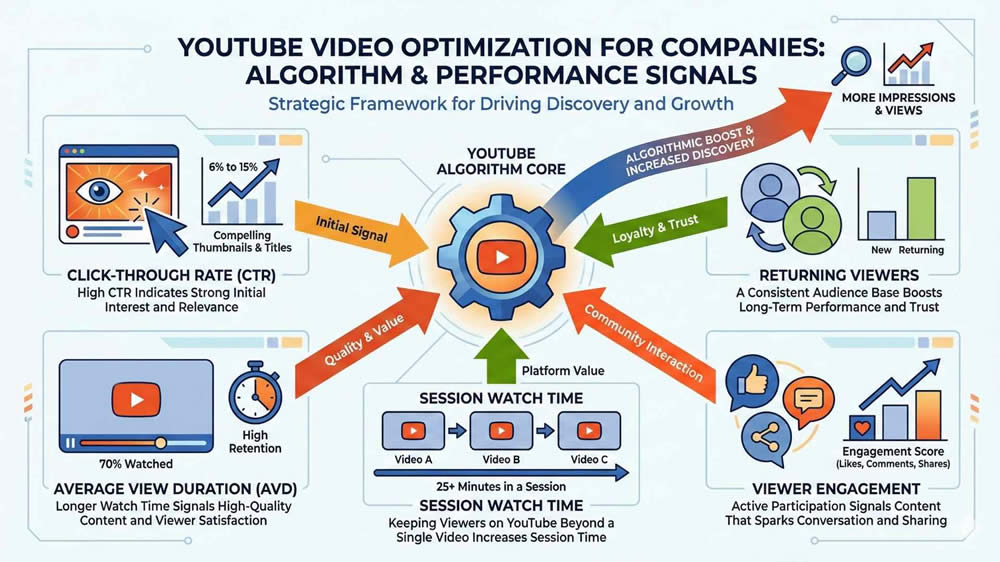
YouTube’s algorithm is no longer a mystery box; it’s a dynamic system built around user satisfaction signals. At its core, the platform optimizes for time spent on YouTube and user retention. For companies, this means we need to engineer video experiences that not only capture attention, but sustain and deepen it. The key performance indicators we target include:
- Click-through rate (CTR) on impressions
- Average view duration (AVD)
- Percentage viewed
- Returning viewer frequency
- Session start and extension behavior
While many brands obsess over views and subscriber count, those are lagging indicators. We focus on optimizing early engagement to trigger upward visibility trends. Videos that perform well within their first 24–48 hours are more likely to be recommended and surfaced in “Suggested Videos” or on the homepage.
Structuring Videos for Retention and Discovery
The first 15 seconds of any video are the most critical for retention. This is where we lose, or retain, up to 30% of viewers. I recommend starting with a strong value proposition, avoiding slow intros, and using high visual contrast to maintain attention. Even seemingly small decisions like when the presenter appears on screen or when animations start can materially affect the retention graph.
We also design for narrative structure:
- Hook: A clear and compelling preview of the content
- Value Delivery: Breakdown of the main points with pacing and visual support
- Engagement Prompts: Questions, comments, or mid-video CTAs
- Retention Mechanics: Teases of what’s coming next, pattern interruptions
- Exit Strategy: End screens that feed into related videos or playlists
By aligning this structure with algorithmic priorities, we create videos that both serve the audience and get rewarded by the platform.
Engagement Mechanics & UX Signals
Prompting and Structuring User Interactions
YouTube interprets user interactions as trust signals. High engagement, likes, comments, shares, and subscriptions send a message to the algorithm that the video is valuable. I script engagement cues into the content itself, not just at the end. These prompts can include:
- “Drop your experience in the comments.”
- “Which of these features would you use first?”
- “Hit subscribe so you don’t miss part two.”
These aren’t fillers, they’re performance tools. We use interactive elements like polls, end screens, and pinned comments to generate participation. Engagement drives retention. Retention drives visibility.
Enhancing Navigation and Flow
From a user experience standpoint, optimizing video flow reduces drop-off. We use cards to link to related videos right when contextually relevant. End screens are not randomly assigned, but chosen based on viewer intent. For example, if someone finishes a tutorial on feature A, the end screen should offer the deep dive on feature B, not the company promo reel.
We also prioritize:
- Clean and predictable transitions between video sections
- On-screen text for clarity
- Visual guides like progress bars or section titles
- Mobile-friendly formatting, especially for shorter videos
User signals tell us where we’re succeeding or failing. We read them, interpret them, and optimize accordingly.
Technical Video Optimization
Encoding and File Standards
Many companies overlook the importance of technical optimization, but this layer affects performance, playback quality, and even discoverability. For every client, we establish encoding standards that match platform preferences. The optimal combination includes:
- MP4 format with H.264 codec
- Constant bitrate encoding for consistency
- Resolution of 1080p or 4K (depending on use case)
- Frame rate maintained at source (usually 24, 30, or 60 fps)
We also recommend that file names include target keywords before upload. YouTube scans metadata during ingestion, and while it’s a subtle signal, every element contributes to the overall relevance score.
Accessibility, Captions, and Schema Integration
Accessibility optimization benefits both users and algorithms. We always upload custom SRT caption files to ensure accuracy and keyword alignment. Automatic captions often fail with industry-specific language, technical jargon, or non-native speakers.
Additional technical improvements include:
- Translated captions for multilingual markets
- Video schema markup on embedded pages to enhance SEO
- Audio normalization to avoid drop-offs due to volume spikes
- Thumbnail compression without sacrificing resolution
These technical layers rarely win attention in creative meetings, but they are foundational to scalable, high-performance video publishing.
Localization, Internationalization & Language Scaling
Strategic Localization for Global Reach
Companies operating in multiple countries face a unique challenge on YouTube: how to scale content while maintaining regional relevance. I don’t recommend simply translating captions and calling it a day. Effective localization includes:
- Language-specific metadata (title, description, tags)
- Adjusted thumbnails for cultural resonance
- Voiceover re-recording or subtitle timing edits
When done well, this increases watch time and retention in local markets. When ignored, content underperforms or generates poor engagement. Our goal is to treat each region as a high-potential micro-market within the YouTube ecosystem.
Structuring Channels and Assets for Scale
Depending on company size and market segmentation, we may opt for:
- A single global channel with multiple language tracks
- Regional sub-channels under a unified brand umbrella
- A hybrid model using playlists and metadata to segment content
Each approach requires governance, asset management, and performance tracking. We manage translation workflows using both in-house and AI tools, with manual QA to ensure accuracy. Content localization is not just a post-production step, it’s a strategic pillar.
Analytics, KPIs, and Performance Dashboards
Moving Beyond Vanity Metrics
Many stakeholders still measure YouTube success by views and subscribers. That’s a mistake. We focus on actionable performance metrics such as:
- Click-through rate (CTR) from impressions
- Average view duration (AVD)
- Retention curve drop-off points
- Returning vs. new viewers
- Playlist completion rates
These metrics reflect both algorithmic value and real audience engagement. For companies using YouTube as a performance asset, this data is essential to campaign planning, optimization, and reporting.
Custom Dashboards and Integrations
Native YouTube Studio is powerful, but limited in segmentation. For more robust insights, we pull data into:
- Looker Studio: For executive dashboards and trend lines
- Google Analytics 4: To track on-site conversion from embedded videos
- CRMs (like HubSpot or Salesforce): To link video views with lead scoring
We build UTM structures into video descriptions to support this tracking. This allows us to measure not just video performance, but business impact. The ultimate goal is to treat YouTube as a first-class funnel contributor, not just a content library.
Paid & Organic Video Interplay
Using Paid to Boost Organic Reach
Paid YouTube ads, when used strategically, can accelerate organic performance. For instance, we often launch key videos with a 7-day ad campaign targeting ideal buyer personas. This gives the video a spike in CTR and watch time, helping it earn placement in the Suggested and Browse features.
Paid campaigns can also:
- Re-engage viewers who didn’t convert
- Populate retargeting lists for lower-funnel campaigns
- Drive traffic to playlists or product launch sequences
- Test thumbnails, titles, or hooks in real-world environments
The synergy between paid and organic efforts is where companies see outsized returns.
Attribution and Post-Ad Optimization
It’s critical to separate ad-driven traffic from organic performance to avoid false attribution. We use view-through rate, skip rate, and watch time metrics to segment paid performance. Post-campaign, we analyze whether organic exposure increases, particularly on related videos.
A well-structured YouTube Ads campaign can act as an accelerant. But if the underlying video is weak, even the best targeting won’t save it. Paid is a multiplier of good creative, not a replacement for strategic content.
Content Repurposing & Distribution at Scale
Breaking Down and Repackaging Content
One video shoot should generate a content cascade. From a single 10-minute webinar, we can extract:
- A 2-minute summary for YouTube
- Five YouTube Shorts
- Quote images for LinkedIn
- An audio snippet for podcast intros
- An internal enablement clip for sales teams
The key is to plan for this in pre-production. Script with repurposing in mind. Shoot extra takes. Capture B-roll for cutdowns. With this approach, each piece of video content becomes a portfolio, not just a file.
Cross-Channel Syndication Strategy
YouTube is the anchor, but distribution should be multi-channel. We embed videos in blog posts, product pages, newsletters, and LinkedIn posts. Each format requires slight adjustments in thumbnail, format, or messaging, but the core asset remains the same.
We also track how each repurposed element contributes to funnel outcomes. Which variant drove the most email signups? Which Shorts had the best retention? Data from these touchpoints feeds back into our optimization strategy.
Workflow, Tooling, and Cross-Team Ops
Building Repeatable Systems
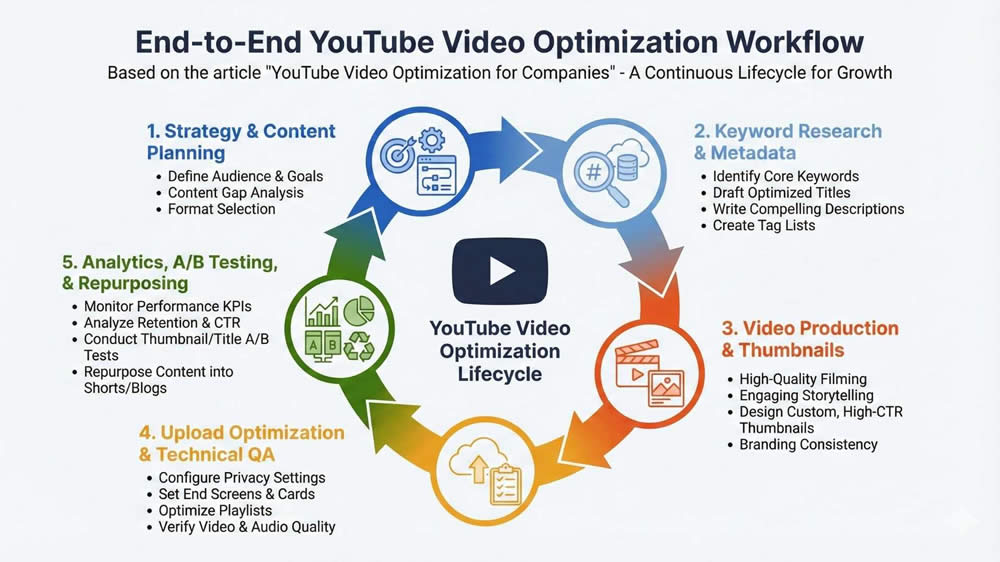
Consistency is what allows companies to scale. We document every step of the video process in SOPs. This includes:
- Pre-production checklists
- Metadata QA before upload
- Publishing calendars and approval flows
- Post-publish performance audits
With the right workflows in place, we reduce the chances of skipped steps, missed opportunities, or publishing errors. Every team member knows their role and responsibility at each stage.
Recommended Tool Stack for Enterprise YouTube Ops
Our preferred stack includes:
- Frame.io for creative review and feedback
- TubeBuddy or VidIQ for optimization workflows
- Looker Studio for visualization and KPI tracking
- Trello, Airtable, or Notion for task management
- Google Workspace for metadata templates and content planning
These tools enable distributed teams to collaborate in real-time, enforce standards, and maintain momentum. YouTube operations are cross-functional by nature, and your tools must reflect that.
Security, Compliance & Brand Control
Protecting Your Channel as a Strategic Asset
A corporate YouTube account is a critical digital property. Too often, it’s created casually and maintained without security protocols. We implement:
- Brand Account structure for shared access
- Two-factor authentication for all admins
- Scheduled audits of permission levels
- Backup access strategies and platform ownership reviews
This prevents issues ranging from accidental deletions to full account takeovers. Treat your channel with the same seriousness as your website infrastructure.
Compliance, Policy, and Crisis Management
Industries like finance, healthcare, and education face regulatory constraints. We embed compliance into the publishing workflow, including:
- Pre-approved disclosures and disclaimers
- Legal review of sensitive content
- Guidelines for using music, footage, or user-generated content
We also build rapid response protocols in case a video must be taken down or edited quickly. Having crisis management baked into the process ensures brand protection and regulatory compliance at all times.
Final Thoughts
Optimizing YouTube for a company is not a one-time task; it’s an ongoing system that blends creative, technical, and operational expertise. The brands winning on YouTube today are not simply creating content; they’re building engines for discoverability, engagement, and conversion. By aligning content strategy with funnel stages, mastering metadata and algorithm signals, and executing with precision at scale, we create a system where every video plays a defined role.
This is not just about getting more views. It’s about turning YouTube into a reliable, measurable, and high-impact channel for business growth. When we treat the platform as seriously as we do paid media or our website, it rewards us with reach, relevance, and long-term visibility.
About LocalEyes: Your Partner in Strategic Video Production
At LocalEyes, we understand that YouTube video optimization doesn’t start with uploading; it starts with strategy. That’s why, as a leading national video production company with over 3,900 videos produced for more than 300 clients, we don’t just create beautiful visuals. We craft video content designed to perform across platforms, with a strong emphasis on YouTube discoverability, retention, and conversion. Whether you’re launching a product, telling your brand story, or building out a video library for inbound marketing, our Emmy Award-winning team ensures every frame is built with purpose.
As the creators behind hundreds of high-performing corporate YouTube campaigns, we work hand-in-hand with your marketing, creative, and SEO teams to align production with platform requirements and business objectives. From our California HQ to our full-service offices in New York, Chicago, Austin, and beyond, we deliver enterprise-grade production with local agility. If you’re ready to turn your YouTube presence into a true business driver, not just a content archive, get in touch with us today. We’d love to help you optimize every step of the process, from scripting to post-production to performance.

Founder at LocalEyes Video Production | Inc. 5000 CEO | Emmy Award Winning Producer