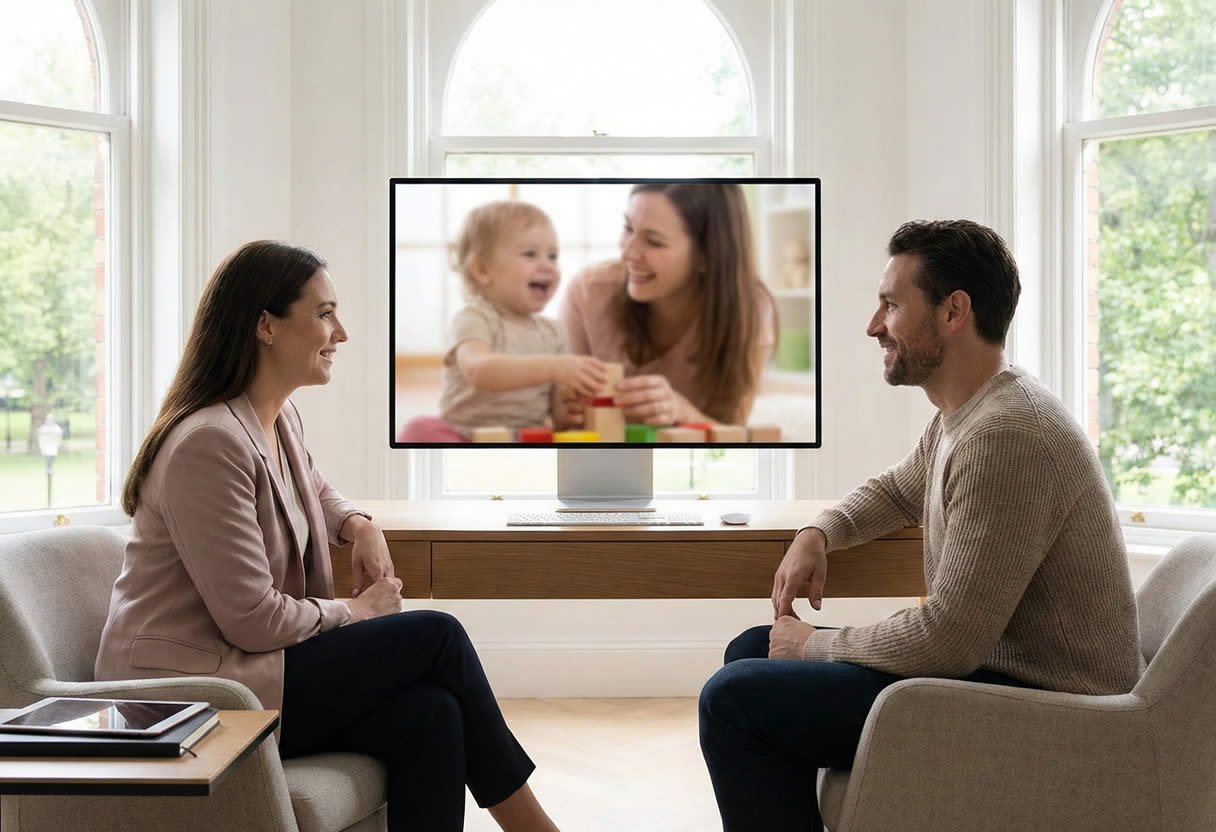
- Video Interaction Guidance (VIG) is a collaborative video-feedback method that enhances relational attunement by spotlighting moments of successful interaction.
- VIG is grounded in attachment theory and intersubjectivity, helping clients observe and internalize their capacity for emotional connection and responsiveness.
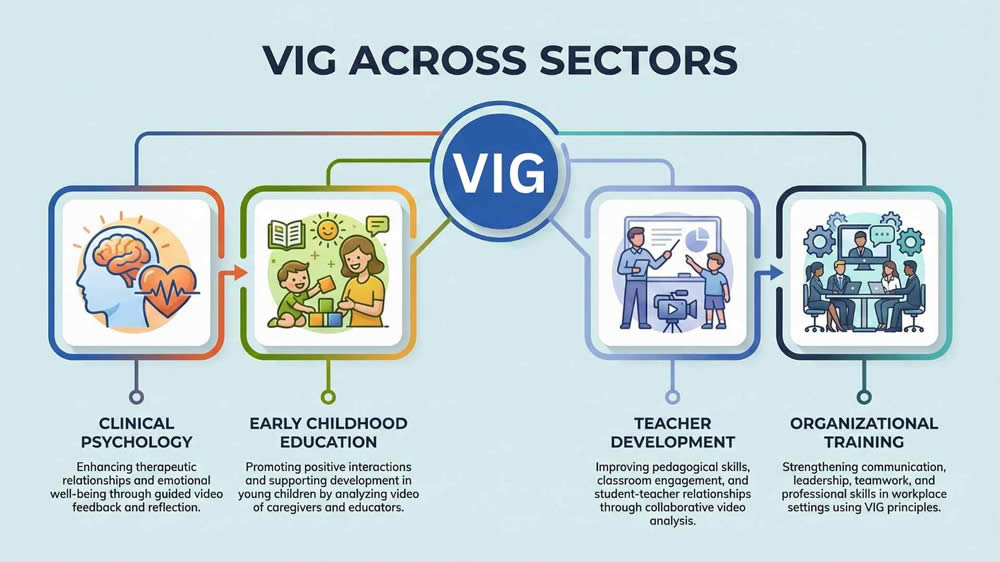
- VIG is used in clinical, educational, and professional contexts to develop reflective insight, improve communication, and strengthen interpersonal relationships.
Video Interaction Guidance (VIG) is a collaborative, strengths-based intervention that uses video feedback to enhance attunement in interpersonal relationships. Unlike deficit-focused models that target what’s going wrong, VIG zeroes in on what’s going right. The goal is to identify and magnify “better-than-usual” moments within naturally occurring interactions, helping clients develop a stronger internal working model of themselves as competent and connected.
As a professional working with children, families, and multidisciplinary teams, I’ve seen how VIG creates tangible relational shifts by anchoring reflection in real-life, emotionally resonant experiences. The video becomes a mirror, not of pathology, but of possibility. VIG fosters emotional insight and builds relational bridges, especially valuable in systems where communication is fragmented or compromised.
Theoretical Framework
Attachment and Intersubjectivity
Attachment theory underpins VIG, shaping both its rationale and observational focus. Drawing on John Bowlby and Mary Ainsworth, VIG highlights secure-base behaviour, responsiveness, proximity-seeking, and emotional regulation as they appear in selected interaction clips.
Building on this, VIG draws from Daniel Stern’s work on affect attunement and Trevarthen’s concept of primary intersubjectivity. The idea that humans co-construct meaning through relational rhythms is central to VIG. During shared reviews, we help clients recognize their capacity to emotionally connect, interpret cues, and engage in reciprocal interaction. This insight often penetrates more deeply than verbal explanation alone could achieve, reflecting why visual feedback is so powerful in relational learning contexts.
Developmental and Comparative Models
We cannot situate VIG meaningfully without looking at other video-feedback models or understanding how different approaches to video-based intervention shape reflection and meaning-making. While VIG shares philosophical DNA with approaches like VIPP (Video-feedback Intervention to promote Positive Parenting), Marte Meo, and Theraplay, it diverges in key ways:
- VIG is collaborative, not directive. The client co-constructs the learning.
- It emphasizes attuned interaction, not simply behavior change.
- It builds from strengths rather than correcting deficits.
VIG also borrows from Vygotsky’s concept of the Zone of Proximal Development (ZPD), using the guider as a relational scaffold to stretch the client’s reflective capacity. This is not just cognitive scaffolding; it is emotional and relational. We position the client to see, sometimes for the first time, that they are already capable of relational depth and precision.
VIG Process and Structure
The Cycle: From Filming to Review
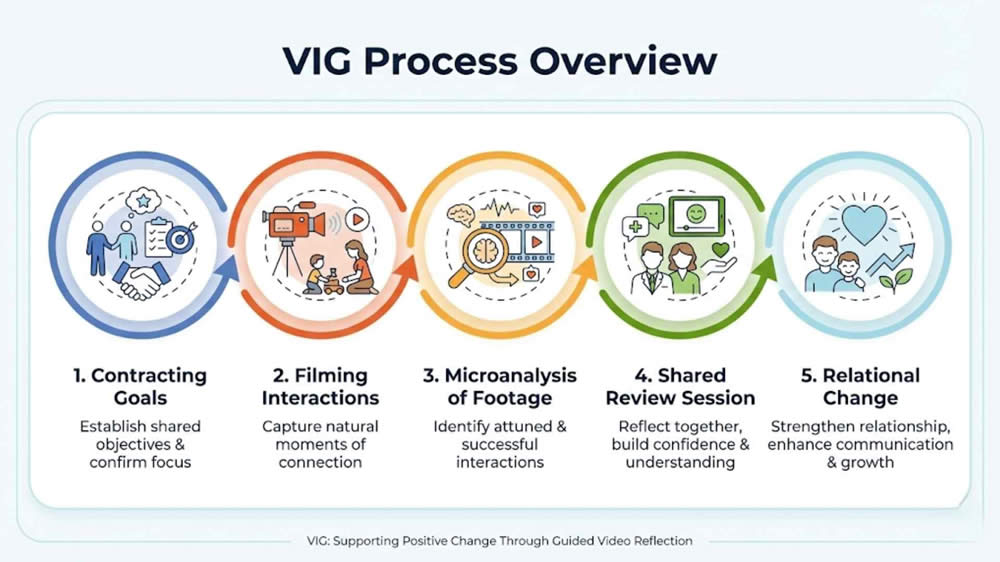
The structure of VIG follows a clearly defined cycle, adaptable across settings:
- Initial Contact & Contracting: Establishing the purpose of the work, setting client-led goals, and managing expectations.
- Filming: Capturing real interactions in natural settings such as the home, classroom, or clinic.
- Video Analysis: Selecting brief clips (20–90 seconds) that demonstrate attunement.
- Shared Review: Viewing selected clips with the client and engaging in guided reflection.
The magic happens during the shared review. When a parent, teacher, or professional sees themselves in an attuned moment, responding, holding space, connecting, it reconfigures their sense of self. The guider facilitates this experience without over-interpreting, allowing the video to speak for itself.
The Role of the Guider
Being a guide in VIG is less about providing answers and more about holding the reflective space. It requires clinical neutrality, emotional attunement, and timing. The guider does not direct the session but gently prompts the client to discover meaning:
- “What do you notice happening here?”
- “How did that moment feel to you?”
- “What do you think the child was experiencing right then?”
We operate as facilitators of insight. The guider must be trained and accredited, often progressing through stages (Trainee, Intermediate, Advanced). Supervision is not optional; it’s a core part of maintaining the relational integrity of the model. Through supervision, we reflect on our own biases, attachment patterns, and relational tendencies that may impact our practice.
Attunement Principles and Coding Framework
Understanding the Attunement Markers
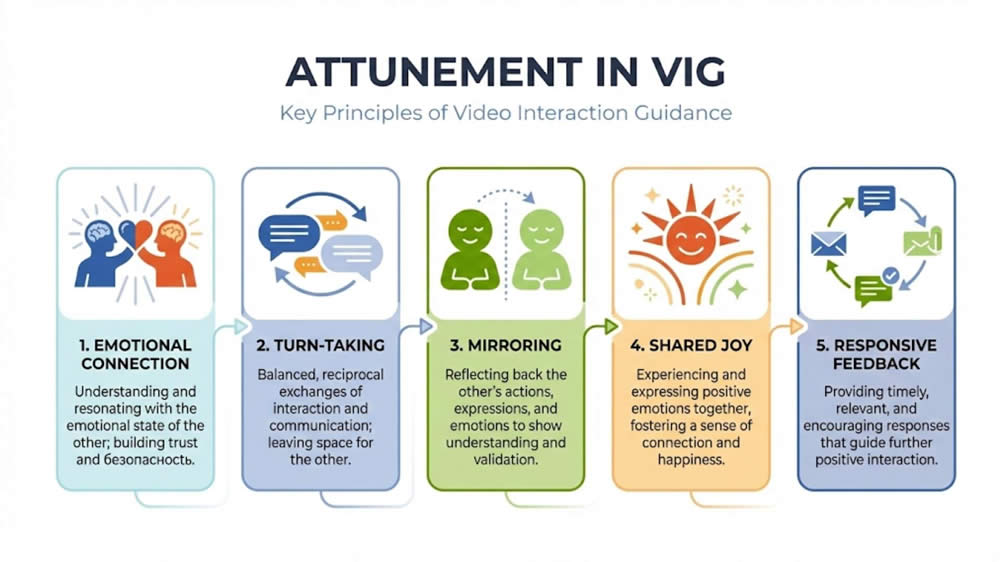
The attunement principles guide the selection of video clips and the structure of reflection. These principles are rooted in observable interaction behaviors that foster connection, including:
- Initiating contact with a warm tone and open body language
- Listening actively and responding promptly
- Encouraging cooperation and turn-taking
- Sharing affect, especially joy or curiosity
These principles are not abstract. They translate directly into observable behaviors such as eye contact, mirroring gestures, and matching emotional tone. The purpose is to help clients see and name these moments in their own interactions, anchoring future relational behaviors in real, embodied experience.
Microanalysis and Reflective Tools
Microanalysis is where theory meets precision. This phase involves:
- Watching footage multiple times, often in slow motion
- Analyzing nonverbal cues such as gaze, pauses, and facial expression
- Identifying sequences of interaction that display reciprocal engagement
We use tools like coding frameworks and attunement grids to organize our observations. These tools help maintain objectivity and ensure fidelity to the model. But they are not ends in themselves; they are springboards for reflective dialogue with the client. The selected clips are presented with care, often building from simpler to more complex examples to scaffold the client’s insight.
Technical Infrastructure and Methodology
Video Recording Standards and Protocols
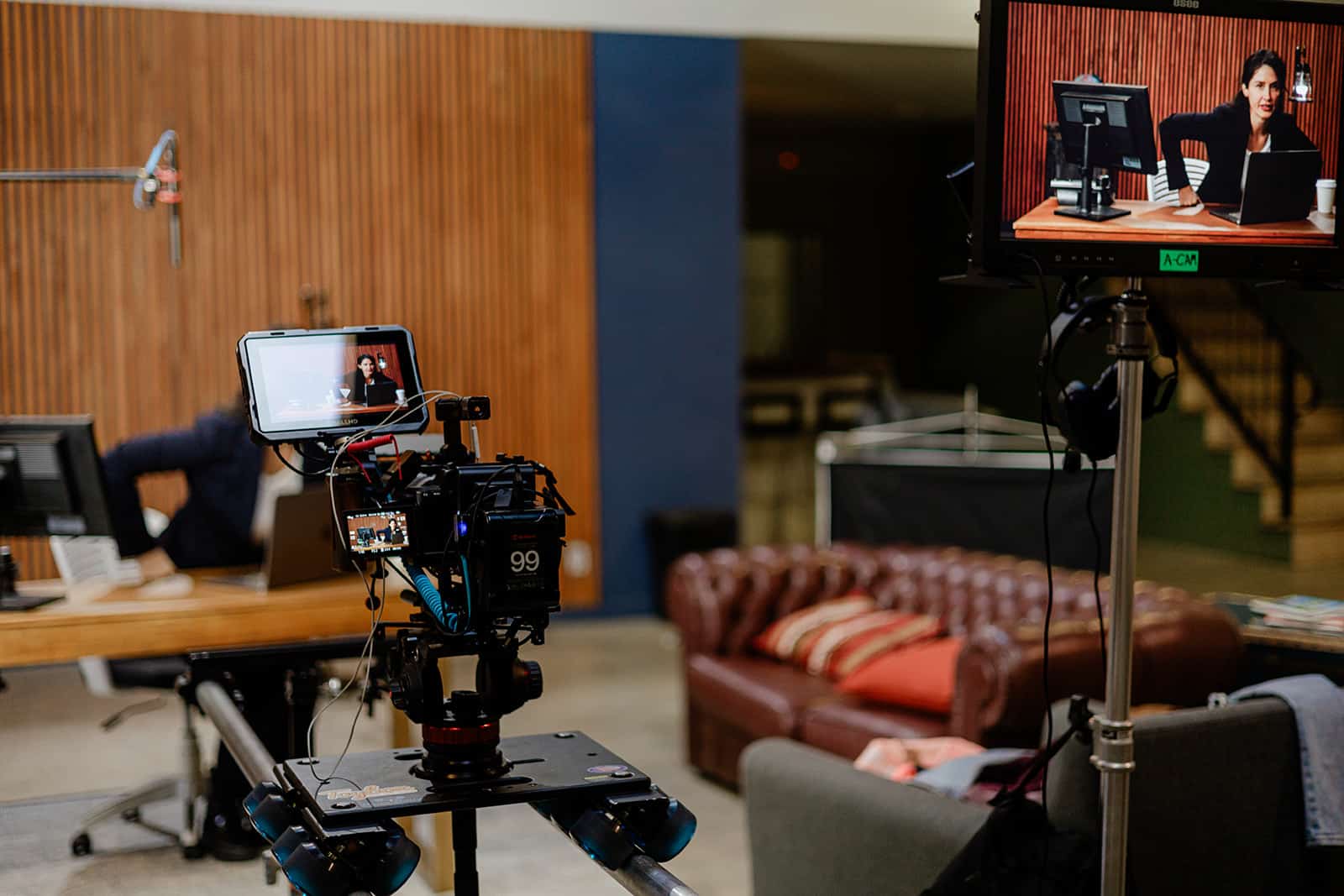
While VIG is relational at its core, the technical quality of the video cannot be an afterthought. Inadequate sound or poor framing can strip a powerful moment of its impact. That’s why we use clear recording standards:
- Camera Angle: Wide enough to capture both interactants fully, but close enough for emotional nuance.
- Audio: High-sensitivity microphones to pick up low-volume speech and tone.
- Lighting: Natural light when possible, avoiding backlighting or strong shadows.
Professionals must also be sensitive to the observer effect. We encourage relaxed, unpressured filming and often record several minutes of interaction to normalize the presence of the camera.
Editing and Review Preparation
After recording, we move to the editing phase, where we:
- Identify clips that match the client’s stated goals and relational strengths
- Use software to trim, tag, and timestamp moments of attunement
- Prepare a sequence of clips for the review session, usually 3 to 5 per session
The technical workflow must be streamlined yet sensitive. The guider is not just curating data; they are curating an experience. Each clip is a doorway to insight, and the way clips are ordered, introduced, and paused during the session can significantly shape the client’s emotional and cognitive responses.
Clinical, Educational, and Professional Applications
Clinical and Therapeutic Contexts
In clinical work, VIG strengthens relational capacity rather than targeting symptoms. This matters because in families facing trauma, attachment disruption, or chronic stress, relational safety is often the primary limiting factor. VIG intervenes directly at the level of interaction, where regulation and trust occur.
I have found VIG particularly effective in work involving:
- Parent-infant and parent-child therapy
- Families affected by trauma or postnatal depression
- Neurodevelopmental presentations such as ASD or ADHD
- Situations where verbal insight is limited but relational capacity exists
Rather than explaining attunement, VIG makes it visible in clients’ own behaviour. This visual evidence often bypasses defensiveness and shame, gently revising self-concept by presenting competence as lived experience.
Educational and Learning Environments
In educational settings, VIG enhances teacher–pupil relationships, especially in inclusive and high-needs classrooms. By slowing interaction, it helps teachers under high cognitive and emotional load notice how micro-responses influence pupil engagement and regulation.
Common applications include:
- Supporting teachers working with neurodivergent pupils
- Improving classroom communication and emotional climate
- Strengthening relationships in early years settings
- Reflective supervision for teaching staff
What distinguishes VIG in education is its non-evaluative stance. Video is not used for assessment but for reflection. Teachers are not shown errors; they are supported to recognise what worked and why, enabling insight without defensiveness and supporting sustained change.
Evidence Base and Research Foundations
Quantitative and Outcome-Focused Research
The evidence base for VIG has grown steadily, though it remains more robust in some domains than others. Research consistently points to improvements in relational quality, particularly parental sensitivity and responsiveness. Outcome measures commonly used in VIG-related research include standardized tools such as the CARE Index, Attachment Q-Set, and Parental Development Interview.
Across studies, improvements are often observed in areas such as:
- Increased parental attunement and reflective capacity
- Improved child engagement and affect regulation
- Enhanced professional-client relationships
- Greater practitioner empathy and observational skill
It is important to note that VIG outcomes are rarely linear or uniform. Because the intervention targets relational processes rather than discrete behaviors, change often unfolds in layered and context-dependent ways.
Qualitative and Mixed-Methods Contributions
Qualitative research plays a critical role in understanding VIG’s impact. Interviews, session transcripts, and reflective journals reveal changes that are difficult to capture quantitatively but are central to practice. These include shifts in self-perception, emotional confidence, and relational intentionality.
Mixed-methods studies are particularly valuable, as they allow us to triangulate:
- Observable interaction changes
- Self-reported experience of clients
- Professional observations over time
At the same time, we must be honest about limitations. Sample sizes are often small, control conditions are difficult to establish, and fidelity varies across implementations. These challenges do not invalidate the model, but they do require careful interpretation of findings and humility in claims.
Training, Accreditation, and Model Fidelity
Training Pathways and Professional Development
Becoming a competent VIG guider is a developmental process, not a short course, echoing how professional video practice itself is built through reflection, supervision, and experience. Most national frameworks follow a staged accreditation model that emphasizes reflective capacity as much as technical skill. Training typically includes:
- Formal instruction in VIG theory and principles
- Supervised filming and video analysis
- Recorded shared review sessions for assessment
- Ongoing reflective supervision
Progression through training levels requires evidence of both competence and integrity. The guide must demonstrate an ability to facilitate insight without leading, correcting, or imposing meaning. This is often more challenging than it sounds.
Supervision and Fidelity Maintenance
Supervision is the backbone of VIG fidelity. Without it, the model risks drifting into directive feedback or performance coaching. High-quality supervision focuses on:
- The guider’s use of language and timing
- Adherence to attunement principles
- Management of power dynamics in review sessions
- The guider’s own emotional and relational responses
Fidelity tools such as checklists and peer review processes help maintain consistency, but they are only effective when embedded in a reflective culture. VIG is not a technique that can be mechanized without losing its essence.
Organizational Integration and Systemic Challenges
Embedding VIG Within Services
Integrating VIG into organizations requires more than training individual practitioners. It requires alignment with service values, workflows, and leadership priorities. Successful integration often involves:
- Clear articulation of VIG’s purpose within the service
- Protected time for filming, analysis, and review
- Managerial understanding of relational outcomes
- Integration with supervision and CPD structures
When these conditions are met, VIG can function at multiple system levels, from direct client work to team development and leadership reflection.
Barriers and Structural Constraints
Despite its effectiveness, VIG faces predictable barriers. Time constraints, practitioner anxiety about being filmed, and organizational cultures focused on output rather than process can all limit uptake. Additionally, relational work is harder to quantify, which can make it less visible in outcome-driven systems.
Common challenges include:
- Limited resources for equipment and supervision
- High caseloads reduce reflective capacity
- Misunderstanding VIG as a performance evaluation
- Cultural discomfort with video-based reflection
Addressing these barriers requires advocacy, education, and leadership that values relational depth alongside efficiency.
Final Thoughts
Video Interaction Guidance offers a rare combination of rigor and humanity. It is structured without being rigid, evidence-informed without being reductionist, and deeply relational without being vague. For professionals working in complex human systems, VIG provides a way to ground change in observable interaction while honoring the subjective experience of those involved.
From my perspective as a practitioner, the enduring value of VIG lies in its capacity to help people see themselves differently in relationships. That shift, once internalized, extends far beyond the filmed moments. It reshapes how professionals listen, respond, and connect in the living present of their work, underscoring the deeper potential of video as a relational tool rather than just a recording device. And in a field where relationships are the medium of change, that is no small thing.
About LocalEyes and Our Role in Video Interaction Guidance
At LocalEyes Video Production, we understand the transformative power of video, not just as a tool for communication, but as a catalyst for insight, learning, and connection. That’s why this discussion of Video Interaction Guidance resonates so strongly with us. While VIG is a specialized psychological intervention, it draws on a principle we live and breathe every day: the power of video to capture real human interaction and elevate it to something more meaningful.
Our Emmy Award-winning team has produced over 3,900 videos for more than 300 clients across the United States, including educational institutions, healthcare organizations, and enterprises working in professional development and relational training. We know what it takes to produce footage that captures authenticity, trust, and connection, exactly the qualities that VIG practitioners depend on. Whether you’re filming attuned moments in a school or building a training resource for a multidisciplinary clinical team, production quality and thoughtful execution are essential.
If you’re a practitioner, researcher, or organization using video to enhance relational work, whether through VIG, training, or reflective supervision, LocalEyes is uniquely equipped to support you. With full-service offices in major cities nationwide and over 500 five-star reviews to back our reputation, we combine local market knowledge with national-scale production capabilities.

Founder at LocalEyes Video Production | Inc. 5000 CEO | Emmy Award Winning Producer