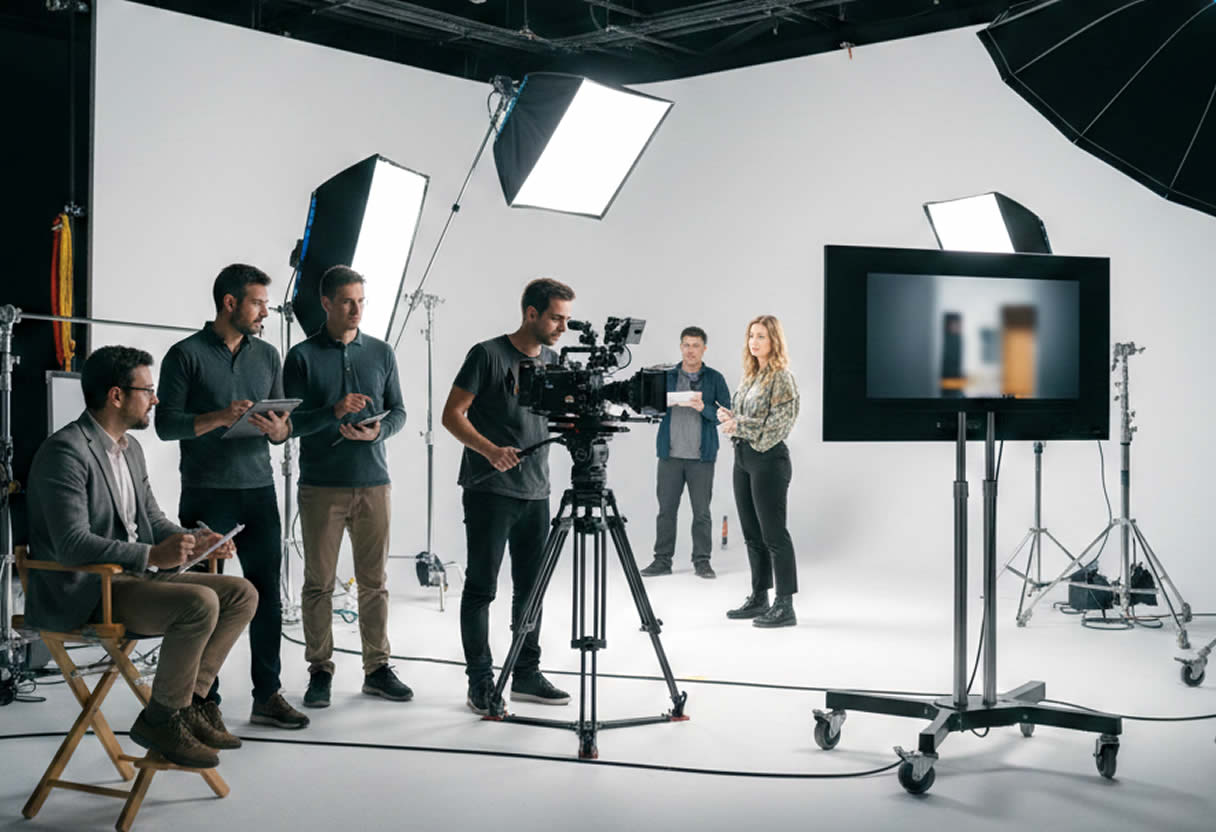
- Commercial video production integrates creative, legal, and strategic elements to achieve specific business goals across paid media platforms
- Pre-production in commercial filmmaking involves detailed technical planning, budget engineering, and cross-departmental coordination to eliminate execution risks
- Post-production for commercial videos includes structured editing, platform-specific exports, rights management, and compliance across audio, visual, and legal standards
Commercial video production isn’t just an artistic endeavor or a logistical exercise. It’s an exacting, multidimensional operation that requires strategic thinking, technical fluency, and precise coordination between departments. From the first treatment to the final deliverable, everything we do is intentional, interconnected, and accountable to performance metrics. Our job isn’t to make videos; it’s to deliver results through video.
When we say “commercial,” we’re not talking about general brand films or episodic content. We mean advertising that supports measurable business goals, distributed through paid channels, often across multiple platforms with varying specifications. This is work that operates under legal, financial, and creative pressures simultaneously, and professionals in the space understand that mastery comes from integrating form and function at every step of the process.
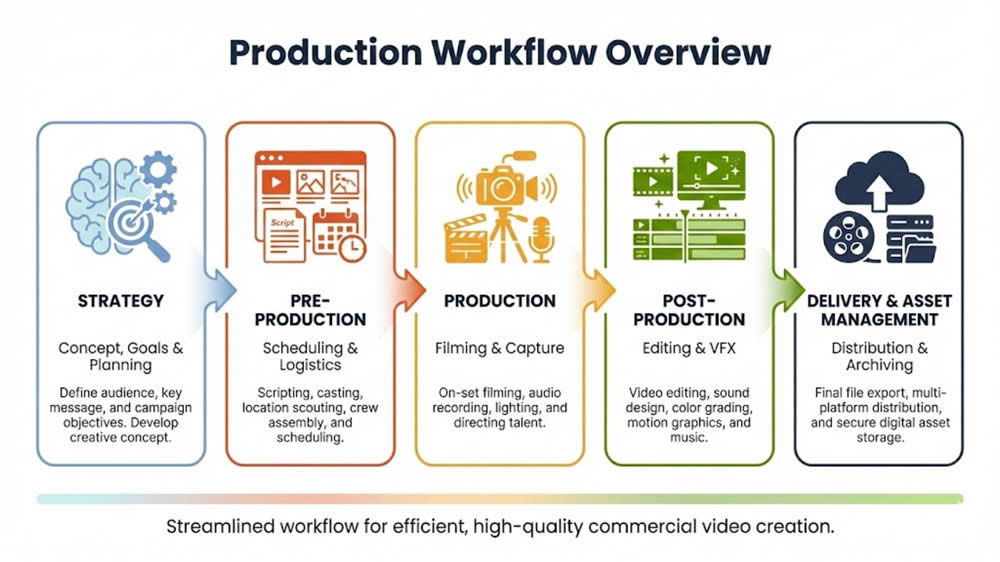
Commercial Video Strategy: Aligning Creative With Marketing Goals
Understanding Campaign Objectives
In commercial production, strategy begins with clarity of purpose. Not every video drives conversion; some build recall, trust, repositioning, or traffic. The video’s role within the wider campaign and funnel, whether awareness, consideration, conversion-focused decision making or must be defined first.
Creative can only succeed if it answers to the strategy. That’s why we align every scene, tone, and pacing decision with the business goal. Whether it’s top-of-funnel awareness or a direct-to-consumer CTA, we tailor the entire concept around it. Vague goals create diluted execution. Sharp strategy breeds sharper creativity.
Target Audience and Channel Mapping
One of the most overlooked aspects of production is platform behavior. A 30-second TV spot requires a completely different narrative flow than a six-second bumper ad on YouTube. Understanding where the audience will encounter the message allows us to craft visuals that hit quickly and stick, particularly when designing for mobile-first viewing behavior versus traditional screens.
We assess:
- Whether the ad will autoplay with or without sound
- If the aspect ratio should be vertical, square, or widescreen
- The psychographic profile of the user and their attention span on that platform
Without platform fluency, even the most creative concept falls flat.
Pre-Production Mastery
Creative Breakdown and Technical Planning
Pre-production is not about checking boxes. It’s about eliminating ambiguity, which is why a disciplined pre-production blueprint is critical to protecting both budget and creative intent. We translate scripts into shot lists, lookbooks, and scene-by-scene breakdowns. Every decision made here affects cost, time, and creative flexibility. I push for technical read-throughs with key departments so everyone can flag challenges early.
We often:
- Generate boards and animatics to preview timing
- Pre-light and camera test when working with specialty lenses or motion control
- Sync creative expectations with physical feasibility
Pre-pro is where 80% of the real thinking happens. Production is simply the execution of those decisions under pressure.
Budget Construction and Value Engineering
Budgeting in commercial work is rarely about spending less; it’s about spending smartly by understanding how commercial production costs shift based on scope, talent, locations, and deliverables. The agency or client may hand us a number, but it’s our job to build a functional blueprint within that number. I create detailed line-item budgets that expose the real cost of each decision.
A typical value engineering process may include:
- Swapping lens packages to reduce grip/electric needs
- Replacing a location built with a partial practical set and compositing
- Moving a day exterior to interior if the weather risk is high
These adjustments aren’t cuts. They’re optimizations. We protect production value by reallocating, not just eliminating.
Bidding & Production Company Selection
Agency Bidding and Comparative Evaluation
In agency-driven production, triple bidding is standard. This is less about price comparison and more about evaluating risk, vision alignment, and executional creativity. When I submit a bid, I don’t just drop in numbers. I tell a story. My deck includes:
- Director vision and reel examples
- Production plan per scene or challenge
- Explanations for every high-cost line item
The best bid is the one that inspires trust, not necessarily the lowest. Clients want to know you’ve anticipated problems before they happen.
Assessing Fit and Capabilities
Not every production company is right for every job. Some excel in tabletop work with food and beverage brands. Others have strength in VFX-heavy spots or location-driven lifestyle campaigns. I look at more than just past work. I want to know:
- What size jobs are they operationally built for
- How they manage agency/client communications
- Whether they have redundancies for key crew positions
Choosing the right partner reduces stress on set and creates space for real creative work.
Casting
Union, Non-Union, and Legal Licensing
Casting isn’t about picking people who “look right.” It’s a blend of aesthetic, performance, and legal complexity. If the job is union, we must navigate SAG-AFTRA agreements, including term, territory, and residuals. Missteps here can result in penalties or worse, campaign takedown.
We track:
- Whether usage is global or regional
- What platforms are included (broadcast, OTT, paid digital)
- Contract renewal windows and associated costs
Talent is often the largest long-term expense. We manage it like an asset, not a variable.
Performance, Authenticity, and Fit
Modern casting demands authenticity. For performance-driven spots, the actor’s rhythm and delivery need to match brand voice and editorial pacing. But for testimonial or lifestyle spots, we often cast real people who bring credibility that actors can’t fake.
When evaluating talent, I consider:
- How do they take direction under time pressure
- Whether their energy matches the campaign’s tone
- How they’ll interact with other characters or environments
Chemistry is a production variable that’s hard to fix in post. We solve it at the casting level.
Location Scouting & Logistics
Creative, Technical, and Operational Requirements
Locations must serve multiple masters. Creative wants a visual match, camera and G&E need workable lighting conditions, and production needs space for staging, crew parking, and catering. I never approve a location until all departments have walked it and signed off.
A strong location strategy includes:
- Noise profile checks at shooting hours
- Sun path and weather tracking
- Permit availability and restriction evaluation
A beautiful but impractical location costs more than it’s worth. We look beyond the lens.
Permits, Contingencies, and Time Management
Permit coordination is never passive. We’re often navigating overlapping jurisdictions, community board approvals, and conditional fire marshal presence. One missed form can halt a shoot before breakfast. We build timelines that account for:
- Permit processing delays
- Neighbor notification protocols
- Alternate location holds in case of denial
I also block time for reset and turnover between locations. Travel time is always longer than Google Maps says. Logistics are where ambitious boards become realistic schedules.
Production Execution: On-Set Best Practices
Crew Coordination and Set Leadership
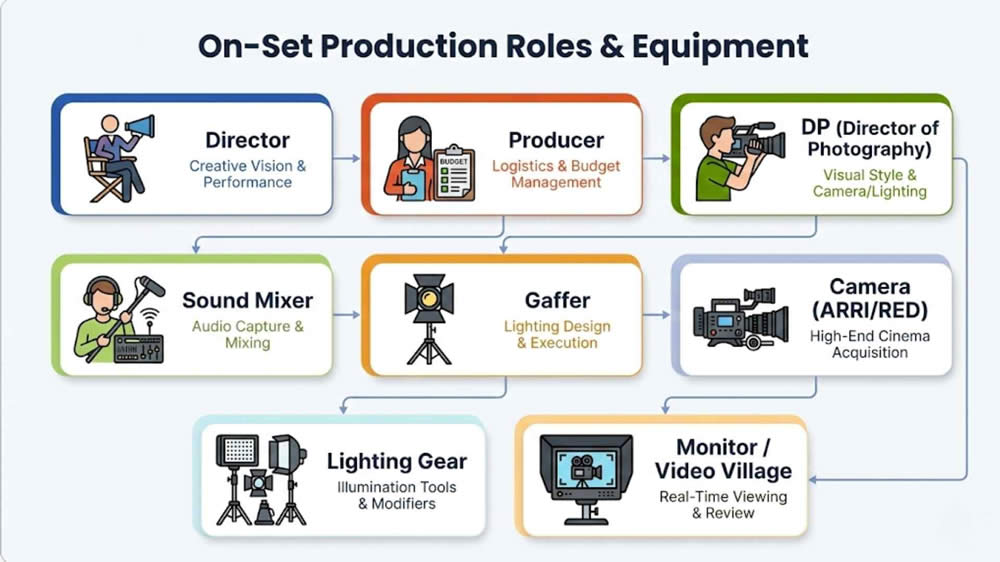
A commercial set is not a democracy. It’s a hierarchy built on trust and efficiency. The 1st AD drives the clock, but the producer drives morale and macro decision-making. I keep department heads focused, stakeholders informed, and clients feeling heard without breaking stride.
My leadership principles include:
- Clear chain of communication
- Fast but respectful escalation of issues
- Constant schedule reassessment based on setup speed
On set, we earn trust minute by minute. Every reset, every delay, every great take adds up to our reputation.
Client and Agency Interaction
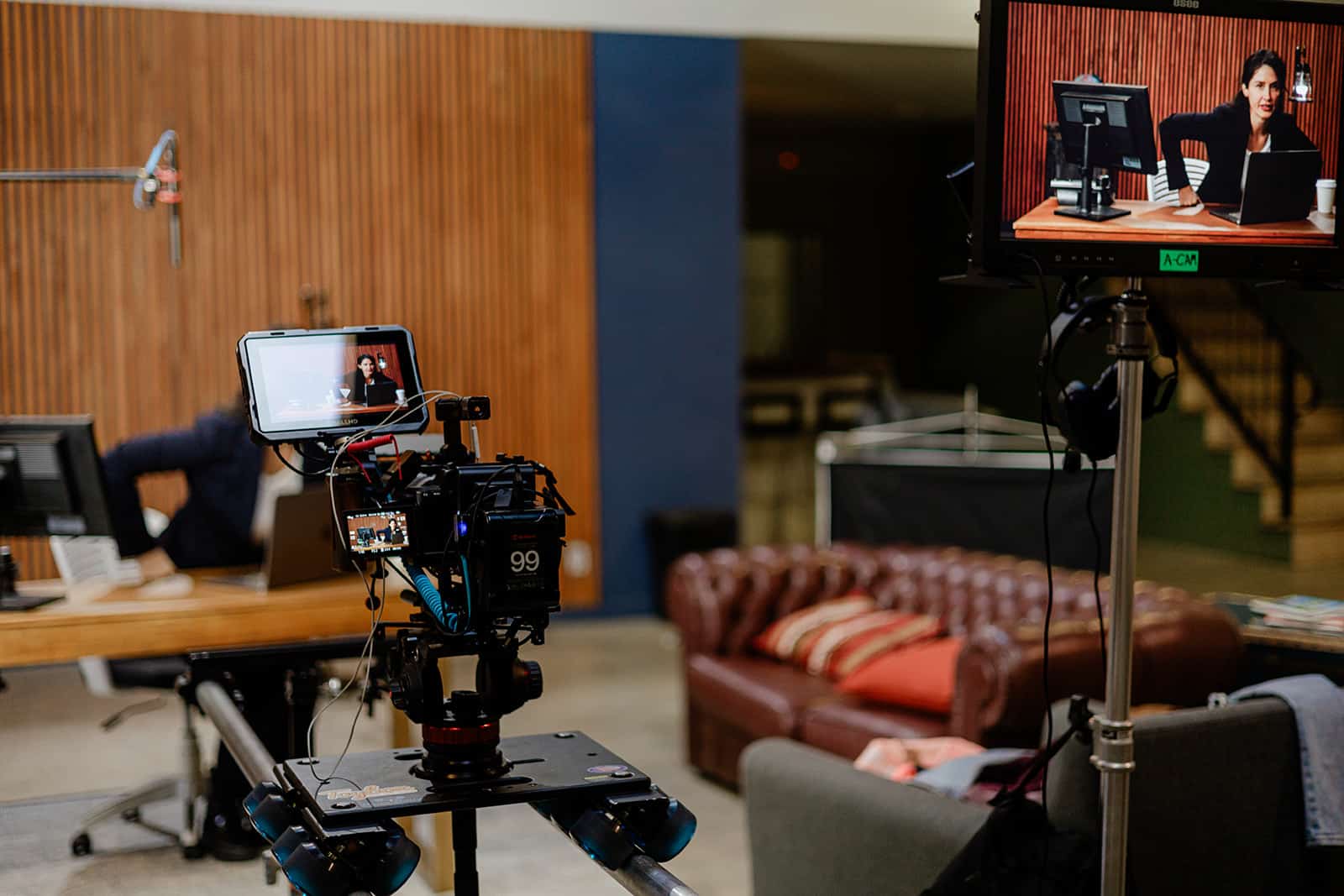
A video village can either be a calm cockpit or a panic room. I set clear expectations with clients: what they’ll see, how they’ll give feedback, and when their voice should guide a reshoot. I ensure they get real-time visuals with accurate LUTs and synced audio.
We establish:
- A designated agency liaison to consolidate feedback
- A review loop that includes alternate takes when feasible
- A process for flagging client-side requests without derailing momentum
Production isn’t just about making the work. It’s about managing the humans around the work.
Camera & Lens Workflow
Camera Selection Based on Deliverables
Camera bodies aren’t just toys; they’re tools chosen based on end-use and desired aesthetic. If we’re delivering to HDR platforms, we prioritize cameras with high native dynamic range. If we’re doing VFX-heavy composites, we need a clean, log image with minimal compression.
Popular selections include:
- ARRI Alexa Mini for color depth and skin fidelity
- RED Komodo or V-Raptor for a small footprint and high resolution
- Sony Venice for Rialto flexibility and dual base ISO
Sensor choice must also match the color pipeline of the post. No decision is made in isolation.
Lens Selection and Image Character
Lenses give character to a frame. We run tests not just for sharpness, but for falloff, flares, bokeh quality, and distortion. Directors and DPs often bring strong preferences, but we align final selection with what the brand wants visually.
Typical considerations:
- Anamorphic for cinematic texture and lens flares
- Spherical primes for clarity and fast glass
- Zooms for dynamic camera moves when speed trumps perfection
We also evaluate how lenses perform in low light or under specific lighting conditions to ensure consistency across scenes.
Lighting Execution
Setup, Style, and Practicality
Lighting is one of the most powerful visual tools we have in commercial storytelling. Whether we’re lighting for beauty, drama, or hyper-real product focus, the choice of units, modifiers, and placement defines the final image. I plan lighting in tandem with camera and production design; those three departments must be in sync before we roll a single frame.
We typically evaluate:
- Source type (HMI, LED, tungsten) based on color temperature and throw
- Modifier use (softboxes, flags, diffusers, bounces) to sculpt the light
- Practical and motivated lighting to sell realism or exaggerate mood
Lighting setups are tested and documented during tech scouts or pre-light days. The more complex the lighting, the more vital our pre-rig and generator logistics become.
Controlling Variables and Continuity
Exterior shoots, especially daylight-dependent ones, require contingency planning for variable conditions. I work with the DP to identify best-case lighting goals and worst-case backups. The gaffer and key grip prepare a rig that lets us adapt mid-shoot without derailing time.
We control continuity through:
- Blocking sequences by light angle and time of day
- Keeping lighting ratios consistent across takes and camera angles
- Using LUT previews on set that reflect post-grade expectations
This level of control isn’t just about perfection; it’s about efficiency. Fixing lighting inconsistencies in post eats time and budget.
Post-Production Workflow and Delivery
Editorial Structure and Review Flow
Once we’re in post, everything speeds up, but only if we’ve prepped well. Editors work from proxy files that are synced with audio, script notes, and metadata. I make sure the editorial house or internal post team knows exactly what client rounds to expect, including:
- Internal agency rough cut
- Client-facing first pass
- Legal/compliance reviewed, locked cut
We maintain naming conventions and export logs for every version. Nothing is delivered without watermarks, timecodes, and burn-ins at early stages to avoid confusion.
Color, Finishing, and Export Management
Color grading isn’t just aesthetic; it’s brand fidelity. If a product’s red pops in one cut and looks muted in another, we have a problem. I make sure our look is defined early using:
- Reference frames approved in pre-pro
- Creative LUTs created and tested per scene
- Shot-matched grading workflows in DaVinci Resolve
When it comes to mastering, we’re exporting for delivery, not just for approval. I check that every export:
- Matches spec (resolution, codec, bitrate)
- Includes legal slate, tone, and bars for broadcast
- Is tested for platform compliance before handoff
We double-check file integrity using MD5 hashes or visual QC on calibrated monitors.
Graphics & Finishing
Design Integration and Technical Review
Graphic elements in commercial spots aren’t decorative; they’re legal, branding, and conversion tools. Whether we’re dealing with animated text, callouts, or product info, the design must align with brand guidelines and technical specs.
We build templates that:
- Reflect approved typography and hierarchy
- Include safe zones for text overlays across aspect ratios
- Allow flexibility for multi-language versioning
All final graphics are tested for legibility on small screens and evaluated under real-use conditions (like autoplay mute on mobile).
VFX, Beauty, and Final Polish
Commercial finishing often includes cosmetic retouching, beauty work, or subtle VFX. From removing stray hairs in beauty closeups to enhancing product labels with shine or texture, these finishing touches are what distinguish pro work from amateur.
I supervise final renders that involve:
- Skin smoothing and blemish removal within natural bounds
- Set extensions, sign replacements, or composited elements
- Motion-tracked overlays for product UI or animated elements
Every deliverable is matched frame-accurately, rendered in full resolution, and reviewed in multiple environments before approval.
Audio Post
Voiceover, Mix, and Music Licensing
Audio defines how viewers emotionally engage with a commercial. Whether we’re using VO, dialogue, or pure music, the sound mix must be surgically crafted. I ensure VO sessions happen in calibrated booths, with alternate reads and pacing variations recorded to give editorial flexibility.
When it comes to music, I always verify:
- Sync license for use in the video
- Master license for the specific recording
- Usage limitations (territory, term, platform)
The final mix happens in Pro Tools or a similar DAW, with stereo and multi-channel outputs rendered according to spec.
Mix Compliance and Quality Assurance
Each platform and broadcaster has loudness targets and file requirements. I work with the audio post team to hit these numbers:
- Broadcast loudness (e.g., -24 LKFS in the US)
- Digital standards for streaming or social (e.g., -16 LUFS max)
- Peak and true peak limits for OTT or YouTube delivery
We listen on a mix of monitors: reference studio speakers, AirPods, laptop speakers, and mobile devices. If it doesn’t sound good everywhere, it doesn’t ship.
Deliverables, Mastering, and Versioning
Platform-Specific Outputs
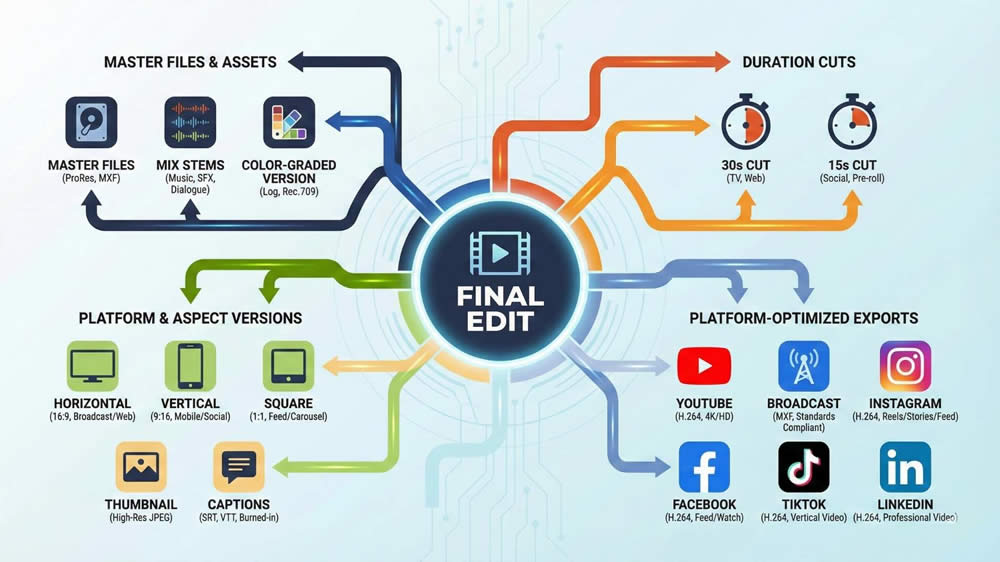
One master file is never enough. Most campaigns require multiple aspect ratios, durations, and formats. I built a deliverables matrix that aligns with the media buy and the creative plan.
Typical outputs include:
- 16:9 master for YouTube and broadcast
- 9:16 vertical crop for Instagram Stories, Reels, or TikTok
- 1:1 and 4:5 variants for in-feed paid social
- Clean and tagged versions (with end cards, offers, disclaimers)
Each version must maintain design integrity, pacing, and color across platforms. Nothing is auto-cropped without a human eye.
Versioning and File Management
Version control is a discipline. We track every variation using a naming convention tied to:
- Date and revision number
- Platform and format
- Territory or language code
Files are stored in organized MAM systems or cloud backups with expiration and renewal reminders for licensed elements (music, talent, stock). Final delivery is documented with:
- A signed-off deliverables checklist
- QC report
- Receipt of delivery confirmation
This is what separates professional pipelines from improvised ones.
Legal, Licensing, and Insurance Essentials
Usage Rights and Compliance
Licensing isn’t a footnote; it’s core infrastructure. If we don’t have the rights, we don’t have a campaign. I maintain a tracker that includes:
- Talent contract terms and end dates
- Stock usage allowances by platform and region
- Music cue sheets and license PDF backups
I also ensure all disclaimers, legal copy, and product claims are reviewed by brand counsel before lock. Compliance delays are a real threat to launch dates.
Insurance and Contracts
Before we shoot, we secure:
- General liability and workers’ comp coverage
- Gear insurance (including rented equipment)
- Errors and omissions (E&O) for high-risk campaigns
We also execute deal memos with crew, location agreements, appearance releases, and NDAs where necessary. International work triggers additional needs: currency exchange planning, local labor laws, and jurisdiction-specific legal reviews. I don’t leave any paperwork unsigned.
Production Operations & Process Optimization
Workflow Infrastructure
Efficiency isn’t luck; it’s systematized. We use a suite of tools like StudioBinder, Frame.io, and AirTable to manage pre-pro, scheduling, and asset approvals. I maintain:
- Shared calendars synced with crew holds and shoot windows
- Daily status trackers for each department
- Redundant backups for files at every major stage
This lets us onboard new crew or respond to changes quickly without losing alignment.
Feedback, Documentation, and Client Reporting
Client feedback is logged with timecodes and stored in shared documents. We avoid ambiguity by tagging notes to specific shots, using review platforms, and confirming approvals in writing.
At wrap, I deliver:
- A wrap book with call sheets, permits, contracts, and COIs
- Cost report with final vs. estimated budget
- List of all master files and expiration-sensitive assets
Clients don’t just want the content. They want confidence in the process.
Scheduling, Calendars & Timelines
Project Timeline Design
I break down every job into phases: creative development, pre-pro, production, post, and delivery. Each has a separate calendar that rolls into a master schedule. Critical path items (casting, product arrival, director confirmation) are tracked daily.
We build in:
- Flex days for weather or client delays
- Approval deadlines that trigger automatic reminders
- Contingency scenarios for overruns
Nothing derails a shoot like pretending things will go perfectly. We plan for reality.
Shoot Days and Call Sheets
Shoot days are planned down to the minute. I generate call sheets with contact info, maps, health protocols, and shot priority lists. My team preps:
- Shot order based on lighting continuity and talent availability
- Load-in and load-out windows with crew shifts
- End-of-day wrap protocols to protect equipment and morale
If your call sheet is vague, your set will be chaotic. I never leave it to chance.
Production Reporting & Reconciliation
Wrap Documentation and Reporting
After the shoot, I oversee a wrap process that’s as detailed as pre-pro. We close out all POs, reconcile credit card statements, and submit the final cost report to the agency or brand.
The wrap book includes:
- Final call sheets and production reports
- Receipts, COIs, and contracts
- Version tracking log and delivery report
I also meet with department heads for post-mortem reviews to discuss what worked and what didn’t.
Overages, Margins, and Financial Accountability
If we exceeded the budget, we document why. Maybe the client added shots. Maybe we needed additional VFX cleanup. Overages are presented transparently, with receipts and timelines.
I monitor:
- Profit margin erosion across categories
- Crew or vendor rate shifts across campaigns
- Trends in insurance claims or post delays
This intel informs the next bid. Reconciliation isn’t just bookkeeping. It’s operational intelligence.
Performance, Analytics, and Client Reporting
Creative Analysis and Future Planning
Once the campaign is live, we pay attention. If version B performs better than version A, we want to know why. I coordinate with agency analytics or client marketing teams to assess:
- View-through rates
- Click-through rates
- Engagement and drop-off timestamps
Creative isn’t a one-shot deal. We learn, iterate, and improve.
Asset Lifecycle Management
Every asset has a shelf life. I maintain:
- Expiration logs for talent, music, and stock licenses
- Regional compliance notes for different market versions
- Secure storage with version history and master backups
When clients come back in 6 months needing a new cut or a right extension, we’re ready. We don’t just produce, we preserve and protect.
Final Thoughts
Commercial production is about precision. Every decision, from casting to codecs, reverberates across departments, deadlines, and deliverables. Our responsibility is not just to make something good. It’s to make something that works, on time, on budget, and on message.
I’ve built my career on the belief that great work is no accident. It’s the result of structure, skill, foresight, and respect for the process, the people, and the product. When we get it right, everyone wins: the client, the agency, the audience, and the crew. That’s what commercial video production is all about.
About LocalEyes
At LocalEyes, commercial video production isn’t just our service offering, it’s our craft, our process, and our proven strength. Everything discussed in this article, from strategic alignment to post-production precision, is embedded into how we approach every single project. With over 3,900 videos produced for more than 300 clients nationwide, we’ve seen firsthand how detailed, process-driven production can directly impact brand outcomes and business results.
Our Emmy Award-winning team brings a rare combination of creative vision and logistical expertise to every campaign. Whether we’re producing a fast-paced social spot or a high-end national TV commercial, we apply the same standards of clarity, collaboration, and executional excellence. We operate across the country with full-service teams in New York, Los Angeles, Chicago, Austin, Miami, and beyond, ensuring that you receive local market insight backed by national-scale production capability. If you’re looking to work with a team that understands how to execute complex commercial video projects with precision and purpose, we’d love to talk.

Founder at LocalEyes Video Production | Inc. 5000 CEO | Emmy Award Winning Producer