- Legal videos function as litigation infrastructure, meaning they must be treated as secure digital evidence with cryptographic hashing, preserved metadata, and a fully documented chain of custody to maintain evidentiary integrity.
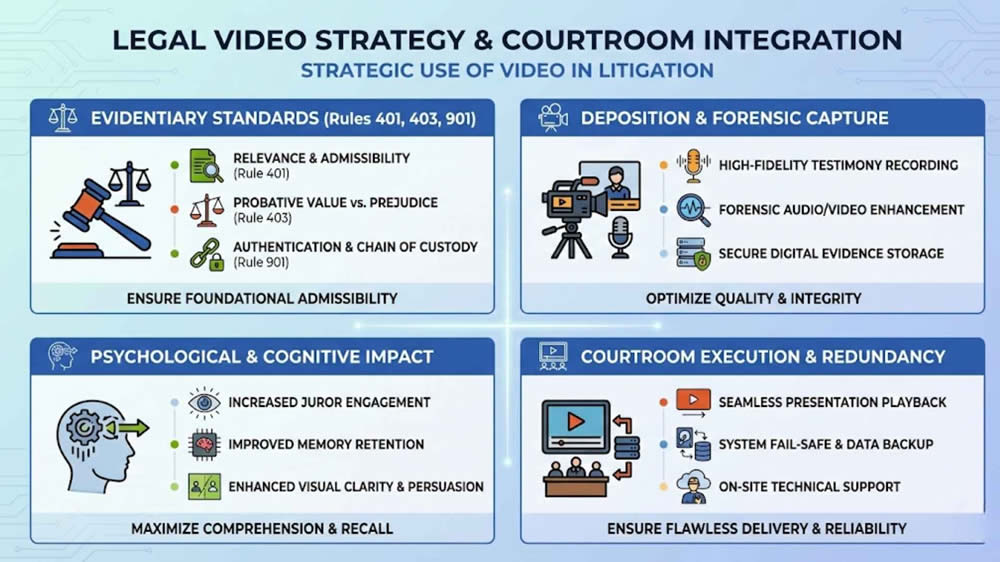
- For courtroom admissibility, legal videos must independently satisfy Federal Rules of Evidence 401, 403, and 901 through documented authentication, reliable handling procedures, and neutral, non-prejudicial editing practices.
- For reliable courtroom use, legal videos require standardized capture protocols, redundant playback systems, verified courtroom compatibility, and secure long-term archival preservation.
Legal video production is no longer an auxiliary litigation service. It is a technical discipline that intersects evidentiary law, digital forensics, cognitive science, and courtroom engineering. When I work with sophisticated trial teams, the conversation is rarely about whether to use video. The conversation is about how to design, capture, process, authenticate, and deploy video in a way that aligns with legal standards and strategic objectives.
This reflects how I approach legal video production in complex litigation. I am writing for professionals who already understand the basics of depositions, discovery, and trial presentation. What follows is not a beginner’s overview. It is a structured examination of video as litigation infrastructure, with attention to authentication mechanics, production methodology, evidentiary defensibility, and courtroom execution.
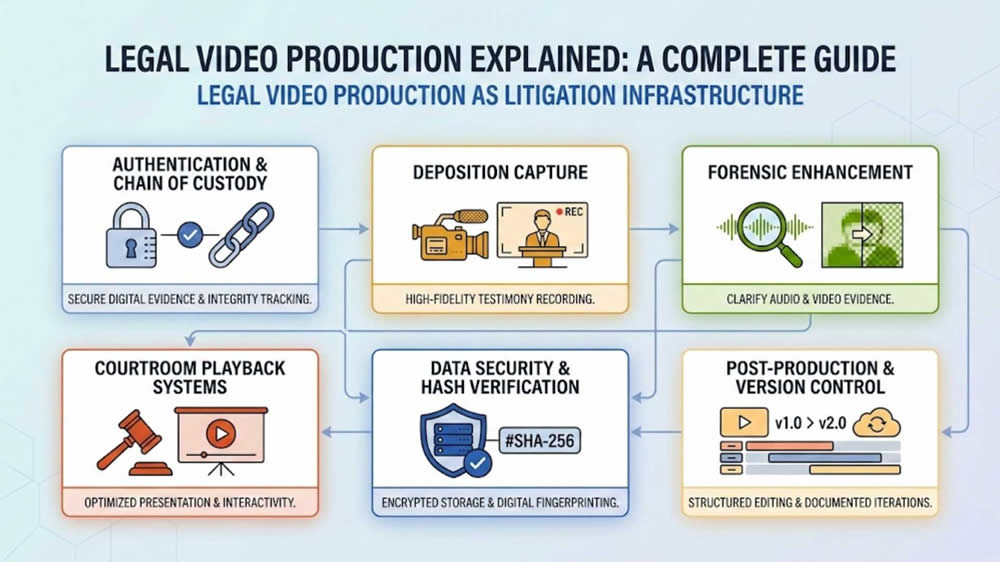
Strategic Context: Video as Litigation Infrastructure
Video as an Evidentiary Asset Class
In serious litigation, video must be treated as an evidentiary asset class rather than as a creative deliverable. It carries metadata, chain of custody implications, duplication risks, and authentication burdens that mirror other forms of digital evidence. When I ingest footage, I treat it with the same rigor applied to forensic image analysis or server extraction data.
From an operational standpoint, this means:
- Generating cryptographic hash values at intake
- Logging file origin, transfer method, and storage location
- Segregating original media from derivative working copies
- Maintaining documented processing histories
This structure prevents common breakdowns. For example, I have seen cases compromised because edited exports were mistaken for originals or because transcoding stripped embedded metadata. Infrastructure thinking avoids those failures.
Video Across Litigation Phases
Video serves different strategic functions depending on the litigation phase. During investigation, it preserves transient evidence and captures witness demeanor before narratives solidify. During discovery, it becomes both documentation and leverage, particularly when deposition testimony may be designated for trial.
At mediation, a curated video package can alter settlement dynamics by clarifying risk exposure. At trial, video must integrate seamlessly into the presentation environment. It must withstand Rule 403 scrutiny, survive authentication challenges, and play without technical interruption. Finally, for appellate preservation, video must remain accessible in stable formats long after trial ends. That long tail influences every technical decision made at the outset.
Legal and Evidentiary Architecture
Governing Evidentiary Standards
Video evidence must satisfy relevance, authenticity, and reliability. Under Federal Rules of Evidence 401 and 403, courts evaluate whether probative value is outweighed by unfair prejudice or confusion. In practice, this means production choices can affect admissibility. Overly stylized edits, aggressive color grading, or dramatic audio treatment may invite exclusion arguments.
Authentication under Rule 901 requires evidence sufficient to support a finding that the item is what the proponent claims it is. In the video context, this often involves testimony regarding:
- Equipment used
- Recording conditions
- File handling procedures
- Whether the footage has been altered
If the video has been enhanced or processed, I prepare documentation demonstrating that adjustments were uniformly applied and did not introduce new content. That preparation is not theoretical. It anticipates cross examination.
Authentication Mechanics in Digital Media
Digital video presents unique authentication challenges. Unlike analog tape, digital files can be copied perfectly, but they can also be modified without visible trace unless safeguards are in place. My workflow includes:
- Immediate SHA-256 hash generation upon ingestion
- Preservation of native container formats
- Documentation of codec, resolution, frame rate, and bitrate
- Controlled export logs for all derivatives
If transcoding is required for courtroom playback, I retain the original and produce a documented derivative. Each derivative includes an internal reference number tied back to the original hash. That audit trail is essential when opposing counsel questions whether edits altered substantive content.
Metadata preservation is equally critical. Embedded timestamps, device identifiers, and encoding details can support authenticity. However, careless file transfers or platform uploads may strip metadata. For that reason, I avoid unnecessary platform-based processing and use secure transfer protocols that preserve file integrity.
Categories of Legal Video Production
Deposition Video Capture
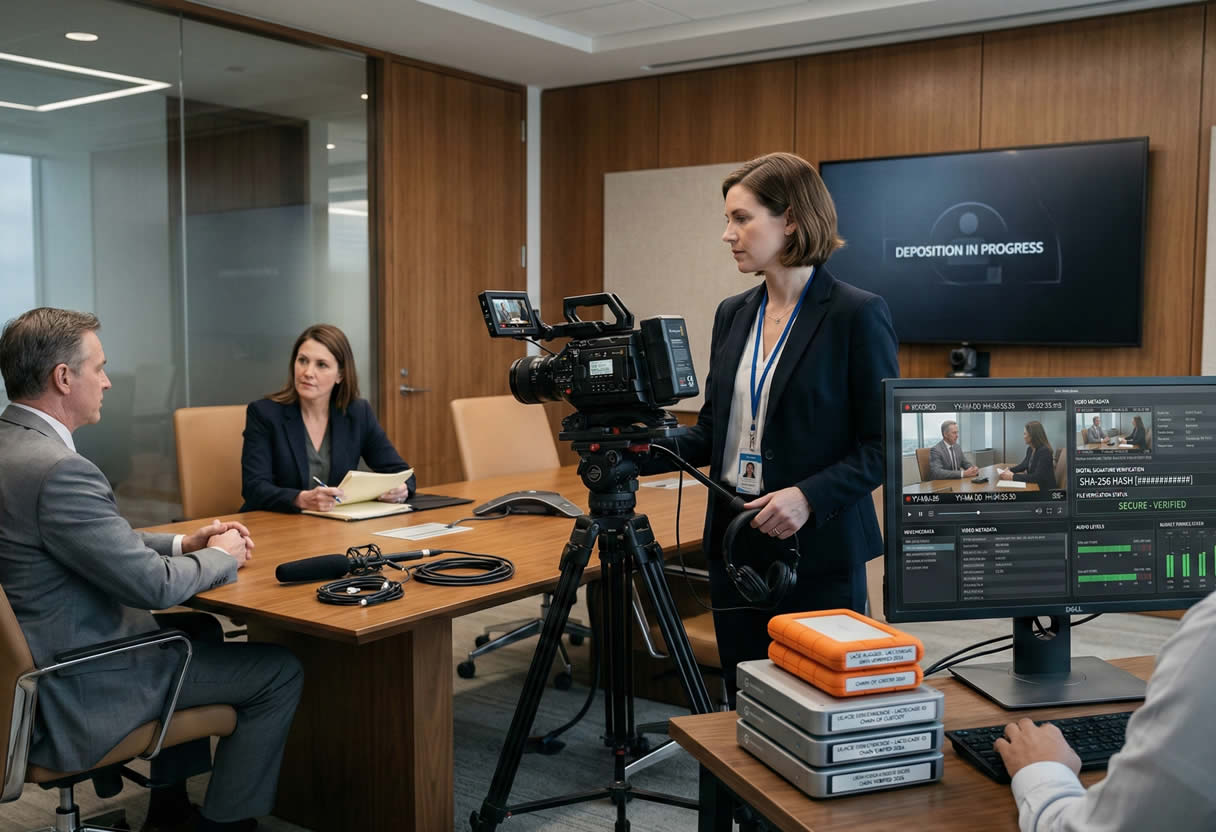
Deposition video is foundational. Poor capture cannot be fixed in post production. I approach depositions with a broadcast mindset focused on clarity and reliability rather than aesthetics. Key considerations include:
- Locked framing with neutral background
- Dual system audio recording
- Embedded timecode synchronized with transcript
- Redundant storage media during recording
Audio is paramount. I monitor gain staging carefully to avoid clipping or noise floor distortion. I also record a secondary audio channel to guard against lavalier failure. In remote depositions, I prefer hardware ISO recording over platform capture because compression artifacts and dropped frames are common in web-based recordings.
When preparing designation clips for trial, I extract segments using non-destructive editing workflows. Each clip is cross referenced to transcript page and line numbers. Export settings are standardized to avoid volume inconsistency or resolution shifts across clips.
Damages and Human Impact Documentation
Day in the life productions require disciplined neutrality. The objective is accurate documentation of functional limitations, not emotional amplification. I structure these productions chronologically, capturing representative tasks rather than staged moments.
Technical discipline reduces admissibility risk. I avoid:
- Dramatic lighting contrasts
- Selective close ups designed to intensify emotional reaction
- Artificial music or sound design
Duration also matters. Jurors experience cognitive fatigue with repetitive content. I edit for representativeness and clarity while preserving authenticity. When opposing counsel reviews the footage, it should withstand scrutiny as an accurate depiction rather than a curated narrative device.
Site Inspection and Physical Evidence Recording
Site inspections demand optical precision. Wide lenses can distort spatial relationships, so I often rely on calibrated prime lenses with known distortion profiles. I document camera height, distance from subject, and focal length in a production log.
To preserve spatial accuracy, I incorporate scale markers and measurement references within the frame. Lighting is adjusted to reduce glare and shadow interference. When capturing reflective surfaces, I use polarizing filters and reposition light sources to avoid misrepresentation of texture or depth.
If aerial capture is required, compliance with aviation regulations is confirmed in advance. Altitude, orientation, and flight path are logged. These details may later become relevant if perspective is challenged.
Forensic Video and Technical Enhancement
Forensic enhancement is frequently misunderstood. Clarification is permissible when uniformly applied and properly documented. Alteration that changes substantive content is not. I maintain strict processing logs that record:
- Software name and version
- Parameters adjusted
- Date and operator identity
- Export specifications
Frame interpolation and artificial upscaling are particularly sensitive. While they may improve visual smoothness, they introduce generated data. In evidentiary contexts, I avoid such techniques unless explicitly supported by expert testimony and disclosure.
Bitrate consistency is verified to ensure no compression artifacts were introduced during export. When presenting enhanced footage, I am prepared to explain exactly what was done and why it does not alter underlying information.
Trial Presentation and Playback Systems
Courtroom integration is an engineering task. Many courtrooms operate with limited codec compatibility and inconsistent display calibration. I test exported files on hardware configured to replicate the courtroom environment.
Redundancy is non-negotiable. My standard deployment includes:
- Primary playback workstation
- Secondary mirrored laptop
- External solid state backup drive
- Offline copy on separate physical media
Audio levels are calibrated to ensure intelligibility without distortion. Resolution is optimized for the display system rather than for theoretical maximum quality. A flawless 4K file is useless if the courtroom projector cannot render it reliably.
Pre-Production Strategy in Litigation
Case Theory Reverse Engineering
Every production begins with case theory alignment, following a structured pre-production framework similar to a comprehensive pre-shoot planning framework. I ask counsel to articulate which elements require visual reinforcement. Not every fact benefits from video. Some facts are stronger in testimony or document form.
I map visual assets to legal elements. For example:
- Duty may be illustrated through policy documents or operational procedures
- Breach may be demonstrated through site conditions or surveillance footage
- Causation may require expert animation
- Damages may be documented through functional limitation footage
This mapping ensures video is purposeful rather than decorative.
Witness and Subject Preparation Logistics
Consistency enhances credibility. I standardize backgrounds, camera angle, and lighting across sessions to avoid visual inconsistencies that may distract or imply staging. Environmental noise is addressed in advance, including HVAC and ambient sound sources.
Technical rehearsal includes testing exhibit integration, verifying audio monitoring, and confirming stable recording media. These preparations reduce interruptions that can disrupt witness composure.
Technical Format Planning
Format planning influences downstream compatibility. I typically capture in high quality intra frame codecs such as ProRes or DNxHD for editing flexibility. For distribution and courtroom playback, I generate optimized H.264 derivatives due to broad compatibility.
Color space is standardized to Rec. 709 to avoid display inconsistencies. File naming conventions follow structured protocols that integrate with case management systems, including case identifier, subject name, date, and sequence number.
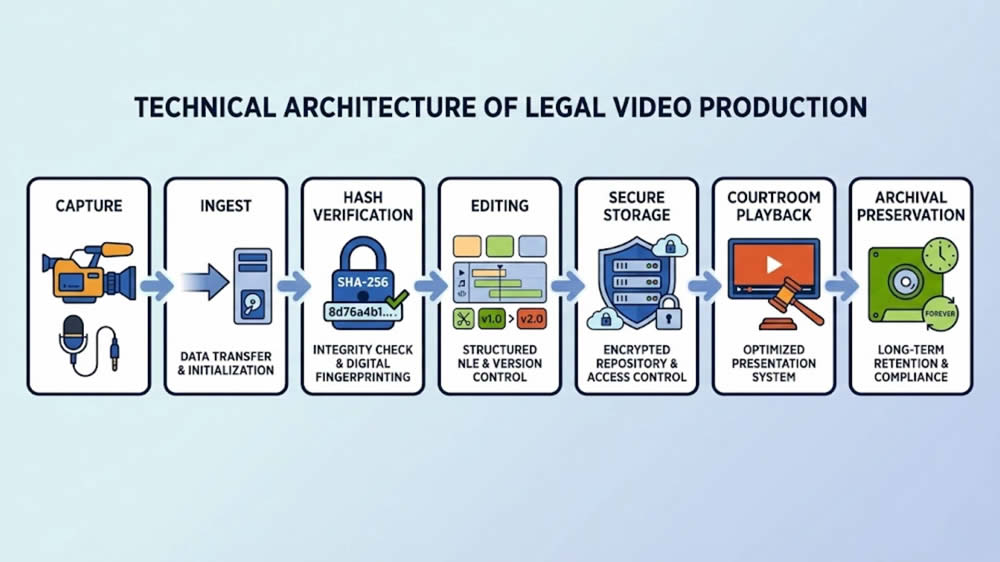
Production Methodology
Capture Architecture
Camera choice prioritizes reliability over cinematic features. Stable codecs, timecode support, and dual media slots are more valuable than advanced stylistic capabilities. Before recording, I verify jam sync across all timecode enabled devices.
Lighting is configured for clarity. Ratios are controlled to avoid dramatic contrast. White balance is locked to prevent shifts between sessions. These decisions support reproducibility and reduce grounds for challenge.
Audio Engineering in Legal Context
Audio integrity underpins transcription accuracy and courtroom clarity. I monitor levels continuously and record redundant channels when possible. HVAC systems and environmental noise sources are identified and mitigated.
A common configuration includes:
- Primary lavalier microphone
- Secondary boundary or shotgun microphone
- Direct feed from conference system if available
Phase alignment is checked to prevent interference between channels. Clean audio reduces post production correction and preserves natural speech cadence.
Remote and Hybrid Capture Systems
Remote capture introduces compression and packet loss risk, which is why carefully engineered distributed recording systems are essential in litigation contexts. Platform recordings often degrade quality. Whenever possible, I implement local recording solutions that capture higher quality streams independent of internet stability.
Immediately after recording, I verify file integrity and generate hash values. Backups are created before any editing occurs. This immediate verification protocol reduces the risk of undetected corruption.
Post Production Workflow in Litigation Context
Data Management Infrastructure
Post production in legal video is not merely an editing phase, but part of a controlled end-to-end production methodology designed to withstand evidentiary scrutiny. It is a controlled data management environment that must withstand evidentiary scrutiny. The moment footage leaves the camera media, the workflow must shift from creative processing to defensible handling. I implement a structured ingest protocol that includes verification, hashing, logging, and storage allocation before any editorial review begins.
My baseline data architecture follows the 3-2-1 redundancy model:
- Three copies of all media
- Two distinct storage types
- One offsite or offline backup
RAID systems provide drive level redundancy, but they do not replace true backup architecture. I use encrypted storage solutions with AES-256 encryption for active projects, and access permissions are role-based. Every file movement is logged. This level of control ensures that at any point in litigation, I can document where a file originated, how it was handled, and who accessed it.
Editing Standards for Evidentiary Use
Editing in litigation is fundamentally different from commercial editing and requires a defensible, controlled post-production environment built around transparency and reversibility. It must be non-destructive, transparent, and reversible. I always preserve original files in an untouched state. All edits are performed on duplicated working files, and the original hash values remain documented and preserved.
Designation-based editing requires particular precision. When extracting deposition segments for trial, I:
- Cross-reference transcript page and line numbers
- Verify timecode accuracy
- Standardize audio levels across clips
- Maintain consistent export resolution and frame rate
Color correction is limited to uniform adjustments that enhance clarity without altering substantive content. Any global correction is logged in a project change record. I avoid selective manipulation of portions of the frame, as that can raise authenticity challenges.
Graphics, Demonstratives, and Animations
Demonstrative graphics must be tightly aligned with evidentiary support. When producing animations based on expert testimony, I require written confirmation of underlying assumptions and measurements. This documentation becomes part of the production file and supports later foundation testimony.
For technical modeling, especially in medical or biomechanical contexts, I often work directly with DICOM imaging datasets. This ensures anatomical structures are accurately represented. Rendering pipelines are configured for clarity and compatibility, not cinematic flair. Complex animations are exported in standardized formats that integrate reliably with trial presentation software.
Key safeguards include:
- Maintaining versioned animation files tied to expert approval
- Documenting modeling parameters and data sources
- Testing playback on courtroom hardware prior to trial
This process protects against claims that animations are speculative or misleading.
Version Control and Documentation
Version control is one of the most overlooked aspects of legal video production. In multi-month cases, dozens of exports may be generated. Without a strict naming and archiving protocol, confusion is inevitable.
I use structured version identifiers that include:
- Project name
- Content category
- Revision number
- Date stamp
Every revision is logged with a summary of changes. Playback verification logs record where and how each file was tested. This documentation is not bureaucratic overhead. It is a defensive asset if production integrity is questioned under cross examination.
Psychological Architecture of Legal Video
Cognitive Load Management
Jurors process visual information differently than legal professionals. They are not trained to parse dense technical exhibits. I structure videos to reduce cognitive overload by segmenting information into logical units.
Instead of presenting complex data in a single uninterrupted sequence, I break it into structured segments that correspond to discrete issues. Pacing matters. Each visual component must remain on screen long enough for comprehension but not so long that attention declines. Overproduction often undermines clarity.
To manage cognitive load effectively, I focus on:
- Controlled pacing
- Minimalist graphic overlays
- Consistent typography and layout
- Logical visual progression
This discipline allows the substance of the evidence to carry persuasive weight without visual clutter.
Perception Calibration
Camera angle, distance, and framing influence perception. A low angle may convey dominance. A tight close up may intensify emotional impact. These effects can be unintentional. I standardize framing to maintain neutrality.
Lighting and color temperature are also calibrated carefully. Variations between sessions can create subtle perception shifts. By maintaining consistent lighting ratios and color balance, I ensure that no witness appears visually emphasized or diminished relative to others.
Perception calibration requires attention to subtle details:
- Eye level camera placement
- Neutral backgrounds
- Balanced lighting without dramatic shadow
- Consistent audio quality
These factors preserve credibility and reduce grounds for argumentative challenge.
Sequencing Strategy for Persuasion
Sequencing is where technical execution intersects with advocacy. Even without overt dramatization, order influences interpretation. I work closely with counsel to align sequencing with the structure of opening statements and closing arguments.
The principles of primacy and recency are operationalized through clip ordering. Critical admissions or impactful visuals are placed at structurally significant points within a sequence. However, this is done within the bounds of authenticity. I do not manipulate chronology to create artificial emphasis.
Rehearsal is essential. Playback timing is coordinated with oral argument. Transitions are simplified to avoid distracting from substance. The objective is integration, not spectacle.
Courtroom Integration and Operational Execution
Compatibility Testing Protocols
Courtroom environments vary widely. Some venues offer modern HDMI connectivity and digital displays. Others rely on aging projectors with limited codec support. I conduct advance testing whenever possible, including physical inspection of courtroom AV systems.
Testing includes:
- Verifying resolution compatibility
- Confirming audio output levels
- Testing full length playback of representative files
- Checking aspect ratio presentation
Resolution mismatches can distort visuals or crop critical information. I export courtroom-specific versions that match display specifications while preserving evidentiary integrity.
Redundancy Systems
Redundancy planning is not theoretical. Equipment fails. Cables disconnect. Storage media can become unreadable. My standard courtroom kit includes layered backup systems.
A typical deployment contains:
- Primary presentation workstation
- Secondary mirrored system with identical file structure
- Independent external storage drive
- Printed exhibit index cross-references
Power supply stability is verified, and backup adapters are available. I assume that something will fail and plan accordingly. This preparation prevents technical disruption from undermining credibility before the fact finder.
Real Time Courtroom Execution
Live courtroom presentation demands responsiveness. I organize video assets into indexed folders aligned with witness order and exhibit numbers. Rapid retrieval is essential when impeachment opportunities arise.
When objections are raised, playback must stop immediately without destabilizing the system. Side by side playback for comparison purposes is rehearsed in advance. Audio levels are adjusted in real time to match courtroom acoustics.
Operational discipline in the courtroom communicates professionalism. Technical hesitation erodes authority. Flawless execution reinforces the perception that the evidence itself is reliable.
Security and Confidential Information Handling
Controlled Access and Secure Transfer
Legal video routinely contains protected health information, confidential business records, and sensitive personal data. Security therefore cannot be limited to storage alone. It must govern who can access the material, how it is transmitted, and how activity is documented. I apply role-based access controls for all active matters and restrict permissions to only those individuals directly involved in the case.
All storage environments, whether local or cloud-based, are encrypted using enterprise-grade standards. File transfers are conducted exclusively through secure, encrypted channels such as SFTP or encrypted client portals. Consumer-grade file sharing platforms without documented encryption and access logging are avoided. Access logs are preserved so that any handling history can be reconstructed if questioned during litigation.
Archival Integrity and Long-Term Preservation
Confidentiality extends beyond active litigation. Appeals, post-judgment motions, and related proceedings may require retrieval of video assets years later. For that reason, archival planning is treated as a technical discipline rather than an afterthought. Master files are preserved in stable, widely supported formats to reduce obsolescence risk.
Long-term integrity is verified through periodic hash comparison against original SHA-256 values. Encrypted offsite backups are maintained to guard against physical loss or system failure. This layered approach ensures that the evidentiary record remains both secure and verifiably intact long after the trial phase concludes.
Cost Engineering and Operational Scaling
Cost Drivers in Legal Video Production
Cost in legal video production is driven by complexity, not aesthetics, much like broader budgeting considerations in professional video investment planning. Key variables include crew size, duration of capture, geographic logistics, storage infrastructure, and post production requirements such as animation.
For example, multi day site inspections requiring controlled lighting and aerial capture will generate higher costs than a single camera deposition session. Animation based on expert modeling introduces additional labor and rendering time. Understanding these drivers allows for strategic budgeting.
Cost drivers commonly include:
- Equipment redundancy requirements
- Travel and location logistics
- High capacity storage and backup infrastructure
- Specialized forensic or animation services
Each must be evaluated relative to strategic value.
Resource Allocation Strategy
Not every case warrants full scale production. I advise clients to align production intensity with case exposure and strategic necessity. High stakes catastrophic injury litigation may justify comprehensive damages documentation and expert animation. Routine matters may require only disciplined deposition capture.
In house litigation support teams can manage standardized deposition recording efficiently. For complex animation or forensic enhancement, specialized vendors may provide necessary expertise. Hybrid models often combine cost efficiency with technical depth.
The key is intentional allocation. Video resources should be deployed where they materially influence perception, clarity, or risk assessment.
Failure Points and Risk Mitigation
Primary Risk Categories
Legal video production failures typically occur in four predictable areas: capture integrity, storage and transfer, export compatibility, and documentation gaps. Audio dropout, corrupted media, unsupported codecs, and stripped metadata are not unusual anomalies. They are foreseeable risks when workflow controls are weak or inconsistent.
The most common exposure points include:
- Single-channel audio recording without redundancy
- Failure to verify files immediately after capture
- Transcoding without preserving originals
- Courtroom playback using untested codecs
- Incomplete chain of custody or hash documentation
Identifying these risk clusters in advance allows mitigation to be built into the process rather than imposed after damage occurs.
Structured Safeguards
Risk mitigation is procedural. Redundancy, verification, and documentation must be embedded at each stage of production. The objective is not perfection. It is defensible.
Core safeguards include:
- Dual-channel or redundant audio capture
- Immediate post-recording file verification
- SHA-256 hash generation at ingest and transfer
- Standardized export presets tested on courtroom systems
- Documented chain of custody and processing logs
When these controls are institutionalized, technical failure becomes statistically rare and far easier to defend if challenged.
Operational Best Practices Checklist
Pre-Production and Capture Discipline
Best practices begin before recording. Production must align with evidentiary objectives and anticipated objections. Codec, frame rate, color space, and file naming conventions should be standardized in advance to prevent downstream inconsistencies.
During capture, focus remains on clarity and reproducibility:
- Redundant audio recording
- Locked framing and white balance
- Timecode synchronization
- Environmental noise control
- Real-time monitoring and spot verification
Capture errors cannot be repaired later. Discipline at this stage protects the entire workflow.
Post-Production, Presentation, and Archival Controls
Post-production must remain non-destructive and transparent. Originals are preserved intact, while all edits occur on working copies with documented change logs. Any enhancement or correction must be uniformly applied and technically defensible.
Presentation and preservation extend that discipline:
- Courtroom compatibility testing
- Redundant playback systems
- Encrypted storage for master files
- Offsite backup under the 3-2-1 model
- Periodic hash revalidation for long-term integrity
When these practices are standardized, legal video production operates as controlled litigation infrastructure rather than ad hoc technical support.
Final Reflections
Legal video production, when executed at a professional level, is a convergence of evidentiary law, digital forensics, production engineering, and courtroom strategy. It requires far more than camera operation or editing skill. It demands procedural rigor, technical fluency, and strategic alignment with case theory.
When I design and deploy video in litigation, my objective is clarity, defensibility, and operational reliability. The persuasive power of video is real, but it is only effective when supported by disciplined infrastructure and meticulous execution. In complex litigation, that level of rigor is not optional. It is the standard.
About LocalEyes Video Production
At LocalEyes, we approach video production with the same discipline, structure, and strategic intent described throughout this guide. While this article focuses on legal video production at a technical level, the underlying principle remains consistent across every industry we serve. Video must be engineered with precision, aligned with business objectives, and executed with operational excellence. That philosophy is what has allowed us to produce more than 3,900 videos for over 300 clients nationwide.
Over the past seven years, we have grown into one of America’s premier video production companies, earning recognition on the Inc. 5000 list for three consecutive years. With more than 500 five-star reviews across platforms such as Clutch, DesignRush, and Google, our reputation is built on consistency, quality, and results. Our Emmy Award-winning production standards, combined with a national footprint that includes offices in California, Atlanta, Austin, Boston, Chicago, Dallas, Denver, Los Angeles, Miami, New York City, and San Diego, allow us to deliver enterprise-level capabilities with local expertise anywhere in the United States.
Whether the project involves high-stakes legal documentation, corporate storytelling, testimonial capture, brand development, explainer videos, educational content, promotional campaigns, event coverage, or animation, we bring structured workflows, experienced crews, and strategic insight to every engagement. We do not treat video as a commodity. We treat it as a strategic asset designed to drive measurable outcomes.
If you are looking for a production partner that combines technical precision with national reach and award-winning quality, we invite you to connect with our team. Reach out to LocalEyes Video Production to discuss your next project and discover how we can help you produce a video that delivers real results.

Founder at LocalEyes Video Production | Inc. 5000 CEO | Emmy Award Winning Producer