Key Takeaways
- A B2B social media video production agency builds a connected system of clips engineered for pipeline, not a feed of disposable posts chasing views.
- LinkedIn and YouTube are the two channels where B2B buying committees actually research, so production budget belongs there rather than on broad-reach consumer platforms.
- The efficient model is asset-first: one campaign shoot becomes a month of channel-specific cutdowns, so production cost is spread across many placements.
- Evaluate an agency on whether it plans distribution before the camera rolls, ties cuts to buyer stages, and reports on pipeline influence, not impressions.
- Specs, hooks, captions, and safe zones are not afterthoughts. They protect paid efficiency and stop you cropping one asset into too many jobs.
Most B2B teams never actually decided to invest in social video. They inherited a “we should be posting more” mandate from a leadership offsite, staffed it, and only later got asked what any of it returned. That question is the whole game, and the honest answer depends entirely on whether the video was built to feed a pipeline or just fill a content calendar.
What Is Social Media Video Production for B2B, and How Is It Different From Consumer Social Content?
Social media video production for B2B is the practice of planning, shooting, and editing video specifically to move business buyers through LinkedIn, YouTube, and paid social toward a sales conversation. It is built around the buying committee, the deal cycle, and the channels your demand gen already runs, not around trends or follower counts.
A social media video production agency is a partner that produces and packages that video as a campaign system. The good ones do not hand you one clip.
They build a set of channel-ready assets, each with a defined job in awareness, consideration, retargeting, or sales follow-up.
What Does a Social Media Video Production Agency Do?
For a B2B team, the work runs in a clear sequence:
- Strategy and message: define the buyer, the business goal, and the one idea each asset has to land before any creative is written.
- Production planning: map the channels and formats up front so the shoot captures the right material for every cut.
- Capture: film hero footage, interviews, product moments, and B-roll once, in a way that survives cropping to vertical and square.
- Editing and cutdowns: turn that footage into a hero piece plus a stack of LinkedIn clips, YouTube versions, retargeting cuts, and sales-ready snippets.
- Channel optimization: apply the right aspect ratios, lengths, captions, hooks, and safe zones for each placement.
- Handoff for performance: deliver assets your paid and sales teams can run without re-editing, plus a plan for what each one is meant to do.
How Is It Different From Consumer Social Content?
Consumer and UGC-style social content is built for volume, reach, and feed velocity. A creator posts often, the cost per clip is low, and a viral hit is the win.
B2B social video works differently because the buyer is different. You are reaching a small, defined group of people, often a buying committee of five to ten, over a 30 to 45 day cycle, and the goal is a booked call, not a like.
That changes the production standard. The footage has to carry credibility, the message has to survive a sound-off scroll, and the asset has to do real work inside paid campaigns and sales outreach. 72% of B2B buyers say vendor video shapes which companies make their shortlist, so the clip is not entertainment, it is part of the evaluation.
Think of it this way. A consumer-content shop optimizes for the algorithm. A B2B social media video production agency optimizes for the pipeline that algorithm is supposed to feed.
Why Does Most B2B Social Video Fail With Views but No Pipeline?
Most B2B social video does not fail because the production looks bad. It fails because it was never connected to a business outcome.
The team posts clips, watches the view counter, and reports impressions to leadership while the demand gen number stays flat.
This is the gap that matters. 73% of B2B marketers say video has a positive impact on marketing ROI, yet plenty of teams cannot show what their social video actually moved. The same problem shows up in events, where Event Marketer found 70% of teams struggle to demonstrate ROI from their programs.
Views are easy to count. Influence on a deal is harder, so teams default to the easy number and call it performance.
The Three Failure Patterns
- Volume without a job. The team commits to posting daily, so every clip is built to fill a slot rather than answer a buyer question. The feed grows. The pipeline does not.
- Polish without distribution. A team invests in one beautiful hero film, publishes it once, and moves on. A single asset cannot cover the LinkedIn ad, the YouTube pre-roll, the retargeting cut, and the sales follow-up that a campaign needs.
- Consumer tactics on a B2B buyer. Trend-chasing and meme formats can lift raw engagement, but engagement from the wrong audience is noise. A VP of Demand Gen does not buy because a clip was clever. She buys because it made her job easier to understand.
So the fix is not more clips. It is treating social video as part of demand gen infrastructure, where every asset has a defined role and a next step. HubSpot’s research shows short-form video delivers one of the highest returns of any digital channel, but that return depends on building the video for how buyers actually consume it, not on posting frequency alone.
Which Channels Matter for B2B, and What Formats Does Each Reward?
For pipeline-accountable teams, two channels carry the weight: LinkedIn and YouTube. Instagram and TikTok can support reach in specific cases, but they are not where B2B buyers do their serious research.
The numbers make the priority clear. 60% of B2B buyers use YouTube during vendor research, compared with 28% on Instagram and 20% on TikTok. So spend your production budget where the buying committee already is.
LinkedIn: The Room Where the Buyer Scrolls
LinkedIn is the demand gen channel for B2B. Video is shared there 20 times more than any other content format, and the platform reports video engagement up 44% year over year.
What rewards you on LinkedIn is clarity and credibility delivered fast. LinkedIn’s analysis of more than 13,000 video ads found that cinematic, narrative-driven brand films drove a 129% lift in engagement, while short vertical “real talk” clips with real people drove 103% higher dwell time.
That tells you something useful. You need both a polished story for belief and quick human clips for mid-funnel movement.
YouTube: The Channel Buyers Research On
YouTube is where buyers go to understand your product before they talk to anyone. It rewards longer, search-friendly content: product walkthroughs, customer stories, and explainers that answer the questions a buyer types in.
It also runs your pre-roll and bumper ads, where six seconds buys one idea and 15 to 30 seconds buys a tighter product story. YouTube is less about feed velocity and more about being the clear answer when someone is actively evaluating.
Match the Channel to the Format and the Goal
Format choice is a campaign decision, not a specs decision. Use this table to plan the right mix before production starts.
| Channel | Format that wins | Primary goal | What protects it |
| LinkedIn feed | 15 to 30 second clips, vertical or square, one clear point | Reach the buying committee, build belief | Captions and a sound-off hook in the first 2 seconds |
| LinkedIn paid | Brand film cutdowns and role-specific clips | Demand gen, retargeting engaged accounts | Buyer-stage message, not repeated awareness creative |
| YouTube organic | Product walkthroughs, customer stories, explainers | Vendor research, consideration | Search-led titles and clear chaptered structure |
| YouTube ads | 6 second bumpers and 15 to 30 second pre-roll | Awareness, message reinforcement | One idea per cut, strong first line before the skip |
| Retargeting | Short proof and next-step clips | Move engaged buyers toward a call | Progress the message, add proof, name the action |
The pattern across both channels is consistent. Short formats carry one idea. Longer formats earn the right to explain. And every cut should know which buyer stage it serves before anyone opens the edit timeline.
How Do You Turn One Campaign Shoot Into a Month of Social Cutdowns?
The teams that win at B2B social video do not shoot more often. They shoot smarter, then cut deeper.
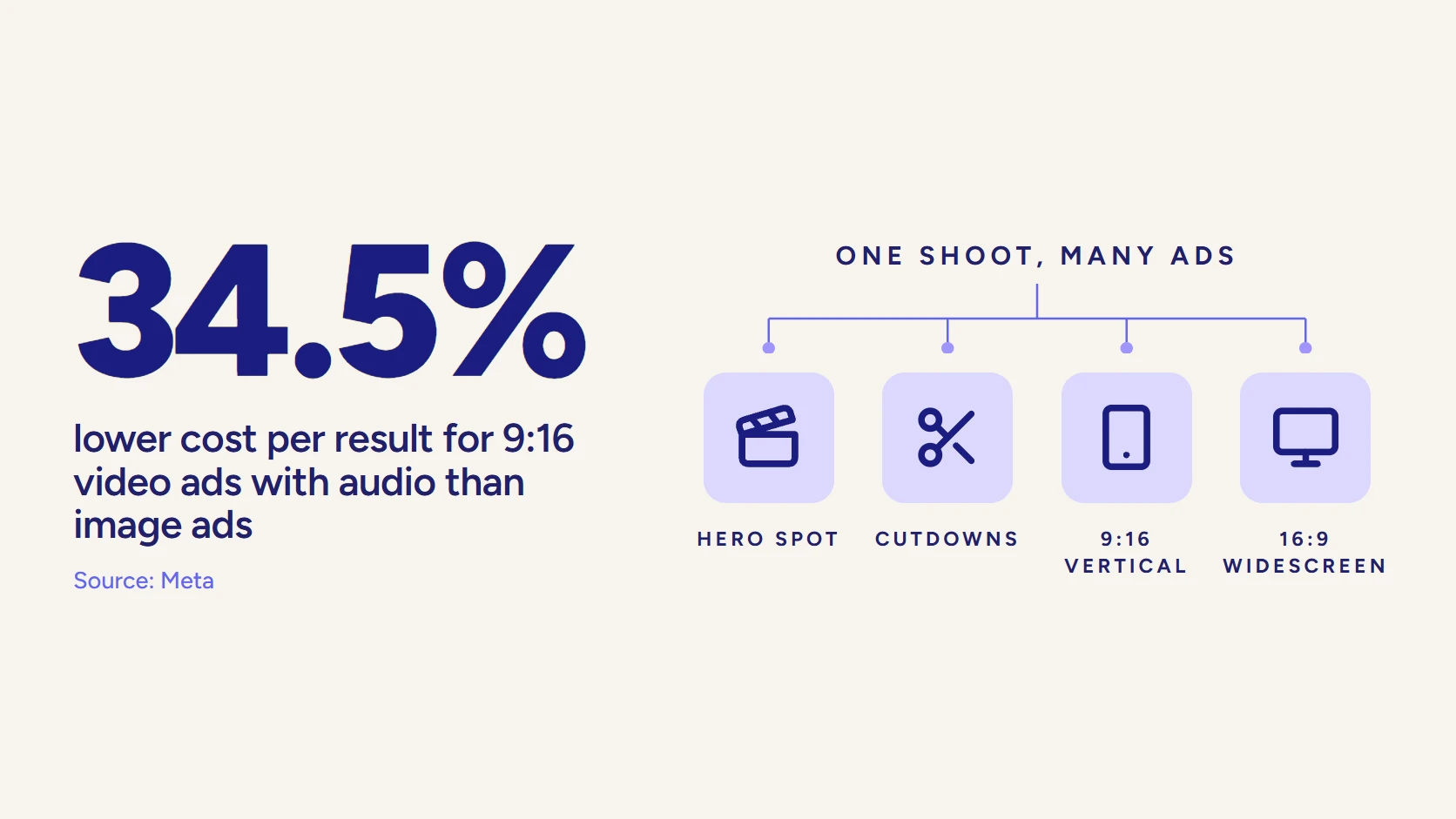
The core idea is simple: plan one campaign shoot around the full set of assets you will need, so a single production fills a month or more of channel-specific content.
This matters because paid competition keeps rising. U.S. digital video ad spend grew 18% in 2024 to $64 billion, and IAB projected $72 billion for 2025. More spend means more clutter, which means you need a steady supply of fresh, on-message cuts to keep paid efficiency from sliding.
Producing each of those cuts as a separate shoot is slow and expensive. Producing them from one well-planned capture is neither.
What One Campaign Shoot Can Yield
When the shoot is planned for outputs, a single production day commonly produces:
- A 60 to 90 second hero film for the website and launch campaigns.
- Three to five LinkedIn feed clips, each making one clear point.
- Short paid variants in vertical, square, and landscape for LinkedIn and YouTube.
- A YouTube product or customer-story version with a search-led title.
- Retargeting cuts that add proof for buyers who already engaged.
- Sales-ready snippets reps can send in follow-up to answer common questions.
That is a hero asset plus roughly a dozen supporting cuts from one capture. The shoot is planned once, but the output supports awareness, consideration, retargeting, and sales for weeks.
A Worked Example
Take a mid-market SaaS team launching a new platform feature. Instead of booking three separate shoots, they plan one. The crew captures the founder explaining the problem, a product lead demonstrating the workflow, and a customer describing the outcome.
From that single day, the agency cuts a 75 second hero film for the launch page, four LinkedIn clips (one per buyer objection), a 30 second YouTube pre-roll, a six second bumper, two retargeting cuts with the customer proof, and a handful of sales snippets. The launch runs for six weeks on assets produced in one. That is the asset-efficiency model in practice, and it is the difference between a content treadmill and a content system.
The planning discipline is what makes it work. Distribution and outputs are decided before the shoot, so capture prioritizes clean audio, tight framing that survives a crop to vertical, and the specific moments each cut will need. Post-production gets easier when the capture plan already knows the outputs.
How Do You Evaluate a Social Media Video Production Agency for B2B Performance?
Portfolio quality is table stakes. The stronger question is whether the agency can turn one production investment into campaign-ready assets your marketing and sales teams can actually use.
Most consumer and UGC shops cannot, because they are built for a different buyer.
The Evaluation Checklist
Use these criteria before you sign anything. A B2B performance partner should clear all of them:
- Strategy before camera. Do they ask what the video needs to do, or only what you want it to look like? The answer reveals whether you are buying a system or a clip.
- Distribution planned up front. Can they tell you the full asset list, by channel and buyer stage, before the shoot? If formats are an afterthought, you will end up cropping one asset into too many jobs.
- B2B buyer fluency. Do they understand demand gen, sales enablement, and the buying committee, or do they talk in follower counts and trends?
- Multi-asset delivery. Does one engagement produce a hero piece plus the cutdowns, or does each clip cost another project?
- Usage rights and approvals. Are customer and executive permissions, talent releases, and channel usage rights handled cleanly before distribution?
- Specs and paid discipline. Do they build captions, hooks, aspect ratios, and safe zones into the edit so assets run in paid without rework?
- Measurement framing. Do they talk about pipeline influence and buyer movement, or only views and impressions?
- Multi-market reliability. If you run programs across cities or on tight deadlines, can they deliver the same standard every time?
B2B Performance Agency vs. Consumer or UGC Shop
| Dimension | B2B performance agency | Consumer or UGC shop |
| Primary goal | Pipeline, SQLs, booked calls | Views, reach, follower growth |
| Audience | Buying committee, defined accounts | Broad consumer feed |
| Output | Hero asset plus channel cutdowns | High volume of standalone clips |
| Planning | Distribution and stage mapped first | Post then see what sticks |
| Success metric | Influence on revenue | Engagement rate |
| Credibility bar | Executive and customer-grade | Casual, fast, disposable |
If an agency scores well on the left column, it can serve a pipeline-accountable team. If it lives in the right column, it will produce content that performs in a feed and disappears from your demand gen report.
What Specs, Hooks, Captions, and Safe Zones Protect Paid Efficiency?
Specs are not a technical detail you sort out at export. They decide whether an asset runs cleanly in paid or quietly wastes spend.
Getting them right protects the efficiency of every dollar behind the video.
LinkedIn Video Specs to Build To
LinkedIn accepts 1:1 (square), 4:5 (vertical), 9:16 (portrait), and 16:9 (landscape) video, requires the MP4 format, caps files at 500MB, and recommends keeping ads short to qualify for more placements.
For mobile feed, 4:5 takes up more screen space than landscape and tends to hold attention better, so vertical and square should be the default for feed clips. Save 16:9 for YouTube and desktop placements.
Captions and Sound-Off, Not Optional
Picture the buyer catching your clip in line for coffee, phone on mute. That is the default viewing condition. Most people watch social video with the sound off, and video optimized for silent viewing, with captions and on-screen text, sees about a 21% lift in engagement.
So every B2B social cut should be legible muted. That means burned-in captions, the core idea shown on screen, and a hook that works as text in the first two seconds.
The Hook and Safe-Zone Checklist
Run every social cut through this before it ships:
- Hook in 2 seconds. Name the buyer or the problem immediately. Do not open on a logo or a slow establishing shot.
- One idea per clip. A six second bumper carries one memory cue. A 30 second clip carries one argument, not five value props.
- Captions on by default. Burned-in, legible, and accurate.
- Safe zones respected. Keep key text and faces clear of the platform UI that overlays the top and bottom of vertical video, so nothing important is covered by buttons and handles.
- Visual clarity without sound. The point should land muted, then be reinforced by audio for those who turn it on.
- Clear next step. End on one obvious action, matched to the buyer stage, without over-explaining.
- Length matched to placement. Short for feed and reach, longer only where the buyer has patience and intent.
When these are built into the edit rather than patched on later, the same footage runs across LinkedIn, YouTube, and retargeting without a re-edit, which is exactly where the asset-efficiency model pays off.
What Common Mistakes Do B2B Teams Make With Social Video?
Even teams with budget and intent fall into a few predictable traps. Knowing them is the fastest way to protect your spend.
- Treating cadence as the strategy. Posting often is not a plan. Monthly video posting has roughly doubled from two to four posts as more teams commit to video, and weekly uploads lift engagement about 23% over irregular posting, but cadence only helps when each clip has a job. Volume on top of no message just produces more noise.
- Shooting before planning distribution. When you decide formats after the shoot, you crop one asset into jobs it was never framed for. Plan the outputs first.
- Repeating awareness creative in retargeting. Showing an engaged buyer the same intro clip again wastes the warm moment. Retargeting should progress the message and add proof.
- Optimizing for the wrong audience. Chasing broad engagement pulls in viewers who will never buy. For B2B, the right 4,000 views inside your accounts beats 400,000 from the open feed.
- Ignoring sales enablement. The same footage that fuels marketing can arm reps with proof clips for follow-up. Teams that skip this leave half the value of the shoot on the table.
- Reporting impressions to leadership. If the only number you can show is views, you have not connected the work to pipeline. Build the measurement plan before the campaign, not after.
What Are the Most Frequently Asked Questions About B2B Social Video Production?
What Is a Social Media Video Production Agency?
It is a partner that plans, produces, and packages video specifically for social channels. For B2B, the strongest ones build a connected system of assets, a hero piece plus channel-ready cutdowns for LinkedIn, YouTube, paid, and sales, each engineered to move buyers toward a conversation rather than just collect views.
How Much Should a B2B Team Budget for Social Video?
Think in campaigns, not single clips. Performance-grade B2B social video usually lives inside campaign budgets that start around $20,000 and scale into $50,000 to $150,000 programs, because the spend covers one planned shoot plus a full set of channel cutdowns.
The cost-per-asset drops sharply when a single production fills a month of distribution, which is why asset planning matters more than chasing the lowest quote.
How Often Should B2B Brands Post Video on LinkedIn?
Consistency helps, with weekly uploads lifting engagement about 23% over irregular posting. But cadence is a multiplier, not a strategy. A planned campaign shoot gives you enough quality cutdowns to post weekly without scraping for filler, which is the right way to hit a steady rhythm.
In-House or Agency for B2B Social Video?
In-house teams are strong for fast, native, ongoing posts and founder-led clips. An agency earns its place on the campaign-grade work: planning a shoot for multi-channel output, producing executive and customer content at a credibility bar that survives a buyer’s scrutiny, and delivering a system of cuts you can run in paid.
Many teams run both, in-house for daily presence and an agency for the campaigns that have to perform.
Which Is Better for B2B, LinkedIn or YouTube?
They do different jobs. LinkedIn reaches the buying committee in the feed, where video is shared 20 times more than any other format. YouTube is where buyers research before they engage, with 60% of B2B buyers using it during vendor evaluation. A complete program uses both, and the asset model lets you feed both from one shoot.
How Do You Measure B2B Social Video for Pipeline, Not Vanity?
Set the measurement plan before the campaign. Track movement that ties to revenue: engaged target accounts, video-influenced opportunities, demo or call requests from retargeted viewers, and sales reply rates on clips reps send.
Use views only as a leading indicator. 72% of B2B buyers say vendor video shapes their shortlist, so the question is whether your video reached the right accounts and moved them, not how many people watched.
Should B2B Social Video Be Vertical or Horizontal?
Default to vertical or square for feed and mobile, where 4:5 and 9:16 take up more screen and hold attention, and keep 16:9 for YouTube and desktop placements. A well-planned shoot frames key action and text to survive the crop, so the same footage delivers both.
How Long Should a B2B Social Video Be?
Match length to placement. Use six seconds for a bumper, 15 to 30 seconds for feed and pre-roll, and longer only on YouTube where buyers are actively researching. LinkedIn recommends keeping ads short to qualify for more placements, so a tighter cut often reaches more of your audience.
How Do You Build a Social Video System That Feeds Pipeline?
If your social video is producing views but not conversations, the problem is usually the plan, not the camera. LocalEyes builds performance B2B campaign video engineered to drive SQLs and pipeline, planned from one shoot into the LinkedIn clips, YouTube versions, paid variants, and sales cuts your team can actually run.
The work starts with your goal, your buyer, and the channels you already run, then we shape the creative and deliverables around what your campaign needs.
See how our commercial and social media video ad production services turn one campaign into a month of channel-ready assets. When you are ready, book a call and get an estimate, and we will map the asset system before anyone picks up a camera.

Founder at LocalEyes Video Production | Inc. 5000 CEO | Emmy Award Winning Producer