Key Takeaways
|
Mobile video advertising is paid video built for mobile environments, including apps, mobile web, feeds, Stories, Shorts-style platforms, native placements, and YouTube.
It changes how your creative needs to work because viewers scroll fast, watch muted, and judge relevance almost instantly. Mobile video advertising often fails when teams create a single hero video, then crop it for mobile after production.
Mobile is now too central to treat as an afterthought. Here’s what recent data is telling us:
- DataReportal’s Digital 2025 report says there are 5.78 billion mobile users globally, with mobile reaching more people than the internet itself.
- IAB’s 2025 Digital Video Ad Spend & Strategy Report found that U.S. digital video ad spend grew 18% year over year in 2024 to $64 billion. IAB projected it would reach $72 billion in 2025.
- EMARKETER’s 2025 U.S. mobile advertising forecast projected that nearly two-thirds of digital ad spending would be delivered on mobile devices.
This article explains how mobile formats, specs, safe zones, captions, hooks, and production systems should shape your next campaign.
Why Mobile Video Advertising Changed the Rules of Video Production
Many business-to-business (B2B) teams face a planning challenge with mobile video ads.
For example, the production starts with one polished hero video. Then, the team requests mobile cuts after the main edit has already been approved. By then, the most important mobile decisions have already been missed by accident:
- The subject may sit too far from the center.
- The first five seconds may build slowly.
- The call to action (CTA) may land too late.
- The copy may depend on audio that the viewer never turns on.
Mobile-first production starts earlier. Before filming or animation begins, the team decides where each asset will run and what each version needs to do.
Mobile-first video ads account for:
- Fast Scroll: The first frame has to create a reason to stop.
- Muted Viewing: Text and visuals must convey the message.
- Tight Visual space: Small screens punish cluttered layouts.
- Platform Overlays: Interface elements can cover key information.
- Short Patience: Slow setup often loses the viewer before the point lands.
This is especially important for B2B teams. Complex products and services still need nuance. But mobile environments don’t give you unlimited time to explain. The creative has to create enough clarity for the next step.
Poor mobile adaptation wastes media spend before the message lands.
What Mobile Formats and Specs Actually Mean for Performance
Specs become strategic when they affect visibility, message retention, and completion.
Aspect ratio, length, captions, and safe zones aren’t production housekeeping. They shape whether the viewer can understand the ad in the actual placement.
Use this table to plan the right mobile format before production begins.
| Format | Typical Ratio | Best Use Case | Main Risk If Misused |
| In-Feed Mobile Video | 1:1 or 4:5 | Scroll-based awareness and demand generation | Weak hook gets skipped fast |
| Stories or Reels-Style Video | 9:16 | Vertical, full-screen short-form campaigns | Cropped messaging or buried CTA |
| Shorts-Style Vertical Video | 9:16 | Fast reach, retargeting, and message reinforcement | Too much context for a short format |
| Native In-Article Video | 16:9, 1:1, or responsive | Awareness inside content environments | Viewer intent may be low |
| Interstitial Video | 9:16 or 16:9 | High-visibility mobile moments | Can feel disruptive if unfocused |
| Rewarded Video | 9:16 or 16:9 | App-based value exchange placements | Less relevant for many B2B campaigns |
| Bumper-Style Mobile Ads | 16:9, 1:1, or 9:16 | One-message recall and reinforcement | Cannot carry a full pitch |
- A vertical video ad can create more screen presence in a full-screen placement.
- An in-feed mobile video may need tighter copy and a faster visual setup.
- A native placement may need to feel useful inside the content environment.
Our guide to native video advertising explains how these placements differ from display. For example, bumper-style placements also require a narrow message. YouTube bumper ads are only 6 seconds long, so they work best for a single idea.
Safe zones also affect performance. Platform interface elements can cover logos, captions, and CTAs. Keep essential information centered, readable, and uncluttered.
What Strong Mobile Video Ads Do in the First 3 Seconds
The opening frames carry the most pressure on mobile. A viewer may never reach your strongest product shot or proof point. If the first few seconds feel slow, unclear, or irrelevant, the campaign loses attention early.
Strong mobile openings usually use one of these patterns:
- Movement: Use motion early to interrupt the scroll without feeling gimmicky.
- Pain-Point Framing: Name the audience problem before the viewer has to infer it.
- Visual Contrast: Make the first frame easy to understand on a small screen.
- Direct Audience Signal: Show who the ad is for through text, context, or visual cues.
- First-Frame Text: Add clear copy when sound may be off.
In short, avoid slow intros, logo-first openings, and vague cinematic setups. B2B mobile creative doesn’t need gimmicks to earn attention.
A healthcare, finance, or software-as-a-service (SaaS) ad can open with a specific buyer problem, a clear visual, or a role-based line of copy. The point isn’t to make the ad louder. It’s to make the right viewer recognize it faster.
For example, “Your claims workflow is slowing revenue” gives a finance or healthcare buyer more context than a slow logo reveal. “See where handoffs break” gives a SaaS evaluator a reason to keep watching.
The first three seconds should answer three questions:
- Who is this for?
- What problem is it about?
- Why should I keep watching?
That’s the standard for mobile-first video ads. Clarity has to arrive before polish can matter.
Why Sound-Off Design and Caption Strategy Are Now Mandatory
Mobile viewing often happens muted, distracted, or in public.
A buyer might see your ad between meetings, during a commute, or while using another screen. Voiceover cannot carry the full story in that environment.
Sound can strengthen the message. It shouldn’t be required to understand it.
Plan for sound-off viewing with:
- Burned-In or Platform-Safe Captions: Keep key lines readable across placements.
- High-Contrast Text: Make text legible on small screens and busy backgrounds.
- Clear Visual Sequencing: Let the viewer follow the story without audio.
- Centered Focal Points: Keep the main subject away from interface overlays.
- Supportive Graphics: Use graphics to clarify, not decorate.
Captions support accessibility and buyer comprehension.
A muted ad can still educate when the text, visuals, and pacing work together. A sound-dependent ad loses relevance before it earns a chance.
This also connects to second-screen advertising strategies. Mobile viewers often split attention across devices, apps, and tasks. Your ad should survive fragmented attention without making the viewer work too hard.
What Stronger Teams Are Doing Differently With Mobile-First Production
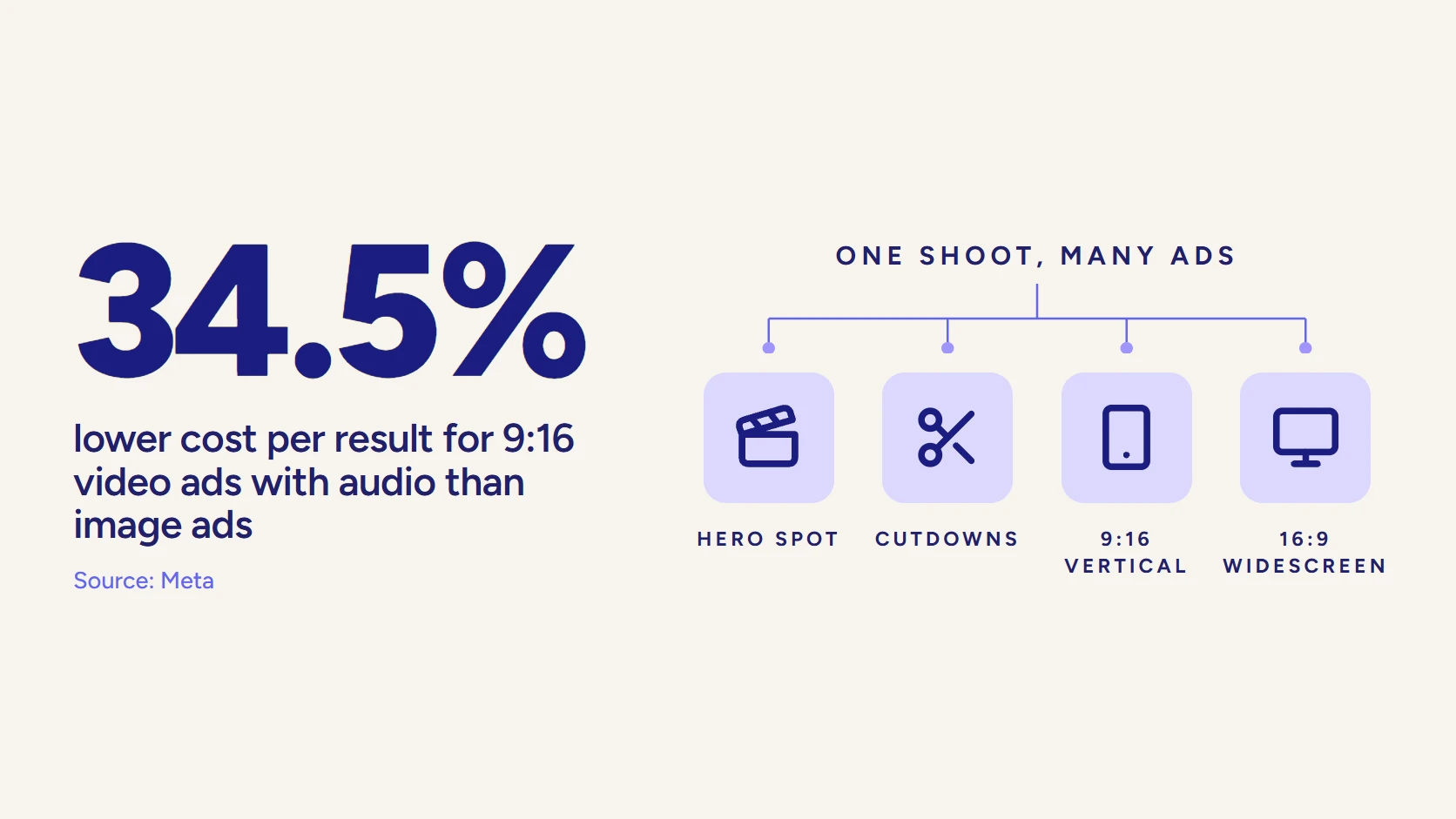
More effective teams plan mobile-first production around modular creative, platform-aware cuts, and repeatable testing. The goal of video ad production is a campaign-ready asset system connected with creative planning.
For example, a SaaS campaign might start with one core message. That message can become:
- A vertical hook for short-form mobile video platforms.
- A square feed cut with captions.
- A muted retargeting clip.
- A six-second reminder ad.
- A sales-ready snippet for rep follow-up.
This approach makes production more useful and gives paid media teams more to test than one audience or placement.
Use this framework before production starts:
- Primary Screen: Where will the viewer most likely see the ad?
- Audience State: Is the viewer cold, warm, retargeted, or account-based?
- Core Hook: What must land in the first three seconds?
- Format Mix: Which ratios, lengths, and placements are needed?
- Caption Plan: Can the ad work without sound?
- Reuse Plan: What paid, owned, and sales assets should come from the same production?
- Testing Plan: Which hooks, text overlays, and pacing choices should be compared?
This is where mobile ad creative best practices come into play.
You’re not testing the creative after production as a patch. You’re building testable creative into the production plan.
How LocalEyes Helps Teams Adapt to Mobile Video Advertising
Mobile video advertising works better when the creative is planned for the screen, placement, and buyer stage.
LocalEyes helps B2B teams create channel-ready campaign videos for paid, owned, and sales use. That includes mobile-first hooks, safe-zone-aware design, caption-ready creative, and multi-asset delivery.
The work starts with message clarity. Then, we shape the cuts, formats, and deliverables around where the campaign needs to perform. This can include vertical video ads, in-feed cuts, bumper-style edits, retargeting clips, and sales follow-up assets.
If your team needs a performance-driven B2B campaign video, explore our video ad production services.

Founder at LocalEyes Video Production | Inc. 5000 CEO | Emmy Award Winning Producer