Fast answer
Key Takeaways
- A video content agency owns strategy and a pipeline of channel-ready assets, not just a single shoot.
- A production company executes a brief; an agency decides what to make and why before anyone picks up a camera.
- Buy an agency when you need ongoing video mapped to the funnel, not a one-off film or a single freelancer hire.
- The right partner ties video to pipeline and revenue, then cuts every hero asset down into channel-ready versions.
- The test that separates the two: can they tell you what the video must do before they tell you how it will look?
“Video content agency” is a phrase that has been stretched until it barely means anything. One vendor pins it on a crew that shows up with a camera, while the shop next door calls itself a creative video agency, or a video marketing agency, and sells the same thing under a different sign.
The words sound precise, but the market treats them as interchangeable, and that quiet gap costs marketing teams real money. A real video content agency owns your video strategy: it decides what to make and why, then runs an ongoing pipeline of channel-ready assets mapped to how buyers actually move through your funnel.
That is not a one-off shoot with a nicer invoice, and it is not a freelancer you brief once and forget. Most companies that struggle with video do not have a production problem at all. They have a strategy problem, and it hides behind footage that looks fine but never moves a number.
Getting a single film made is easy. Deciding which videos move a pipeline, in what order, for which audience, and then keeping that engine running quarter after quarter, is the hard part. This guide draws the lines: where an agency ends and a production company or freelancer begins, what an agency actually produces, and when each one is the right call.
What Is a Video Content Agency?
A video content agency plans, produces, and packages video as an ongoing program instead of a single deliverable. Its one job is to tie video to specific business outcomes, then run the production and distribution that turns that plan into assets your team can use.
The Word Doing the Heavy Lifting: Ongoing
A production company thinks in projects. A brief arrives, a video ships, and the relationship pauses until the next one. An agency thinks in pipelines, and it keeps one full so the next asset is ready before the next launch needs it.
An agency also decides what to make, which is where the leverage lives. It reads your audience, your goals, and the gaps in your funnel, then recommends the video content types that will close them rather than waiting for you to name a format.
The Three Layers You Are Actually Buying
The output arrives in three layers a pure production shop rarely sells together, and it helps to see them named side by side:
- Strategy. The plan for what to make, in what order, and for whom, tied to a business outcome before anyone loads a camera.
- Production. The filming, animation, and editing that turn the plan into finished hero assets.
- Packaging and distribution. The work that turns one shoot into the many channel-ready pieces your team runs, then lands each one where it belongs.
A freelancer sells you the middle layer. A production company sells the middle layer with a bigger crew. An agency sells all three as one accountable engine, and that difference is the whole reason the category exists.
The Test That Settles It
Here is the question that separates the two in a single call. Ask a prospective partner what a video needs to accomplish before you ask how it will look. A production company will happily quote the second question. An agency insists on answering the first.
How Is a Video Content Agency Different From a Production Company or Freelancer?
All three make video. The real difference is where the thinking happens, and how far it travels once the shoot wraps.
Where the Thinking Happens
A freelancer is a skilled pair of hands for a bounded job. A production company is a crew that executes a plan you bring. An agency owns the plan itself, produces against it, and packages the result for your channels.
| Dimension | Freelancer | Production company | Video content agency |
|---|---|---|---|
| Owns | One shoot | Execution | Strategy plus a pipeline of assets |
| Best for | A one-off | You already have the plan | Ongoing video mapped to the funnel |
| Thinks about | The shot | The video | The funnel and pipeline |
None of these wins in the abstract, because each wins for a different job. If you already have the script and just want it shot well once, a freelancer or production company is the efficient choice, and paying agency rates to execute a plan you already built is waste.
What Changes When One Video Becomes a Program
So what happens when “one video” becomes “a video program”? The work of briefing, sequencing, and packaging a full slate of video production services yourself starts to outweigh the per-shoot savings, and that coordination is exactly what an agency exists to own.
There is a quality dimension underneath that, and it comes down to a simple pair of ceilings:
- A freelancer’s output is only as consistent as that one freelancer on that one day.
- A production company’s output is only as strategic as the brief you hand it.
- An agency’s output is accountable for both the craft and the strategic fit, because it wrote the brief in the first place.
The Accountability Difference
That last point is the one buyers underrate. When a video underperforms, there is no gap between who planned it and who made it for the failure to hide in. The agency owns the outcome end to end, so a miss becomes a lesson for the next round instead of a finger-pointing exercise.
What Does a Video Content Agency Actually Produce?
A good agency does not sell you a video. It sells you a system of formats, each aimed at a stage of the buyer’s journey and built to do one job.
The common mistake is buying a single format, usually a brand film, and expecting it to carry the whole funnel. Awareness content and decision content are different tools, and one cannot do the other’s work.
| Video format | Buyer stage | Primary goal | Typical placement |
|---|---|---|---|
| Brand film | Awareness | Reposition, brand halo, recruiting | Homepage hero, paid social |
| Product / platform video | Consideration | Launch, product marketing, conversion | Product pages, launch, retargeting |
| Customer story | Decision / proof | Sales enablement, credibility | Sales, industry, ABM |
| Executive / event | Trust / ABM | Exec presence, keynotes, internal comms | Conferences, ABM, employer brand |
The Format System, Read as a Supply Chain
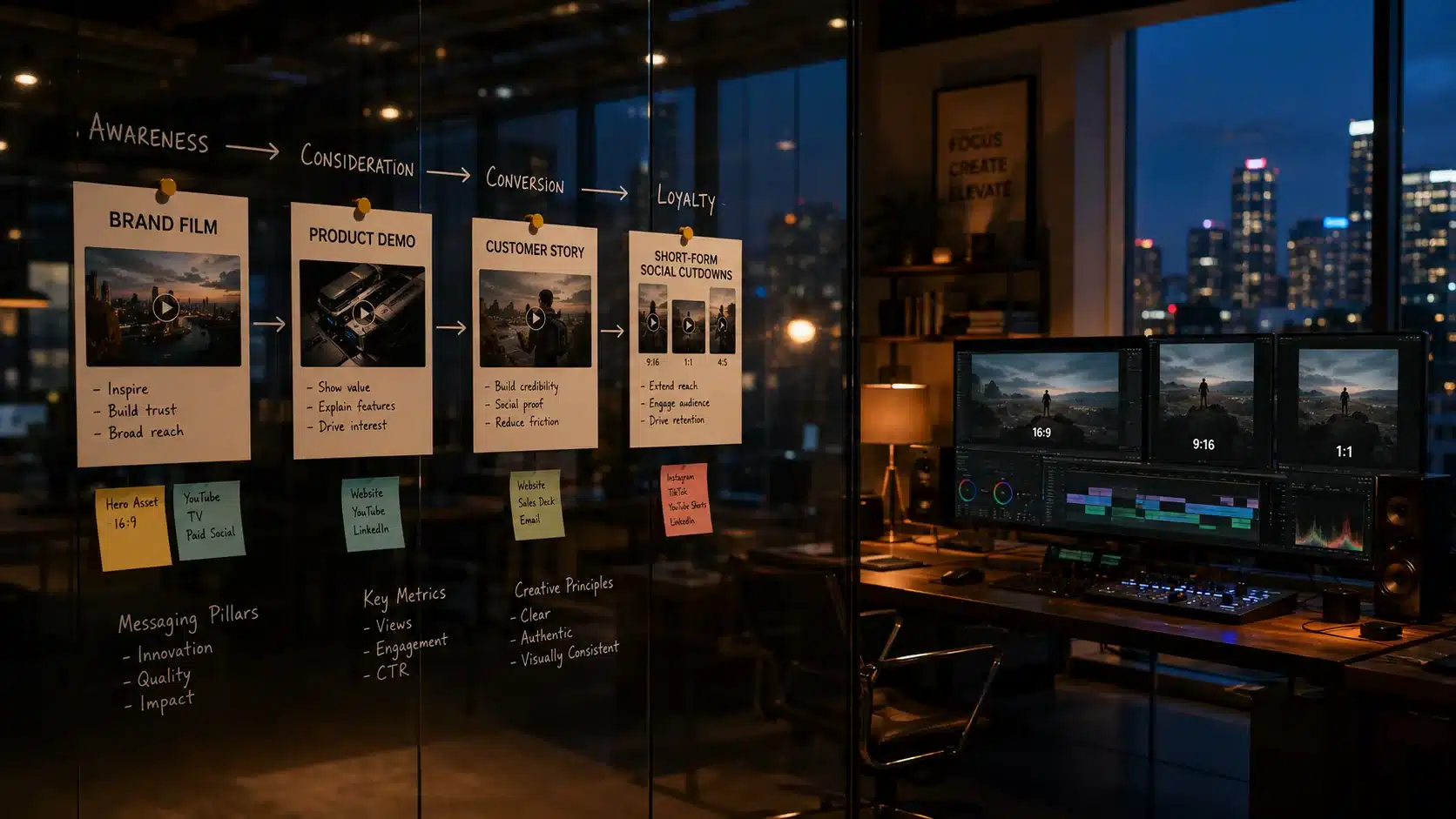
Read that table as a supply chain, not a menu. Each format hands the viewer to the next, and the sequence usually runs like this:
- Brand film. A well-made brand video earns the top-of-funnel attention everything downstream depends on, the way a factory’s first stage feeds every station after it.
- Explainer or product demo. An explainer or product demo answers the consideration question of how the thing actually works.
- Customer story or testimonial. A testimonial video supplies the proof a buyer needs before committing.
- Executive or event piece. A leadership or event film builds the trust that carries an account-based motion into the room.
From One Shoot to a Month of Feed
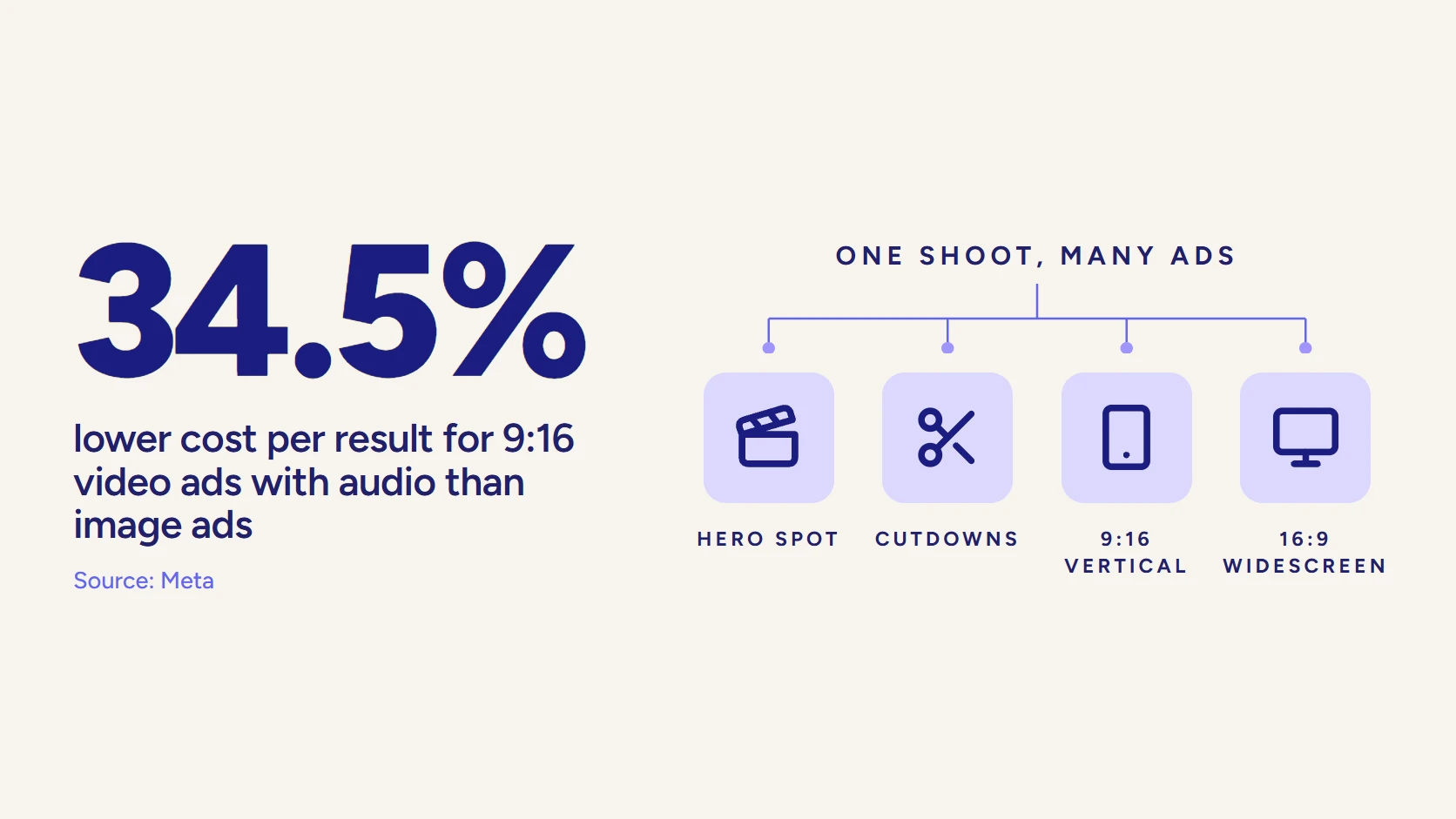
Around those hero assets sits the connective tissue teams tend to underestimate: short-form content. Every hero film gets cut into channel-ready versions, usually fifteen, thirty, and sixty-to-ninety-second edits sized for LinkedIn, YouTube, and retargeting.
That connective tissue is no longer optional. Short-form now generates roughly 2.5x the engagement of long-form on social, and marketers have ranked it their top ROI format three years running. It is how one shoot becomes a month of feed.
The reusability is the whole point. One well-planned shoot can yield a hero film, a product demo, three customer soundbites, and a dozen social cuts, feeding the website, the social platforms, sales, and retargeting from a single production day. Judged per asset instead of per project, strategy-led production is often the most efficient content a marketing team can buy.
How Does a Video Content Agency Map Video to the Funnel?
Mapping the video marketing funnel means deciding, before anyone writes a script, which asset serves which stage, audience, and goal. Done right, the finished library covers the whole journey instead of piling up in one spot, and that mapping is the work you are actually paying for.
Start With Goals, Not Cameras
Where does it start? With a single question about the business, not a shot list. What does the company need more of, and the honest answer sets the video marketing strategy for everything downstream:
- Awareness. A team that needs top-of-funnel reach gets a brand story and a heavy short-form program.
- Qualified pipeline. A team drowning in unqualified leads gets consideration and decision content, so the right buyers self-select and the wrong ones fall away.
- Faster cycles or retention. A team fighting slow deals or churn gets proof and product content aimed squarely at the moment of doubt.
Sequence, Then Distribute
Then the agency sequences the formats. Awareness content ships first because it feeds the top, and proof content follows because it converts the demand that awareness created. Get the order wrong and you end up with four beautiful videos all speaking to one stage while the rest of the funnel sits empty.
Distribution belongs on the map, not in a footnote. An agency plans where each asset runs before it is made, which platform, which landing page, which sales sequence, and that decision shapes the creative itself. A film built to autoplay silently in a feed is edited nothing like one built to open a keynote.
The LocalEyes Blueprint: goal to compounding program
- Goal-First AlignmentStart with the business outcome, not the camera. Decide what the pipeline needs more of, whether that is awareness, qualified leads, faster cycles, or retention.
- The Video BlueprintMap each format to a funnel stage, audience, and goal, then sequence them so awareness ships first and proof follows the demand it creates.
- Production to one standardFilm, animate, and edit the hero assets to a single quality bar, whether the shoot is in one market or ten.
- Packaging and distributionCut every hero film into channel-ready versions and place each one where it runs, from LinkedIn and YouTube to product pages and retargeting.
- Measure and adjustReport on whether each asset did the job it was built for, then tune the next round from what the numbers say.
What does good mapping protect you from? The two most common video mistakes, and they are opposite failures of the same missing plan:
- Top-heavy. Over-investing in a single brand story and starving the middle and bottom of the funnel.
- Bottom-heavy. Producing demos and educational videos with no top-of-funnel content to bring them an audience.
Video that has to work?
Book a discovery call with LocalEyes Video Production and start from the goal, not the brief.
The Measurement Loop
Underneath all of it sits measurement. Because an agency owns the strategy, it can be held to an outcome instead of a deliverable. The right partner tells you what each asset was meant to do, reports on whether it did it, and adjusts the next round from what the numbers say. That loop, plan to produce to measure to adjust, is the difference between a program that compounds and a folder of expensive files.
How Does a Video Content Agency Get Your Video Found?
The short answer: a good agency builds each asset to be discovered, not just watched. A production shop’s job ends at the export, but an agency treats discovery as part of the brief, because a film nobody surfaces is a sunk cost, not an asset.
That work runs on three fronts, and most vendors cover only the first one:
- Search. A relevant video on a landing page lifts dwell time and gives the page more to rank for, and the agency writes the titles, descriptions, transcripts, and chapter markers that let a search engine read a clip it cannot watch.
- AI answer engines. When a buyer asks an assistant how a product category works, the sources that get cited are the ones structured to be quoted, so each hero asset is paired with a transcript and a written companion an engine can extract.
- Platform discovery. YouTube, LinkedIn, and TikTok each rank video by their own signals, and a cut built for one feed rarely lands in another, so every asset is packaged for the platform where it runs.
Why video earns its place in the plan
The numbers behind that discipline are hard to argue with. 73% of B2B marketers say video positively impacts their marketing results and ROI, which is why the layer most vendors skip, structuring an asset to be quoted by an AI engine, is where a brand lands in the answer itself instead of the tenth blue link below it. Packaging every asset for the platform where it runs is what turns a single shoot into reach across all of them.
What Results Should a Video Content Agency Drive?
A production vendor is measured on whether the video looks good. A video content agency should be measured on whether the business moved. That is the higher bar, and the more honest one.
Video is not cheap, and it should not be bought as decoration. Buy it as a performance asset that drives pipeline and revenue, then judge it on exactly that.
Outcomes Over Output
Look for outcomes, not output. The strongest signal a partner can show is a documented result tied to a real program, such as a jump in qualified pipeline, a measurable conversion lift, or a launch that beat its number. Verified LocalEyes Video Production client outcomes include a 90% sales increase for NewAir and more than $2M in enrollment impact for USC.
LocalEyes at a glance
Credibility and Consistency
Credibility markers matter because they tell you whether the work holds up at the level you are buying at. Awards, review volume, satisfaction scores, and the caliber of the client roster are all shorthand for a team you can trust with a program, not just a project.
One more thing worth checking is consistency across markets and over time. A single great video is not proof of a great agency, but a track record of them, produced to one standard whether the shoot is in one city or ten, is. Clients like Zapier and Harvard who keep coming back tell you more than any single reel, because reusable quality at scale is the thing an agency sells that a freelancer structurally cannot.
How Much Does a Video Content Agency Cost?
You do not really buy “a video content agency” by the hour. You buy a program, priced by the asset set, the number of markets, and the outcomes it is built to drive.
Ongoing programs in the premium B2B tier are usually packaged as multi-asset campaigns, and the industry range for that work generally runs from about $50,000 to $150,000 depending on scope.
| Package | Investment | Best for |
|---|---|---|
| Brand campaign | $50K | Single hero film + channel cutdowns |
| Growth campaign | $75K | Hero plus supporting assets across the funnel |
| Multi-asset campaign | $100K | Several formats, multiple markets |
| Enterprise campaign | $150K | Full multi-market, multi-stage rollout |
What Sets the Price
Those figures are industry ranges, not fixed prices, and the right number sits somewhere on a ladder. A single hero film with a set of social cutdowns lands at the entry, while a full multi-market, multi-stage rollout across several formats sits at the top.
Focused projects and blended engagements often land lower, in the $20,000 to $45,000 range, when the scope is a set rather than a full program. The pattern across the ladder is simple: size the investment to the outcome, so a team buying awareness reach is not paying for a decision-stage asset set it does not yet need.
The Freelancer-Stack Objection
You might object that stacking a few freelancers and a production company is cheaper. Per shoot, it is. Once you price in the coordination, the misfires, and the assets that do not fit together, faking a program usually costs more than buying one.
Buying a program vs assembling one yourself
Strengths
- One partner accountable for both what gets made and whether it works.
- Strategy, production, and packaging run as one engine, so assets reinforce each other.
- One shoot yields a hero film plus a dozen cutdowns, dropping the cost per usable asset.
- Consistent quality across markets and over time, not the ceiling of a single freelancer.
Watch-outs
- Higher per-invoice cost than booking a freelancer for a bounded job.
- Overkill when you already have the script and just need one shoot executed well.
- You are paying for strategy you may already have in-house.
The agency premium buys strategy, accountability, and a pipeline that compounds. For a team running video as a real channel, that is usually the cheaper path per outcome, even when it is the higher path per invoice.
Because one production yields a hero asset plus a dozen cutdowns, the cost per usable asset drops fast. A campaign re-versioned across social, sales, and paid for months is doing far more work than the invoice suggests, and our corporate video production costs guide breaks the individual format numbers down.
When Should You Hire a Video Content Agency?
Hire an agency when video has graduated from a project to a channel. The trigger is not budget size. It is whether you need someone to own the strategy and keep a pipeline running, or whether you already have the plan and just need it executed once.
The Three-Way Choice
Match the model to the job, not the other way around, and the decision usually resolves itself:
- Choose a freelancer when the job is bounded and you know exactly what you want: a single edit, a specific animation, a one-day shoot with the script already written.
- Choose a production company when you have the creative plan and campaign strategy in-house and need a crew to execute it to a high standard.
- Choose an agency when you need ongoing video mapped to the funnel, want one partner accountable for both what gets made and whether it works, and are running across enough channels and stages that coordinating it yourself has become the bottleneck.
If you remember one thing, remember this. For B2B marketing leaders who have to show pipeline, not just views, the agency model is what turns video from a cost center into a performance channel, and the deciding factor is rarely the camera.
It comes down to whether the team behind the work understands what your video has to do for the business before they decide how it will look. If you are weighing a program for a launch, a campaign, or a full year of content, that clarity is exactly what to test for, and it is the right moment to talk with a team that starts from the goal. That is how LocalEyes Video Production approaches every brief.
Video that has to work?
Book a discovery call with LocalEyes Video Production and start from the goal, not the brief.
Frequently Asked Questions
What is a video content agency?
How is it different from a production company?
How much does a video content agency cost?
Do you handle strategy and distribution-ready cutdowns?
How does a video content agency make video discoverable?

Founder at LocalEyes Video Production | Inc. 5000 CEO | Emmy Award Winning Producer