Fast answer
Key Takeaways
- An enterprise video partner delivers many finished assets from one coordinated production across 10 US markets, not a single freelancer booked for one shoot day.
- Enterprise-grade means multi-market delivery, security and NDA handling, procurement-ready MSAs, and consistent brand quality at volume, capabilities a freelancer rarely carries.
- A retained partner learns your brand once and reuses that knowledge, while a project vendor re-onboards from zero on every new video.
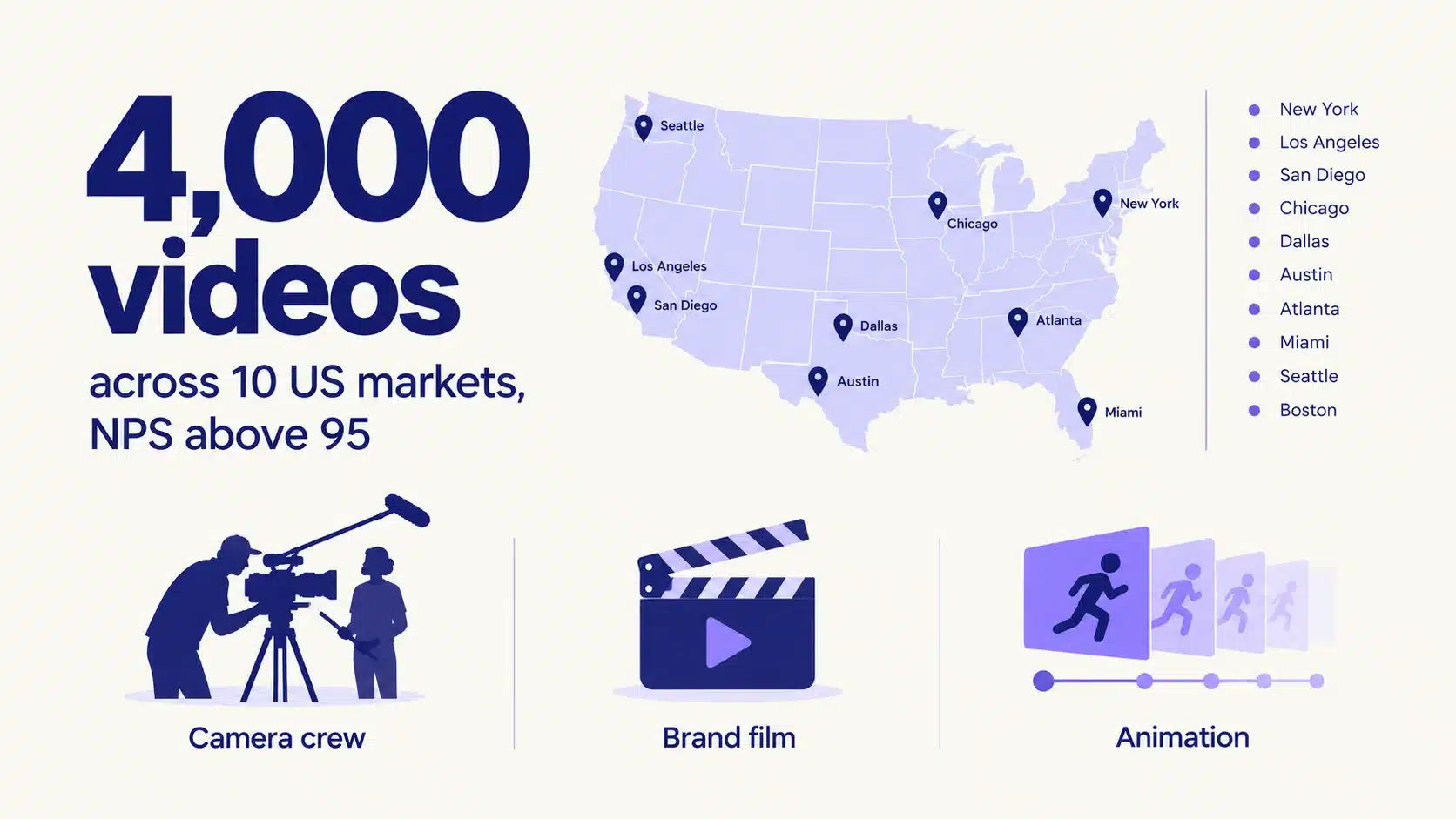
- LocalEyes Video Production has produced 4,000 videos with NPS above 95, evidence that a high quality standard can hold across markets and years.
- A LocalEyes Video Production engagement runs $6,000 to $20,000, scoped to a defined asset set, never billed as a videographer day rate.
A company’s first videos usually come from a freelancer or a single production house, booked for one shoot. That works, right up until video stops being a one-off project and becomes something the whole business runs on.
Then it breaks on scale, not craft. When product marketing, demand generation, recruiting, sales enablement, and internal communications all need video across regions and quarters, the freelancer who shot your last testimonial cannot hold that surface, and neither can a vendor who re-learns your brand from scratch on every brief.
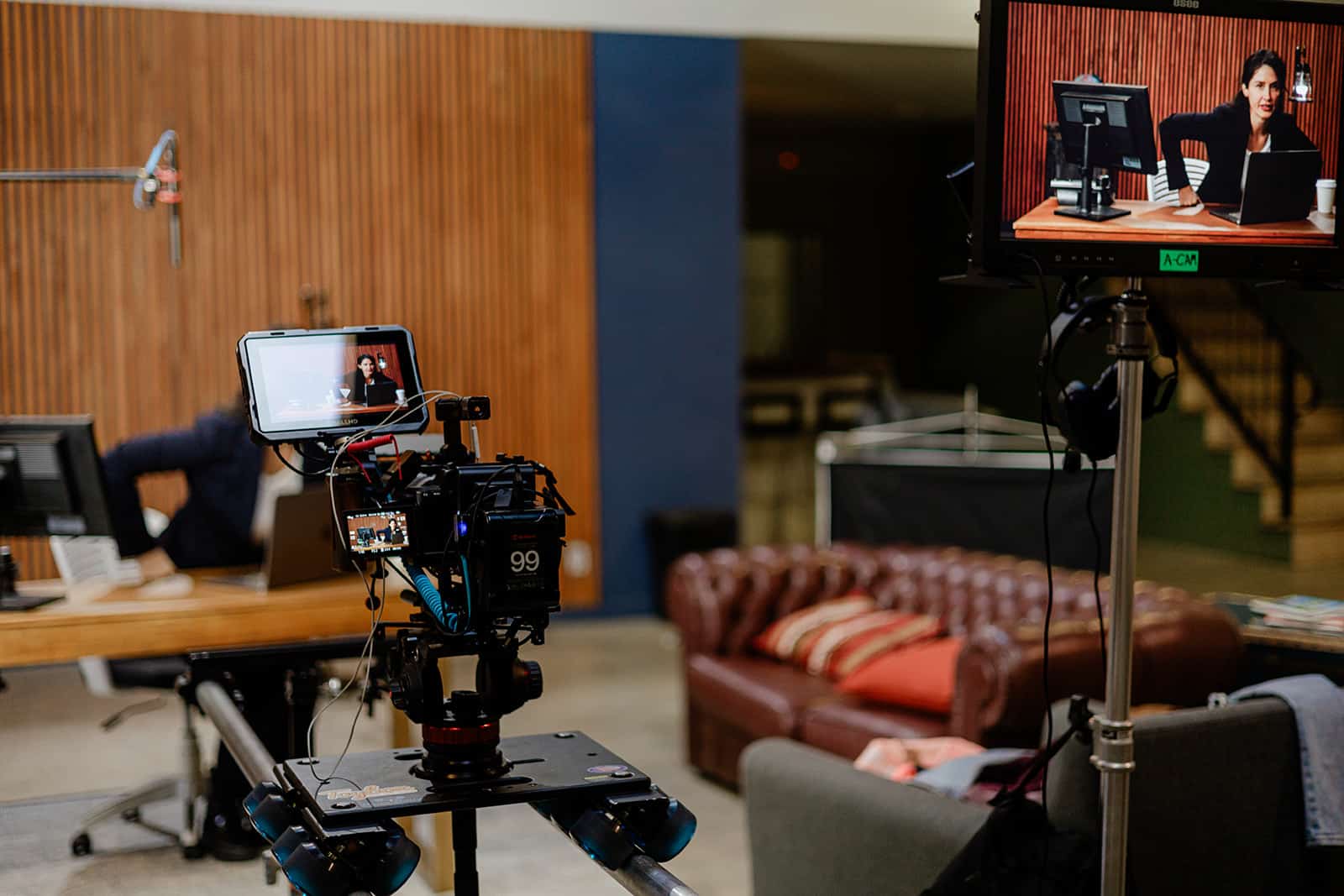
What replaces the patchwork is an enterprise video production partner: one accountable team, camera crews in every market you operate, brand films and animation held to a single standard, and a plan for many finished assets out of each coordinated production.
The real shift is not better cameras. It is treating video as a managed supply of on-brand assets, with an owner, a standard, and a contract behind it.
This guide is for the person signing off on that change, a marketing leader, a brand director, or a procurement lead. It moves in the order the decision actually happens: why the old model breaks, what enterprise-grade means, the assets a program covers, the retained partner model, brand governance, service levels, cost, onboarding, and how to evaluate a partner before you commit.
Why Do Enterprises Outgrow Freelancers and One-Shoot Vendors?
Enterprises outgrow single-person and single-shoot suppliers the moment demand becomes continuous, multi-market, and brand-critical, because those suppliers were built for a project, not a program. The work does not get harder to film. It gets harder to coordinate, secure, and keep consistent.
The Freelancer Ceiling
A great freelancer is a great pair of hands. The ceiling is not talent, it is coverage: one person cannot be in Chicago and Austin in the same week, cannot carry backup crews when someone is sick, and cannot absorb a review cycle with legal, brand, and three stakeholders without the schedule collapsing.
The other quiet cost is memory. When a freelancer moves on, everything they learned about your brand, your product, and your approval chain leaves with them. Your next video starts from zero, and the one after that starts from zero again.
The Single-Shoot Vendor Ceiling
A one-shoot vendor clears the coverage problem for a day and reintroduces it for the year. Each project is re-quoted, re-briefed, and re-crewed, so the final product drifts as you move between suppliers and cities. A polished brand film in one market sits next to a flat talking-head in another, and the brand pays the difference in trust.
Volume exposes the model fastest. A dozen videos a year from a dozen separate quotes is a dozen onboarding conversations, a dozen different color grades, and a dozen chances for the look to wander. That is the exact problem the best video production companies are structured to remove.
The Coordination Tax
The hidden expense is rarely the footage. It is the coordination tax: the internal time spent managing a sprawl of suppliers, sourcing, briefing, chasing files, reconciling invoices, and re-explaining the brand. That work lands on your most senior marketers, the people who should be doing strategy, not vendor admin.
A single partner collapses that overhead into one relationship, one brief, and one point of accountability. The finished videos may look similar to what a good freelancer delivers. The difference is everything that surrounds them.
| What the work needs | Freelancer | Project vendor | Enterprise partner |
|---|---|---|---|
| Multi-market coverage | One person, one city | One crew, re-quoted | Vetted crews across 10 US markets |
| Security and NDA | Ad hoc | Sometimes | MSA, NDA, controlled storage |
| Volume and consistency | Varies by availability | Re-briefed each job | One standard at scale |
| Accountability | You project-manage | Per project | A named team owns outcomes |
| Reuse | Files handed over | One deliverable | A governed asset library |
None of this means freelancers or boutiques are bad. It means they solve a different problem. Enterprise video is a supply chain question, and a supply chain needs an owner.
What Does Enterprise-Grade Video Production Actually Mean?
Enterprise-grade video production means a supplier can deliver consistent, on-brand video at volume, across markets, under the security and contracting terms a large organization requires. It is four capabilities working together, and most of the market has one or two, not all four.
- Enterprise-grade video production
- A supplier that can deliver consistent, on-brand video at volume, across multiple markets, under the security, NDA, and master services agreement terms a large organization requires. It combines multi-market crews, a governed brand standard, procurement-ready contracting, and the capacity to hold quality as output scales.
Multi-Market Delivery on One Standard
Enterprises rarely operate in one city. A partner has to field vetted crews wherever the work is and hold the same creative standard in each, so a shoot in one market looks like it came from the same company as a shoot on the other side of the country. That is a network and a playbook, not a single studio hoping to travel well.
The proof is repeatability. A partner with crews in a market like New York and nine others can keep lighting, framing, and grade identical while the locations change, which is what lets a national campaign feel like one campaign.
Security, NDAs, and Sensitive Footage
Enterprise footage is often confidential: unreleased product, executive messaging, customer data on screens, regulated environments. A serious partner signs NDAs, works inside a master services agreement, and handles raw media on controlled storage with defined access, not a personal laptop and a public cloud link.
The stakes are not abstract. In the United States, the average data breach now costs $10.22 million, and the global average is $4.44 million. A supplier who treats your unreleased footage casually is a line item on that risk, which is why security handling belongs in the evaluation, not an afterthought.
Procurement, MSAs, and Approved-Vendor Status
Getting a supplier approved inside a large company is its own project: security review, insurance certificates, payment terms, and a signed master services agreement. A partner built for enterprise work has done this many times and can move through procurement instead of stalling in it.
The payoff arrives on the next project. Once the paperwork and the approved-vendor status exist, new work starts against an existing agreement rather than a fresh legal review, so the creative process begins in days, not weeks.
Volume and Visual Consistency
The defining enterprise trait is volume held to one look. Producing a handful of strong videos is table stakes. Producing dozens a year, across formats and cities, without the quality wandering is the hard part, and it is where a track record matters.
Consistency at that scale is a system, not a talent. LocalEyes Video Production has produced 4,000 videos on that model, which is the difference between a supplier who can film and a partner who can scale.
What Types of Video Does an Enterprise Program Cover?
An enterprise program covers the full range of business video, from external brand work to internal training, because the point of a partner is one supplier for every format rather than a new vendor per need. The list below is where most enterprise demand concentrates.
- Brand films. The flagship pieces that define who the company is, produced as brand video built to run for years, not a quarter.
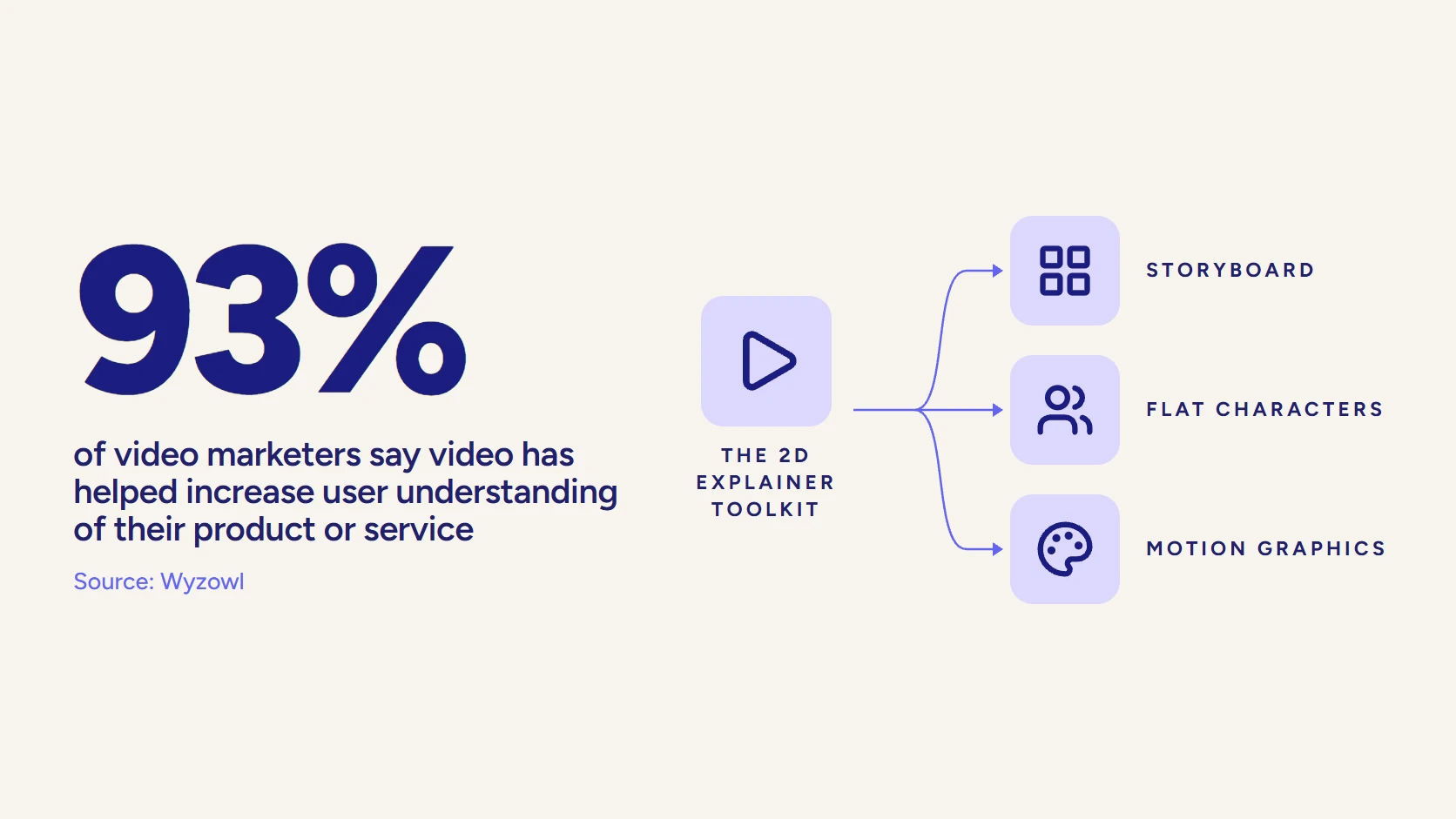
- Product and explainer videos. Demos and animated explainer videos that make a complex product simple, often the highest-volume category for a growing company.
- Testimonial and case study videos. Customer proof captured as testimonial and case study video, the asset that converts on a landing page and in a sales deck.
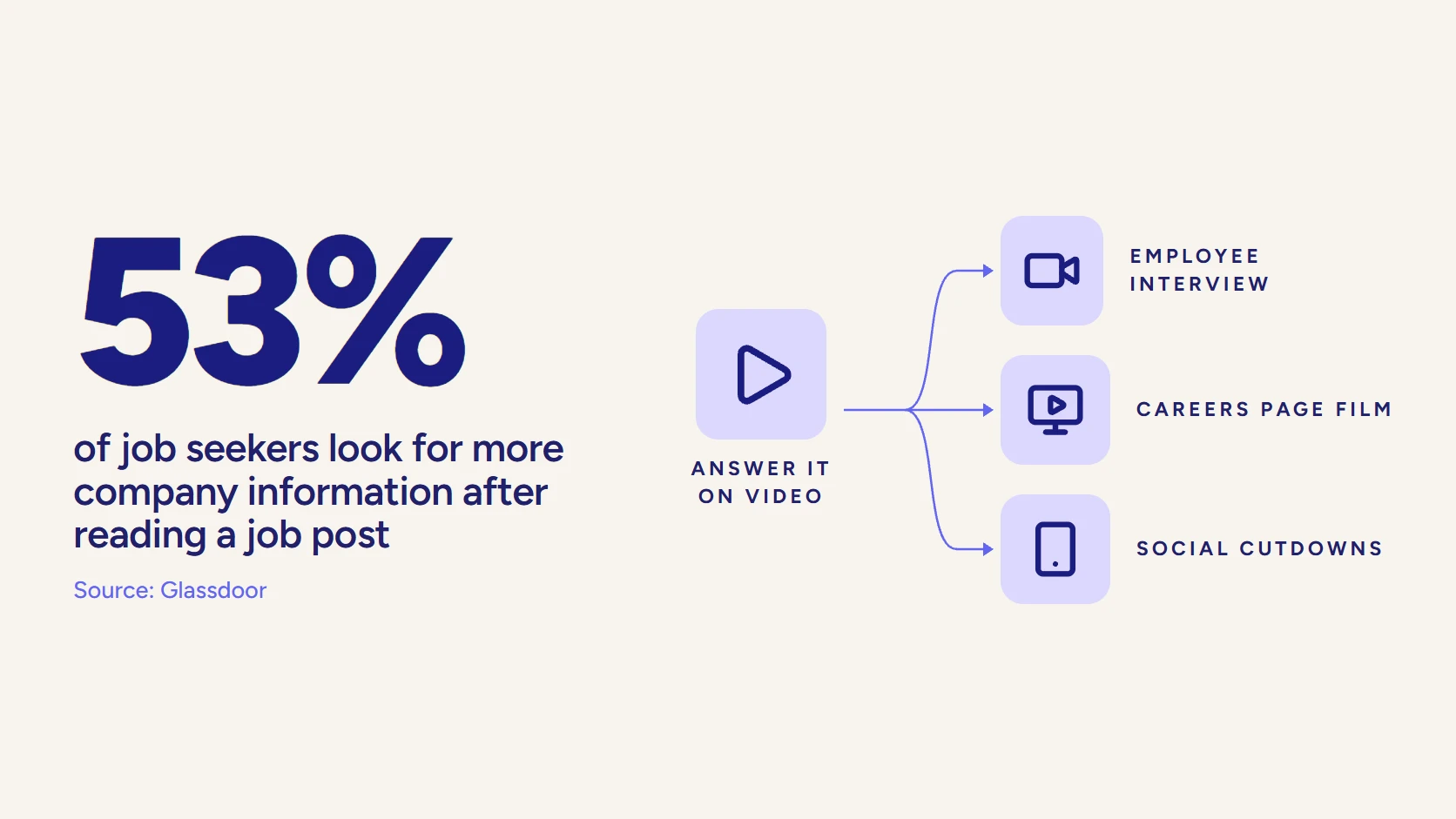
- Recruiting and employer brand. Culture and role videos that carry the brand into hiring, where potential customers and potential hires often watch the same feed.
- Sales enablement. Short, targeted videos that help sales teams move a deal, from an outreach clip to a tailored pitch.
- Internal communications and training. Town halls, onboarding, and training content that turns a live moment into an on-demand library.
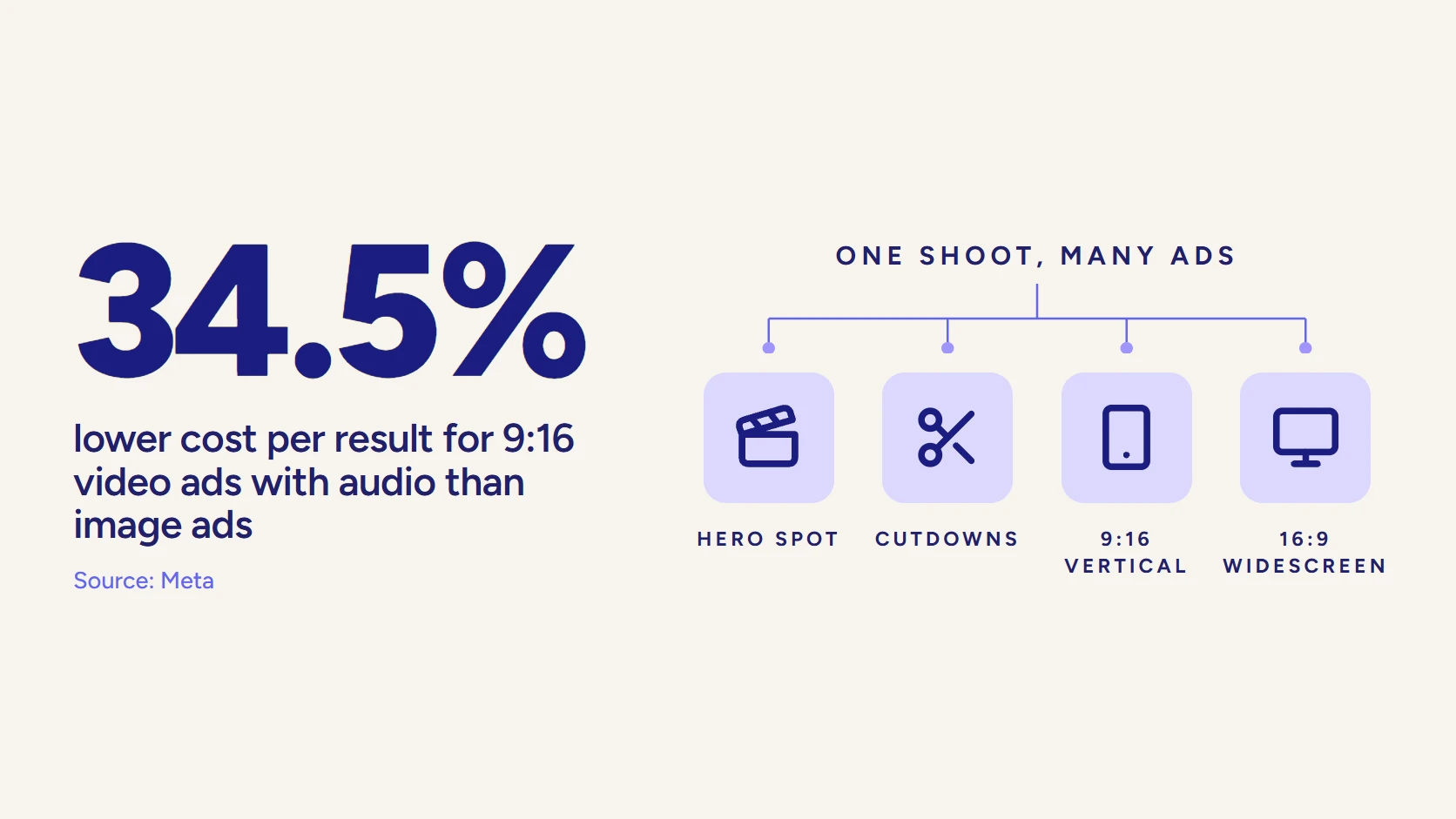
- Social and vertical cutdowns. The same productions reframed and captioned for social media, where the sound is off by default.
One Production, Many Assets
The enterprise advantage is not that a partner can make each of these. It is that a partner can make several of them from one coordinated production. A single customer shoot can yield a long-form case study, a set of social cutdowns, and clips a sales rep drops into an email, which is where content creation stops being duplicated market by market.
One shoot, many finished assets.
That reuse is a strategy question as much as a production one. Mapping each asset to a stage of the video marketing funnel before the shoot is what turns one production day into a quarter of marketing supply.
Should You Retain a Video Partner or Hire Project by Project?
Retain a partner when video is continuous and brand-critical, and hire per project when it is genuinely occasional, because the retained model trades a one-off quote for compounding brand knowledge and reserved capacity. The choice is really about how often you buy and how much consistency costs you when it slips.
| How it works | Project vendor | Retained partner |
|---|---|---|
| Onboarding | Re-briefed every project | Learns your brand once |
| Pricing model | Quoted per job | Scoped program or retainer |
| Turnaround | Back of the queue | Reserved capacity and service levels |
| Brand consistency | Drifts between vendors | Held across every asset |
| Brand knowledge | Leaves with the supplier | Compounds inside the partner |
What the Retained Model Buys You
A retained or long-term partner front-loads the learning once and reuses it forever. They hold your brand guidelines, your product knowledge, and your approval map, so every later project skips the onboarding tax. Capacity is reserved for you, turnaround is governed by an agreement, and the brand look is enforced across every asset instead of re-argued each time.
The relationship also gets better with age, which a one-off never does. The benefits of a long-term production partner compound the way a good agency relationship does: the tenth project is faster, sharper, and more on-brand than the first, because the context is already there.
When a Project Vendor Still Makes Sense
The project model is not obsolete. A single flagship film, a true experiment, or a market you may never revisit can be a clean one-off. The mistake is running an enterprise-scale, always-on video need through a project-by-project process, then wondering why the budget leaks and the brand drifts.
There is a simple test. If you can predict roughly how much video you will need next year, you are running a program, and a program deserves a partner. If you genuinely cannot, a project vendor may be the right call. Our guide on how to choose a video production partner walks that decision in more detail.
How Does an Enterprise Video Partner Govern Your Brand?
Brand governance is the system that keeps dozens of videos looking like they came from one company, and it is what separates a partner from a hired camera. It runs on three things: a documented standard, a real review workflow, and a place everything lives.
Brand Guidelines and a Reusable Video Kit
Consistency is not luck, it is a kit. A partner builds a video style guide (color, motion, typography, lower thirds, music, tone) that turns your brand identity into repeatable production rules. Every crew and editor works from the same kit, so a video shot in one quarter matches one shot two quarters later.
That kit is also what makes new crews safe. A vetted editor in a new market can match the house look on day one, because the standard is written down rather than living in one person’s head.
Review and Approval Workflow
Enterprise sign-off is never one person. A partner runs a structured review: timestamped comments, defined revision rounds, and a clear owner at each stage, so feedback from brand, legal, and product converges instead of ping-ponging. The goal is fewer rounds that actually resolve, not endless rounds that never close.
A real workflow also protects the timeline. When everyone knows how many rounds exist and who owns the final yes, a project cannot quietly drift for months while comments accumulate.
Versioning and a Central Asset Library
One production should yield many finished pieces, and every one needs a home. A governed partner delivers into a central library with clear versioning, so teams across the company can find the approved cut, the vertical social version, and the captioned edit without emailing around for files.
- One documented standard. A video style kit every crew and editor follows, so quality holds without compromising speed.
- One review path. Structured feedback with named owners and fixed revision rounds at every stage.
- One source of truth. A versioned asset library where the approved final product actually lives.
Video that has to work?
Plan your next video project with LocalEyes Video Production and start from the goal, not the brief.
What SLAs and Turnaround Should an Enterprise Expect?
An enterprise should expect written service levels: a defined response time, a production schedule with milestone dates, and fixed revision rounds, so turnaround is a commitment rather than a hope. Vague timelines are the single most common reason enterprise video slips, and they are avoidable.
How an enterprise engagement runs, end to end
- Discovery and MSAGoals, security review, and a signed master services agreement, so future projects start against an existing contract.
- Brand kit lockA documented video style guide (color, motion, tone, lower thirds) every crew and editor will follow.
- Production across marketsVetted crews shoot to the same standard in every city, on milestone dates set at kickoff.
- Review and approvalStructured feedback with named owners and a fixed number of revision rounds, so sign-off converges.
- Delivery and libraryEvery channel version delivered into a central, versioned asset library the whole company can use.
Response and Kickoff
The first service level is simple: how fast does the partner respond and get a project moving? For a retained partner working against an existing agreement, kickoff should be measured in days, because the contract, the brand kit, and the team already exist. That is the compounding payoff of the retained model showing up on the calendar.
Production and Revision Cycles
Timelines depend on scope, and a good partner states them up front. As a working benchmark, a single edited asset typically runs 3 to 4 weeks through production and post, while a multi-asset program across markets runs 6 to 8 weeks end to end.
The number that actually protects a schedule is the revision cap. A defined round count keeps feedback finite, so a project cannot drift indefinitely. For work that leans on multi-camera production, the schedule is set before anyone rolls, not after.
- Response time. A named contact and a committed turnaround on new requests, in writing.
- Milestone dates. Shoot, first cut, and delivery dates locked at kickoff, across every market.
- Revision rounds. A fixed number of rounds per asset, so approval converges on a date.
How Much Does an Enterprise Video Production Partner Cost?
Enterprise video is priced to the program and the asset set, not an hourly or day rate, because the value is the volume of finished pieces from one coordinated production. Buying by the day quietly punishes the thing that makes an enterprise partner worth it.
As an industry benchmark, most corporate video projects land between $7,000 and $30,000, while flagship brand films and national commercials run to $100,000 or more. Those are useful goalposts, but a program is scoped to outcomes, not a single line item.
| Package | Investment | Best for |
|---|---|---|
| Quick project | From $2,500 | A one-day shoot, a short social video, or an explainer |
| Single testimonial or case study | From $3,000 | One fully produced customer story |
| Full program | $6,000 to $20,000 | A coordinated set of assets, everything included |
What the Program Buys
LocalEyes Video Production prices an engagement as a program. A single flagship video, such as a brand or testimonial piece, starts around $3,000, and a full program sits inside a $6,000 to $20,000 engagement, scoped to the exact asset set you need. That price covers the whole production, from strategy and scripting through the shoot, edit, color, sound, motion graphics, captions, and every channel version. For a deeper breakdown, our guide to what B2B teams should budget shows where the money goes.
What Moves the Number
- Asset count. A three-video program and a twenty-video program are different builds, not the same edit copied.
- Markets and crews. Concurrent shoots in multiple cities add crew and coordination.
- Format mix. Live action, animation, and motion graphics each carry a different build.
- Turnaround. Compressed timelines and on-site editing cost more than standard post.
In-House Versus a Partner
The honest comparison is not partner cost against zero, it is partner cost against the fully loaded cost of doing it yourself. An in-house team means salaries, gear, software, and the management time to run it, and many marketing teams do not have the bandwidth to give video the attention it needs.
A partner converts that fixed overhead into a variable, scoped spend. That is why a corporate video production partner often pencils out cheaper than the internal alternative once you count the real volume and the salaries behind it.
How Do You Onboard an Enterprise Video Partner?
Onboard an enterprise partner by front-loading the contracting and the brand standard, then proving the relationship on a real project before you scale it, because the first weeks decide how fast every later project moves. A good onboarding is boring on purpose: it removes friction so the creative work can accelerate.
The First 30 Days
The opening month is administrative, and that is the point. Sign the master services agreement, complete the security review, and lock the brand kit, so the paperwork is never on the critical path again. This is the tax you pay once instead of on every project.
Boring, on purpose.
The Pilot Project
The smart first move is a single, well-scoped pilot project, not the whole annual plan. It tests the things a pitch cannot: how the partner scopes, how they handle a review cycle, and whether the finished product matches the brand kit they built. It is a low-risk way to find the right long-term fit.
Scaling to a Program
Once the pilot proves the model, the relationship widens into a program: a roadmap of assets, reserved capacity, and a cadence that matches your marketing strategy. From here, new work starts against the existing agreement, and the brand knowledge you paid to build keeps compounding.
- Contract once. The master services agreement and security review clear the path for everything after.
- Prove on a pilot. One real project tells you more than any reel about fit and process.
- Scale on a roadmap. A planned asset set and reserved capacity turn a vendor into a partner.
Video that has to work?
Plan your next video project with LocalEyes Video Production and start from the goal, not the brief.
How Do You Evaluate an Enterprise Video Production Partner?
Evaluate an enterprise partner on operational proof, not a highlight reel: coverage, security, consistency at volume, and a real approval process, because those are the things that fail at scale. A beautiful sample tells you they can make one good video. It does not tell you they can sustain that across dozens of videos and several markets.
Questions to Ask Before You Sign
- Can you cover every market we operate in, on one standard? Ask for work from several cities, not one, to find the right fit for a multi-market brand.
- How do you handle security, NDAs, and our footage? The answer should name storage, access, and contracting, not a shrug.
- What does your review and revision process look like? Look for defined rounds and named owners at every stage.
- Do you scope by outcome or by day? A partner asks what the videos are for before quoting; a vendor asks how many hours you need.
- What is your track record at volume? A long-term record of consistent output beats a single award-winning one-off.
Red Flags
Some answers should end the conversation. A supplier who only shows one city, cannot articulate a security posture, prices strictly by the day, or has no repeatable review process is telling you they are built for projects, not programs.
The same discipline applies to specialist work, which is why vetting matters when you are choosing an animation studio for enterprise projects as much as a live-action crew. One more test cuts through the pitch: ask for proof that the work moved a business result. Case studies and B2B testimonial videos that drive enterprise sales tell you far more than a sizzle reel about whether a partner understands your goals or just their own craft.
Why Is LocalEyes Video Production Built for Enterprise Work?
LocalEyes Video Production is built for the four things enterprise video actually demands: coverage, consistency, security, and volume held to one standard. The proof is in the numbers the model has produced, not a promise about the next project.
The company has produced 4,000 videos since 2018 across 10 US markets, with NPS above 95, 500+ five-star reviews, 300+ clients, and Emmy recognition. That combination is the point: high output and a high quality standard at the same time, which is the pairing a freelancer or a one-shoot vendor cannot sustain. Over 8 years, that record is what a track record is supposed to mean.
Demand for this is not softening. In 2026, 91% of businesses use video as a marketing tool, and 82% of video marketers report a good return on it, according to Wyzowl. As video becomes core infrastructure, the buyer’s question changes shape.
The question stops being can we get a video made and becomes can one partner run our entire video program to standard. You can see the answer in our portfolio of finished work and the full scope of our full-service video production.
If video has become a program at your company, the next step is a conversation about the asset set, not a day rate. That is the whole difference between a videographer and a partner.
Video that has to work?
Plan your next video project with LocalEyes Video Production and start from the goal, not the brief.
Frequently Asked Questions
What Is an Enterprise Video Production Partner?
How Is a Retained Partner Different From a Project Vendor?
What Makes Video Production Enterprise-Grade?
How Much Does Enterprise Video Production Cost?
How Does an Enterprise Partner Keep Brand Video Consistent?
What Service Levels Should an Enterprise Expect?
How Do You Evaluate an Enterprise Video Production Company?

Founder at LocalEyes Video Production | Inc. 5000 CEO | Emmy Award Winning Producer