
Fast answer
Key Takeaways
- Airtime and production are two separate bills: the famous Super Bowl figure is media, and a local spot can air for far less than it costs to shoot.
- Production reach sets the tier: a local TV spot, a regional spot, and a national broadcast spot sit in very different cited ranges.
- The shoot takes the largest share, roughly 50 to 60% of a typical budget, with pre-production and post splitting the rest.
- Talent usage, not the session day, is the line that grows: union terms, media type, and a 24-month maximum period of use all move it.
- Plan every version (vertical, cutdowns, CTV) before the shoot; multi-platform finishing adds 15 to 25% to post.
- LocalEyes Video Production commercial projects mostly land between $15,000 and $30,000, scoped from around $10,000, priced by scope rather than a rate card.
Ask 10 marketers what a TV commercial costs and at least one will say $8 million. That is a real number. NBCUniversal sold Super Bowl LX slots at an average of $8 million per 30 seconds. But it buys the airtime, not a single frame of the spot, so it says nothing about commercial production cost.
That confusion wrecks budgets in both directions.
- Teams that think the media price is the production price assume TV is out of reach and never ask.
- Teams that know it is not still fold the two into one line, then find out mid-project that the spot and its airing are funded from the same shrinking pot.
This guide separates them. It prices production first, by channel, then walks a commercial budget sheet the way a producer reads it: one line at a time, with a cited range beside every line and a note on what makes it climb. Our view up front: the lines that surprise buyers are almost never the camera and crew. They are talent usage and versions.
Summary
TV Commercial Cost in 2026, the Short Answer
- Production and airtime are separate bills; the Super Bowl figure is airtime.
- Production cost is set by reach: local, regional, and national spots sit in different ranges.
- The shoot takes roughly 50 to 60% of a typical budget.
- Talent usage and version count are the lines that grow after the quote.
- Hold about 10% as a separate contingency line.
What Does a Commercial Cost by Channel in 2026?
Production cost tracks where the spot will run and how polished it has to look there. Industry 2026 pricing puts a local TV spot at $3,000 to $15,000, a regional-quality spot at $15,000 to $50,000, a national-standard spot at $50,000 to $500,000, and a professionally produced 30-second commercial between $10,000 and $50,000 in most cases.
| Package | Investment | Best for |
|---|---|---|
| Local TV spot | $3,000 to $15,000 | One market, simple concept, small crew |
| Regional TV spot | $15,000 to $50,000 | Several markets, stronger finish, cast talent |
| National broadcast spot | $50,000 to $500,000 | Network airing, full crew, union talent, heavy post |
| Digital and social short | $2,500 to $8,000 | Feed and reels placements, fast turnaround |
| CTV spot (custom :30) | $15,000 to $80,000 | Streaming inventory on a television screen |
Digital, Social, and CTV Sit in Their Own Bands
Short social spots are priced differently because the finish standard is different. One 2026 pricing guide lists social shorts and reels at $2,500 to $8,000 and a 30-second commercial at $15,000 to $60,000.
Connected TV (CTV) is the channel buyers misprice most, because it looks like digital on a dashboard and plays like broadcast on a living-room screen. A custom 30-second CTV spot built from scratch runs $15,000 to $80,000 depending on talent and footage.
Why does the same :30 cost so much more for broadcast than for a feed? Three reasons, and none of them is the camera. Broadcast and CTV demand a higher finish on light, sound, and color. They usually carry wider talent usage, because the spot runs longer and in more media. And they have to pass delivery and clearance checks that a social post never sees. A social cut can be scrappy and still work. A broadcast spot cannot.
If you are still deciding which kind of spot you need, our guide to the different types of commercials maps formats to goals, and the breakdown of video advertising formats covers the digital placements.
Is Airtime Part of the Production Budget?
No. Airtime is working media: a separate purchase, often from a separate vendor, priced by audience rather than by effort.
How wide is the media side? Wider than most production budgets. A 30-second spot in a small local market runs about $200 to $1,500, a large local market $5,000 to $50,000 or more, and broadcast prime time $200,000 to $1 million, while streaming is sold by the thousand, with Hulu inventory quoted at $10 to $30 CPM.
Two practical consequences for a budget owner:
- Size production against the media plan, not the other way around. A spot that will air in one local market does not need the production value of a national flight, and a national flight should not ride on a local-tier spot.
- Protect a real media floor. Most full-service CTV shops want at least $10,000 to $25,000 per month in working media. A beautiful spot with no reach is an expensive file.
For how to judge whether the airtime paid off once it runs, see our piece on measuring TV advertising success.
Where Does the Money in a Commercial Budget Go?
Here is the budget sheet at altitude. A professional video budget typically puts 20 to 25% into pre-production, 50 to 60% of the budget into the shoot itself, and 20 to 25% into post-production.
That middle bar is why shoot days are the most important scoping decision you make. Every extra day multiplies crew, gear, location, and talent lines at once. The sections below take the sheet one line at a time, in the order a producer fills it in.
Line 1: What Do Concept and Script Cost?
Creative is the cheapest line to change and the most expensive one to get wrong. One 2026 breakdown puts creative development at $3,000 to $15,000 and the script and storyboard at $2,000 to $10,000.
The spread is not about how many words get typed. A local retailer’s :30 with one scene and a voiceover is a different job from a national concept that has to survive legal review, three rounds of stakeholder notes, and a storyboard a director can shoot from. What you are paying for on this line:
- Strategy. The single message, the audience, and the one action the spot asks for.
- Script and boards. Timed to 15 or 30 seconds, with every shot the budget below depends on.
- Revisions. Rounds cost money; a clear brief costs nothing.
Our walkthrough on writing a commercial script shows what a shootable page looks like, which is the cheapest way to shrink this line.
Line 2: Why Is Talent the Line That Surprises Buyers?
Because buyers price the day and forget the usage. The same 2026 breakdown puts on-camera talent at $5,000 to $50,000 or more, non-professionals at $500 to $2,000, and voiceover at $500 to $3,000. The session fee pays an actor to perform. The usage fee pays for where, how long, and in which media the performance runs.
What the 2025 Union Contract Changed
If your spot uses union performers, the 2025 SAG-AFTRA Commercials Contracts set the terms you will budget against:
- Wages. Up 5% in year 1, 4% in year 2, and 3% in year 3.
- Pension and health. A 23.5% contribution rate, with a 3.55% waiver for JPC authorizers.
- Maximum period of use. Lengthened to 24 months from the start of on-camera principal photography.
- Paid YouTube. A new category for pre-roll and mid-roll, priced 12% higher than traditional digital.
- Low Budget Digital Waiver. Codified and set to sunset on March 31, 2028.
Read that list as a budget owner. The same performance costs more on paid YouTube than on traditional digital, and a spot that starts online and later moves to broadcast or streaming reopens the usage conversation. Decide the media plan before casting, not after the edit.
Real Customers Instead of Actors
For B2B spots, the most persuasive talent is often a customer. The 2025 contracts updated the Non-Professional Testimonial Waiver: a person qualifies when their appearance consists of describing their own experience or opinion of the product, and paying them to sign the declaration no longer blocks using them in another commercial. Real customers still need releases and still need directing, but the talent line looks very different from a cast spot.
Line 3: What Does the Crew Cost per Shoot Day?
Crew is priced by headcount and by day, and the jump between tiers is steep. A 2 to 4 person crew runs about $3,000 to $8,000 a day, 6 to 10 specialists run $8,000 to $15,000, and a commercial crew of 12 or more runs $15,000 to $25,000 a day.
So what separates a 3-person day from a 12-person day? Mostly the roles a national spot cannot skip:
- Director and director of photography. One owns the performance, the other owns the image.
- Gaffer and grips. The people who shape light, which is most of what makes a spot look expensive.
- Sound mixer. A dedicated ear on dialogue, because bad audio cannot be graded away.
- Hair, makeup, and wardrobe. Invisible when done well, obvious on a large screen when skipped.
- Production designer. Sets, props, and dressing that make a location read as the brand.
- Producers and assistants. The people who keep a costly day on schedule.
A smaller B2B spot may genuinely need a fraction of that list. The mistake is buying the smaller crew for a spot that has to look like the bigger one, then paying in post to hide it.
Line 4: How Do Locations and Shoot Days Add Up?
Permits are the small part of this line: one 2026 breakdown puts them at $200 to $500 for a single location and $500 to $1,500 for several. What grows the line is the kind of place. An office or a small business happy to host costs little, while a closed street, a stadium, or a set built on a stage is quoted on its own.
Shoot days are the multiplier on everything above. Here is how one extra day ripples through the sheet:
| Line | What one more day adds |
|---|---|
| Crew | Another full day rate for every person on the call sheet |
| Equipment | Another rental day for camera, lighting, and grip |
| Location | Another day of fees, permits, and holding |
| Talent | Another session day for every performer booked |
| Travel | Another night of lodging and per diems when the shoot is out of town |
Out-of-town shoots add their own sub-lines: flights, lodging, ground transport, meals, and per diems for crew and talent, plus the travel days themselves. Hiring crew that already lives in the market removes most of them, which is one reason a production partner with crews in several cities can cost less than flying one team everywhere.
The cheapest day is the one a good schedule removes. Grouping scenes by location, prelighting, and cutting a company move (packing up and relocating mid-day) often saves more than any rate negotiation.
Video that has to work?
Plan your next video project with LocalEyes Video Production and start from the goal, not the brief.
Line 5: What Does Post-Production Cost?
Post typically lands at 20 to 30% of the total budget. Inside that share, one 2026 breakdown puts editing at $3,000 to $10,000, color grading at $3,000 to $20,000, sound design and mixing at $2,000 to $10,000, and motion graphics at $2,000 to $15,000.
Music deserves its own warning. Music for a commercial runs $1,000 to $25,000 in the same breakdown, and the range depends on whether the song is known, how long the term is, and which media it covers. A library track cleared for broadcast is a very different line from a recognizable song.
Three things push post toward the top of its range:
- Visual effects and motion graphics. Anything that has to be built rather than filmed.
- Revision rounds. Each new round of stakeholder notes after picture lock reopens the edit, the color, and the mix.
- Finishing specs. Broadcast loudness and delivery formats are not optional, and a spot that fails them does not air.
Our post-production workflow guide covers what happens in each of those passes.
Line 6: Why Do Versions Change the Price?
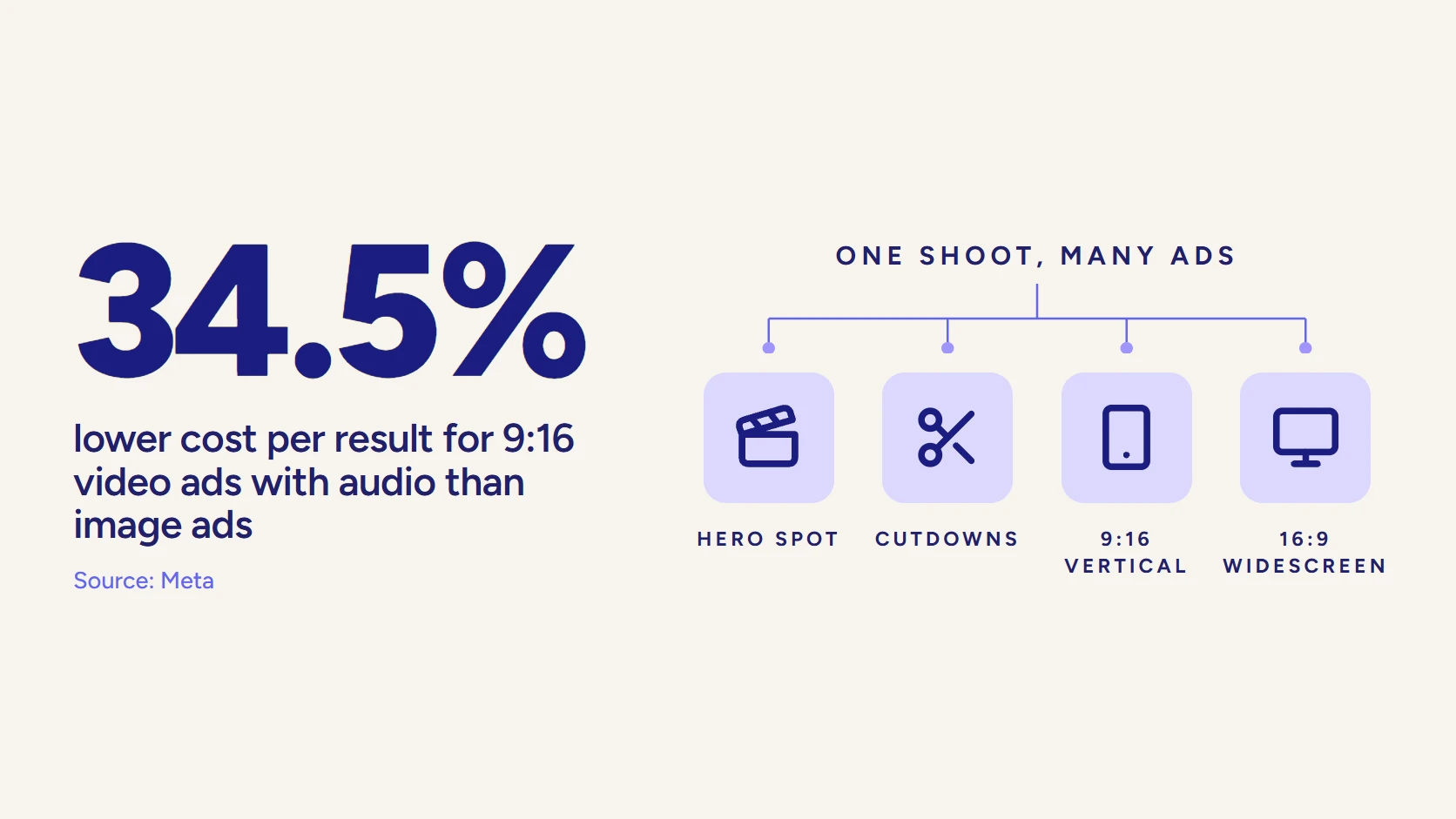
One commercial is rarely one file anymore. A modern campaign might need a :30 for broadcast, a :15 and a :06 for pre-roll, a vertical cut for social, and a CTV master with its own specs. Each is a separate edit, color pass, and export, which is why multi-platform finishing adds 15 to 25% to post.
A realistic version list for a single campaign often reads like this:
- Broadcast master. The :30 hero spot, finished to network delivery specs.
- Cutdowns. A :15 for tighter media buys and a :06 for bumper placements.
- Vertical social cut. Reframed and captioned for feeds that play with the sound off.
- CTV master. Built to the streaming platform’s own technical specs.
- Clean and tagged variants. Versions without supers or with local offers, so regions can swap the ending.
The fix is to plan versions before the shoot. A director who knows a vertical social cut is coming frames for it on set. One who finds out in the edit crops a horizontal frame and loses the product in the process. Versions planned up front cost edit time. Versions discovered late cost reshoots.
Line 7: What Does Clearance Add?
A small line in dollars, a large one in risk. Every spot that airs on US television needs an industry-standard Ad-ID code, and Ad-ID set its open rate at $45 per ad registration from April 1, 2023, so confirm the current fee with Ad-ID before you budget. Broadcast compliance work itself runs $1,000 to $5,000 in one 2026 breakdown. The bigger clearance costs are indirect: legal review of claims, rights paperwork for music, locations, and talent, and the fixes a network asks for before it accepts the spot.
Budget time for it rather than cash. A spot that has to be re-edited for a claims issue after delivery pays for post twice.
Should You Produce In-House or Hire a Company?
It depends on where the spot will run. At the bottom of the market, DIY and AI tools put a usable spot at $0 to $5,000. For an internal update, a quick social test, or a message you plan to rewrite next month, that is a sensible answer.
Broadcast and CTV change the math, because the hard parts are not the camera. They are:
- Usage and rights. Talent, music, and location paperwork that holds up when a network or a streaming platform asks for it.
- Delivery specs. Loudness, formats, and masters that pass a broadcaster’s checks the first time.
- Finish. Lighting, sound, and color that survive a large screen next to national advertisers.
- Versions. A plan for the cutdowns and aspect ratios, built into the shoot rather than cropped afterward.
An in-house team can own the idea and the brief and still hand the production to a company that carries those risks. That split often costs less than an in-house shoot that has to be redone for air. If you are drawing the line between a commercial and a broader ad program, our guide to commercial vs advertisement helps you scope it.
How Should You Budget for a TV Commercial?
Start from the outcome and work backward to the sheet. The order matters more than the template:
- Set the goal and the metric. Awareness in one market, demand in a sales region, or a national launch each imply a different media plan.
- Size the media plan. Markets, dayparts, streaming inventory, and flight length.
- Pick the production tier the media deserves. Local, regional, or national finish, from the channel table above.
- Write the deliverable list. Every length, aspect ratio, and master the media plan calls for.
- Fill the lines. Creative, talent, crew, locations, post, versions, clearance, and a contingency.
| Budget line | What it buys | What makes it climb |
|---|---|---|
| Concept and script | Strategy, script, storyboards | Stakeholder rounds, legal review |
| Talent | Session days plus usage rights | Union terms, media type, term length |
| Crew and equipment | People and gear per shoot day | Headcount, specialty roles, extra days |
| Locations | Fees, permits, holding | Closed streets, built sets, travel |
| Post-production | Edit, color, sound, music | Effects, revision rounds, licensed songs |
| Versions | Cutdowns, vertical, CTV masters | Formats added after the shoot |
| Clearance and contingency | Ad-ID, legal review, a reserve | Claims issues, late fixes |
Three Sample Budgets, With the Math Shown
Here is that sheet filled in 3 ways, using only the line-item ranges cited above. Each total adds the low end of every line the scenario uses, then the high end, before music, airtime, and contingency.
| Budget line | Local spot, 1 shoot day | Regional or CTV spot, 1 shoot day | National spot, 3 shoot days |
|---|---|---|---|
| Creative and script | Script and storyboard: $2,000 to $10,000 | Creative $3,000 to $15,000 + script $2,000 to $10,000 = $5,000 to $25,000 | Creative $3,000 to $15,000 + script $2,000 to $10,000 = $5,000 to $25,000 |
| Crew | 2 to 4 people x 1 day = $3,000 to $8,000 | 6 to 10 specialists x 1 day = $8,000 to $15,000 | 12+ crew x 3 days = $45,000 to $75,000 |
| Talent | Non-professionals: $500 to $2,000 | On-camera talent: $5,000 to $50,000 | On-camera talent: $5,000 to $50,000 |
| Locations and permits | 1 location: $200 to $500 | Several locations: $500 to $1,500 | Several locations: $500 to $1,500 |
| Post-production | Edit $3,000 to $10,000 + sound $2,000 to $10,000 = $5,000 to $20,000 | Edit + color + sound + motion graphics = $10,000 to $55,000 | Edit + color + sound + motion graphics = $10,000 to $55,000 |
| Broadcast compliance | $1,000 to $5,000 | $1,000 to $5,000 | $1,000 to $5,000 |
| Total | $11,700 to $45,500 | $29,500 to $151,500 | $66,500 to $211,500 |
Read the national column first. Crew days are its largest single line at both ends, which is why the schedule, not the camera package, is the first place to look for savings.
Then protect the plan:
- Hold a contingency. Budgeting guides treat 10% as a solid contingency for most productions, set as its own line rather than hidden inside others.
- Lock the deliverable list first. The version count is a budget input, not an edit-stage surprise.
- Decide the media plan before casting. It sets the talent usage terms, which set one of the largest variable lines.
- Get quotes in the same shape. Ask every production company to break its estimate into the lines above so you compare scope, not totals.
For how to vet the companies sending those quotes, our guide to hiring a video ad production company lists the questions to ask, and the video production cost hub compares commercials with every other format.
How Can You Cut Costs Without Cheapening the Spot?
You cut scope, not quality. Most of the savings live in decisions made before anyone is on set.
Where Savings Are Safe and Where They Backfire
Safe to cut
- Shoot days, by grouping scenes by location
- Company moves, by choosing fewer locations
- Revision rounds, by locking the script before boards
- Second shoots, by capturing extra B-roll and alternates
Cuts that backfire
- Crew roles a broadcast finish depends on
- Talent usage terms narrower than the media plan
- Unplanned versions cropped from horizontal masters
- Music without broadcast clearance
The move the 2025 version of this guide recommended still holds: capture extra B-roll and alternate lines on the shoot day, because a second spot cut from footage you already own is far cheaper than a second shoot. Shorter spots help too, but only when the idea fits the length. A :15 that crams in a :30 script saves nothing.
If you want to see how the decisions stack up from brief to delivery, how to make a commercial walks through the whole build.
What Changed in Commercial Costs Since 2025?
The 2025 edition of this guide priced a TV spot mostly as a broadcast object. Four shifts make the 2026 sheet look different.
Streaming Is Now the Biggest Screen
Streaming reached a record 48.6% of US TV viewing in May 2026, per Nielsen’s Gauge, with broadcast at 19.2% and cable at 20.4%. For budgets, that means a CTV master is no longer an optional extra. It is often the primary version, and it is sold by CPM instead of by daypart.
Digital Usage Got More Granular
Union usage now distinguishes paid YouTube pre-roll and mid-roll from other digital placements, and streaming platform rates rose as the contract followed viewers off linear TV. The practical result: the media plan and the talent line have to be written together.
AI Moved the Floor, Not the Ceiling
AI tools pulled the entry point of the market down toward zero for simple, template-driven spots. They did not change what a broadcast-grade spot needs in rights, crew, and finish, which is where most of a broadcast budget goes.
One Shoot Now Feeds Many Placements
The winning 2026 budget buys a shoot plus a version plan, not a single :30. That is the biggest reason the version line exists at all, and the biggest reason to plan it before a camera rolls.
Where Does LocalEyes Video Production Sit on Price?
LocalEyes Video Production prices commercial work by scope, not a rate card. Most projects land between $15,000 and $30,000, and scoped projects start around $10,000. That covers strategy, scripting, crew, the shoot, edit, color, sound, motion graphics, captions, and every channel version, so Line 6 is in the quote from day one rather than added later.
What moves a project up or down is the number of shoot days, cities, and finished deliverables, and how much animation is involved. That is the same budget sheet this guide just walked, which is the point: you should be able to see every line you are paying for.
Two of our own commercials show why the version line exists. The Decibullz commercial runs 1 minute and 16 seconds, longer than any standard broadcast slot.
The Acuity Optical commercial runs 1 minute and 3 seconds. A spot that length reaches a TV break only as a :30 or :15 cutdown, so each of those versions is its own edit on the sheet, not an export setting.
Behind that work sits a team with 4,000 videos produced across 10 US markets since 2018, 500+ five-star reviews, and Emmy recognition.
B2B brands weighing a spot should start with our guide to B2B commercial production, and our full video production services cover the strategy and distribution around the shoot. Book a call and we will scope your project and send a clear quote and a delivery date.
Video that has to work?
Plan your next video project with LocalEyes Video Production and start from the goal, not the brief.
Frequently Asked Questions
How Much Does a 30-Second TV Commercial Cost to Produce?
Is Airtime Included in TV Commercial Production Cost?
How Much Does a CTV Commercial Cost to Produce?
What Is the Biggest Line in a Commercial Budget?
Why Do Talent Costs Vary So Much?
How Much Contingency Should a Commercial Budget Hold?
What Does LocalEyes Video Production Charge for a Commercial?

Founder at LocalEyes Video Production | Inc. 5000 CEO | Emmy Award Winning Producer