Fast answer
Key Takeaways
- Commercial video production turns one brief and one shoot into a full ad set: a hero spot, shorter cutdowns, and every aspect ratio your channels need.
- Plan the 6-second and 15-second cutdowns before the shoot, because a short ad needs its own shots, not a trimmed version of the long one.
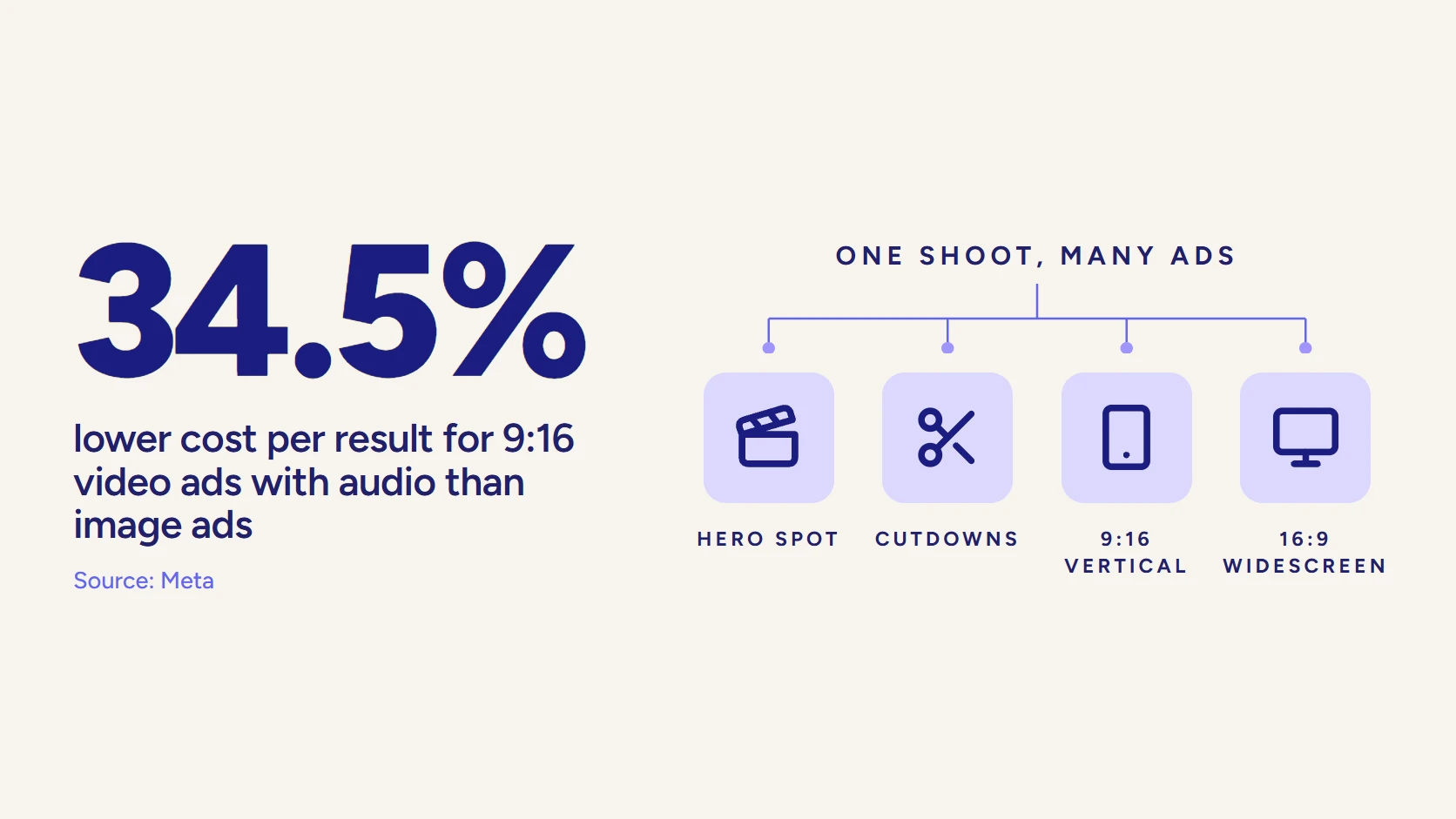
- Vertical 9:16 video with audio earned a 34.5% lower cost per result than image ads in Meta research, so framing for vertical belongs on set.
- Measure each ad length by its own job: bumpers by ad recall, mid-length cuts by completed views, and the hero spot by brand and pipeline lift.
- LocalEyes Video Production scopes commercial work by the finished asset list; most projects land between $15,000 and $30,000.
Three things buyers get wrong about commercial video production, usually before the first call:
- They buy one ad. The brief says “a 30-second commercial,” and the shoot is planned for exactly that, so every other version later gets hacked out of footage that was never framed for it.
- They treat formats as an export setting. A 9:16 vertical cut is a different composition, not a resize, and the decision is made on set or not at all.
- They measure everything by views. A 6-second bumper and a 60-second brand film do different jobs, and one number cannot judge both.
Every one of those mistakes comes from the same assumption: that a commercial is a single object. For a modern business it is a ladder of assets, from one hero spot down through the cutdowns to the formats each channel demands, all produced from one coordinated shoot.
The sections below follow that order from the top down: a definition, what a service includes, and the brief, then the long spot, its shorter versions, and the shapes each channel demands, before measurement, budget, and choosing a partner.
What Is Commercial Video Production for a Business?
Commercial video production is the planning, filming, and editing of paid advertising video for a brand, from the creative brief to a finished set of ads delivered in every length and format the media plan needs. The output runs as paid media: social ads, YouTube pre-roll, connected TV (CTV) spots, and brand commercials.
- Commercial video production
- The planning, filming, and editing of paid advertising video for a brand, delivered as a coordinated set: a hero spot, shorter cutdowns, and a version for every aspect ratio and channel in the media plan.
The Four Kinds of Commercial a Business Buys
- Digital and social ads. Short, sound-off-friendly spots built for paid placements on Meta, LinkedIn, TikTok, and YouTube, where the first seconds decide everything.
- Brand commercials. The emotional anchor of a campaign, built to say who you are and why you matter, usually the longest and most cinematic cut.
- Product commercials. A focused spot that shows one product doing one job, from a hardware reveal to a software workflow; see our guide to product ads for the formats that convert.
- CTV spots. Commercials that play on the living-room screen through streaming apps, held to broadcast-grade finish but bought and targeted like digital media.
What this guide does not cover is the full broadcast pipeline of network clearance and air dates. For the B2B side of that story, including placement and clearances, read our B2B commercial production guide. For the full taxonomy of formats, the types of commercials breakdown lists each one.
Is a commercial different from any other business video? Yes, in one way that matters. A commercial is written to be paid for per impression, so every second has a media cost attached. That pressure shapes the script, the pacing, and the number of versions far more than it shapes the camera. Our explainer on commercial vs advertisement draws the line in more detail.
What Does a Commercial Video Production Service Include?
A full commercial video production service covers everything between a business goal and a folder of ads a media buyer can upload. The stack below is what separates a production company from a camera operator, and each part changes how many usable ads you walk away with.
Before the Camera Rolls
- Creative strategy. The one idea the campaign carries, the audience it targets, and the action it asks for, agreed before anyone writes a line.
- Scripting for every length. The hero script plus the shorter versions, so the 15-second and 6-second cuts have their own beats instead of borrowed ones. Our guide on how to write a commercial script covers the craft.
- Storyboards and shot lists. Every setup mapped to the ads it feeds, including which shots must also work in vertical.
- Casting, locations, and logistics. Talent, releases, permits, and scheduling, the unglamorous work a pre-production checklist exists to catch.
On Set
The shoot is where the ladder is won or lost. A director, a director of photography, lighting, sound, and art direction capture the hero spot, then capture the extra coverage the cutdowns need: tighter product shots, clean end frames, and vertical-safe compositions. Skipping that coverage saves an hour on set and costs every short ad its quality.
After the Shoot
Post-production turns footage into the finished set: the edit, color grade, sound design and music, motion graphics, captions, and then the versioning pass that conforms every cut into each aspect ratio and delivery spec. Our post-production workflow article breaks that stage down.
That versioning pass is the quiet line item. Many quotes price “a commercial” and treat the other versions as extras, which is how a budget that looked complete ends up funding one ad.
What Belongs in a Commercial Brief?
The brief is the top of the ladder, and it is the document most buyers under-specify. A one-line request produces a quote for one ad. A brief that names the whole set produces a plan for the whole set, and the difference shows up in every stage after it.
A brief that lets a production company scope the full ladder answers these:
- The business goal. Awareness in a new market, demand for a launch, or pipeline from a named segment; each one points to a different hero spot.
- The audience and what they believe now. A buyer who has never heard of you needs a different opening than one comparing you with a rival.
- The media plan, even a rough one. Which channels, which placements, and roughly where the budget leans, because that decides which ad length matters most.
- The deliverable list. Every length and aspect ratio you expect, written down, so it is priced and planned instead of discovered.
- Claims and proof. Any statistic, customer name, or performance promise the ad will make, with the evidence behind it, so legal review does not stall the edit.
- Brand assets and approvers. Logos, fonts, color, music guidance, and the names of everyone who signs off, which keeps review rounds short.
You do not need every answer before the first call. A good production partner helps you fill the gaps, and the video production checklist is a useful place to start. What you do need is the willingness to commit to the list before the cameras roll.
Why Build the Hero Spot First?
The hero spot is the rung everything else hangs from.
It is the longest, most complete telling of the campaign idea, usually 30 or 60 seconds, and it sets the look, the music, the voice, and the claim. Every shorter ad is a compression of it. If the hero spot is vague, the cutdowns have nothing sharp to compress.
So the hero spot has to answer three questions before it answers any creative one. Who is watching? What do they believe before the ad? What should they do after it? A brand commercial for a B2B software company, a product commercial for a consumer device, and a recruiting spot for a staffing firm can share a crew and a budget and still need completely different hero spots, because the answers differ.
Live Action, Animation, or a Hybrid?
The hero spot also locks the production style, and that choice ripples down the whole ladder.
Live action vs animation for the hero spot
Live action is strongest for
- Real people, customers, and faces that build trust
- Physical products shown in use
- Emotional brand commercials
- Testimonial-driven ads
Animation is strongest for
- Software, data, and abstract services
- Processes you cannot film, inside machines or systems
- Fast versioning and localization across markets
- A graphic system that carries through every cutdown
A hybrid is increasingly the default for B2B commercials: live action carries the people and the trust, and animation explains the product nobody can film, such as software, data, or a process inside a machine. The motion graphics system built for the hero spot then carries through every cutdown, so the whole set looks like one campaign.
A useful test for the hero spot script: read it aloud with the visuals muted. If the idea survives on words alone, the spot has a spine. If it only works with a specific shot, the cutdowns will struggle, because short ads rarely have room for that shot.
How Does One Shoot Become a Ladder of Ad Lengths?
Every rung below the hero spot is a cutdown: a shorter ad built from the same shoot, with its own structure. The mistake is treating a cutdown as the first 15 seconds of the long version. A good 15-second ad is not an excerpt. It is a separate edit with its own opening hook and its own end card.
| Rung | Typical length | Where it runs | Its one job |
|---|---|---|---|
| Hero spot | 30 to 60 seconds | CTV, YouTube, landing pages | Tell the whole campaign idea |
| Mid-length cutdown | 15 to 20 seconds | CTV, pre-roll, paid social | Land one message completely |
| Bumper | 6 seconds | YouTube, CTV frequency | Build recall with one image and line |
| Vertical cuts | 6 to 30 seconds | Reels, Stories, TikTok, Shorts | Stop the scroll, sound off |
| Square and 4:5 cuts | 6 to 30 seconds | Feed placements | Fill the feed frame |
Our own work for Coffee Bay shows a cutdown in practice. The 27-second social cut below is a shorter version of a longer brand video, chosen to showcase the atmosphere of the cafe and its service.
The shortest ad deserves its own note. A 6-second bumper sounds too short to matter, yet in YouTube’s analysis of 122 US bumper campaigns, over 9 in 10 drove ad recall, with an average lift of over 30%, and 70% drove a significant lift in brand awareness. Our guide to YouTube bumper ads covers the format rules.
Bumpers only work when they were planned. Six seconds leaves room for one image, one line, and a logo, so the shot that carries it has to be captured on purpose, usually as a clean, tight product or face moment the hero spot might never use in full.
What to Plan for Each Cutdown
- Write the short scripts alongside the long one. Each cutdown gets a hook, a single message, and an end card, decided before the shoot.
- Tag the shots. The shot list marks which setups feed the 15, the 6, and the vertical versions, so nothing is left to luck in the edit.
- Capture clean end frames. Every length needs a finish that holds a logo and a call to action without a cut.
- Record the lines in pieces. Voiceover and dialogue captured as separable phrases can be recombined for shorter versions without re-recording.
Done this way, one shoot yields a ladder: a hero spot, a mid-length cut, a short cut, and bumpers, each an honest ad rather than a trimmed leftover.
One shoot can also widen the set instead of shortening it. For TrovaPage, a service-sharing commerce platform, LocalEyes Video Production made a series of 3 commercials from one location and one day, each telling a different use case with its own story and look. Two of them follow, at 35 and 31 seconds.
Same location, same day, a new story. That is a second campaign variant, not a trim of the first.
Video that has to work?
Plan your next video project with LocalEyes Video Production and start from the goal, not the brief.
Which Aspect Ratios Does One Commercial Need?
Most ad sets now ship in three or four shapes: widescreen 16:9 for YouTube, CTV, and the web; square 1:1 or 4:5 for social feeds; and vertical 9:16 for Reels, Stories, TikTok, and YouTube Shorts. Each shape is a separate composition. A wide shot framed for a TV screen loses the product, the face, or the text when it is cropped to a phone.
The payoff for doing it properly is measurable. Meta reports that 9:16 video ads with audio, with the key message inside the safe zone, delivered a 34.5% lower cost per result than image ads. That result depends on a vertical frame built for vertical, not a letterboxed horizontal ad.
Design for Sound Off, Finish for Sound On
Here is the tension every format decision carries. Audio helps, yet a feed viewer may meet the ad with the sound off and never turn it on. The answer is to build both. Burned-in captions and on-screen text carry the message silently, while the mix, the music, and the voice reward anyone who turns sound on.
Practical rules the edit follows:
- Keep text and faces in the safe zone. Platform buttons and captions cover the edges of a vertical frame.
- Put the brand in the first seconds. Feed viewers decide fast, and a logo held for the end card is a logo many never see.
- Caption every version. Captions are part of the ad, not an accessibility afterthought, and they are styled to match the campaign.
For deeper format guidance, see our pieces on vertical video for social media and mobile video advertising best practices.
Where Does a Finished Ad Set Actually Run?
The ladder exists because the media plan is fragmented. US digital video ad spend is forecast to grow 11% in 2026, and digital video is expected to pass 60% of total TV and video ad spend for the first time, with social video and CTV both growing. Each of those channels wants a different cut.
- CTV and streaming. The hero spot and the 15-second cut, finished to broadcast standards, because the ad plays on the largest screen in the house.
- YouTube. Skippable pre-roll for the longer cuts, bumpers for frequency, and Shorts for the vertical versions.
- Paid social. Square, 4:5, and vertical cutdowns, captioned, with the hook in the first seconds.
- Programmatic and display video. Short cuts that must survive small players and muted autoplay; our note on why programmatic video ads need better creative explains the stakes.
Match the ladder to the plan before you finalize the shoot. If most of the media plan is paid social, the vertical cut is the hero in practice, and the shoot should be designed around it.
How Does the Process Run, From Brief to Delivered Ad Set?
Read the process as a series of commitments, each one narrowing what the next stage can change. Discovery sets the goal and audience. The brief turns that into one idea and a deliverable list. Scripts and storyboards turn the idea into shots. Pre-production books the people and places. The shoot captures coverage for every length. Post-production finishes the hero spot, then versions it down the ladder, and delivery hands the media team files in every spec.
The single decision that moves the whole schedule is the deliverable list. Written before scripting, it lets every later stage plan for it. Written after the shoot, it forces the edit to invent coverage that does not exist, which usually means a reshoot or a weaker short ad.
What each commitment locks:
- Brief: the goal, the audience, and the full deliverable list.
- Scripts: every length written and approved together.
- Storyboard: each shot tagged to the ads it feeds.
- Shoot: hero coverage plus cutdown and vertical coverage.
- Hero cut: approved before any versioning starts.
- Versioning: every length and ratio conformed to spec.
Two review points matter more than the rest. Approve the scripts for every length together, so the short versions get the same scrutiny as the hero. Then approve the hero cut before versioning starts, because each change after that point has to be repeated in every length and ratio. For how schedules are built, our video production timeline guide and the broader video production process overview go further.
How Do You Measure Whether the Ad Creative Works?
Creative quality is not a matter of taste; it moves results. When Kantar scored 11,000 YouTube ads for Google, ads that followed the ABCD creative guidelines (attract, brand, connect, direct) showed a 30% lift in short-term sales likelihood and a 17% lift in long-term brand contribution.
The trap is judging every length by one number. Each length has a job, so each gets its own metric:
- Bumpers and 6-second cuts: ad recall and brand awareness lift, the outcomes the bumper research above tracked.
- 15-second cuts: completed views and cost per completed view, because the whole message has to land.
- Vertical social cuts: hook rate in the opening seconds, then cost per result against your static ads.
- The hero spot: brand lift, search lift, and the pipeline it influences over the campaign, not the click-through rate of a single impression.
Test inside the ladder, not across it. Two openings of the same 15-second cut tell you which hook works. A 15-second cut against a 60-second hero tells you almost nothing, because they were never meant to do the same job. Our guides on measuring TV advertising success and calculating video marketing ROI cover attribution in depth.
Plan for Creative Fatigue
So what happens when the same ad runs for weeks to the same audience? Performance softens as viewers stop noticing it. The fix is cheaper when it is planned: alternate openings, a second voiceover line, or a different product moment captured on the original shoot give the media team fresh versions without booking another crew. That is one more reason the shot list should carry more coverage than the hero spot strictly needs.
What Does Commercial Video Production Cost?
Cost follows the ladder. What sets the number is less the camera than everything around it:
- Shoot days. One day for a tight product spot, more when the concept moves between scenes or captures several customers.
- Cities and locations. Each move adds travel, permits, and setup time, which is why multi-market campaigns are scoped carefully.
- Cast and talent rights. Actors, voice talent, and how long and where the ads may run all shape the fee.
- Animation. A hybrid spot adds design and motion work that live action alone does not need.
- The finished asset count. Every length and ratio is an edit, so a full ladder is more work than a single spot, even from the same footage.
LocalEyes Video Production prices commercial work by scope, not a rate card: most projects land between $15,000 and $30,000, and scoped projects start around $10,000. The number that should matter to you is the cost per finished ad. One shoot that yields a hero spot, three cutdowns, and every aspect ratio spreads the crew, the talent, and the locations across the whole set.
For line-item detail, our commercial video production cost guide covers budget drivers, and the video production costs hub compares formats side by side.
How Do You Choose a Commercial Video Production Company?
Most shortlists are built from reels, and reels only show the hero spot. Ask for the rest of the ladder. These questions separate a partner from a crew:
- Can you show one campaign’s full ad set? The hero spot, the cutdowns, and the vertical versions from a single shoot prove the company plans the ladder.
- Who writes the short versions? If the answer is “the editor, after the shoot,” the cutdowns will be trims.
- Is versioning in the quote? Every length and ratio should be a named line, not an extra discovered later.
- Do you handle animation in-house? Hybrid spots need live action and motion design built as one system.
- Can you shoot in more than one market? A campaign that films customers or locations across cities needs one standard everywhere.
Our guide on how to hire a video ad production company adds the contract questions, and our list of the best video ad production agencies compares options nationally. If you are buying locally in South Florida, our Miami promotional video team works the same way.
Why Do Brands Produce Commercial Video With LocalEyes Video Production?
Because the ladder is how LocalEyes Video Production already works. The TrovaPage series and the Coffee Bay cutdown above are two shapes of the same idea: several finished ads out of one production, rather than one ad and a folder of leftover footage.
Behind that sits scale a single crew cannot match: 4,000 videos over 8 years, 500+ five-star reviews, Emmy recognition, and crews in 10 US markets. Our commercial video production services cover strategy, scripting, the shoot, animation, and every cutdown and format your plan needs.
Video keeps earning the budget. In Wyzowl’s 2026 research, 91% of businesses use video as a marketing tool, and 85% of people say a video has convinced them to buy a product or service. The question is no longer whether to run video ads. It is whether one shoot gives you one ad or a full set.
Bring the goal and the media plan to a call. We will scope the ladder, send a clear quote, and give you a delivery date.
Video that has to work?
Plan your next video project with LocalEyes Video Production and start from the goal, not the brief.
Frequently Asked Questions
What Is a Commercial Video?
What Does a Commercial Video Production Service Include?
How Many Versions of a Commercial Do I Need?
Can One Shoot Produce Ads for TV, Social, and YouTube?
How Do You Measure a Video Ad?
Should a Commercial Be Live Action or Animation?
How Much Does a Commercial Video Cost With LocalEyes Video Production?

Founder at LocalEyes Video Production | Inc. 5000 CEO | Emmy Award Winning Producer