Fast answer
Key Takeaways
- Los Angeles has no shortage of crews; for a B2B team the differentiator is a partner that ties video to pipeline, not just camera work.
- Match the format to the buyer stage: brand film for awareness, product video for launch, customer story for proof, executive video for trust.
- For multi-market programs, a distributed crew with centralized producers holds one standard across every city.
- Premium B2B campaign work in Los Angeles typically starts around $20,000 and scales into $50K-$150K programs.
- Vet on process and proof (Emmy recognition, 300+ five-star reviews, Fortune-tier clients), never on lowest price.
No city makes more video than Los Angeles, and none makes the choice harder. Search the phrase and thousands of crews surface at once, from a lone operator with a camera in the trunk to commercial houses with standing soundstages. You would think that much depth would settle the question, but it does the opposite.
Picture the VP of Marketing with a launch on the calendar and a board watching the number, because more options are the last thing she wants. What she needs is one team she can trust with an embargoed product and a hard date, and the flood of near-identical vendor pages tells her almost nothing about which team that is.
This guide is written for her. If you are a demand-gen lead or a marketing VP who needs a launch film, a product video, or a run of executive content out of Los Angeles, and a miss is not an option, the pages ahead walk through what actually matters, from vetting a partner in a saturated market to where you shoot and which permits you need, how to match format to the job, how the work runs from kickoff to delivery, why launch and executive content demand secure handling, and what premium production really costs.
One idea runs under all of it. In a city this deep, the camera was never the scarce thing. The strategy is scarce, along with the standard held across every asset and the discipline that keeps unreleased work locked down until you choose to show it.
Why Is the Los Angeles Video Production Market So Crowded?
The short answer is history. The entertainment industry spent a century training camera operators, editors, and colorists here, and most of them stayed, which is why so much high-end commercial and corporate video production in Los Angeles still starts in this city and why the market is almost unreadable from the outside.
A Century of Craft, Concentrated in One City
There is a second reason the market reads as noise, and it traces back to that same lineage. A director who lights a beautiful spot may never have sat through a pipeline review or asked how a video earns a sales-qualified lead, because craft is what Los Angeles trained for and demand generation is not.
Craft, in other words, is not the scarce ingredient. Commercial judgment tied to a buyer’s journey is what runs short, and that judgment is exactly what a B2B team is paying for when it hires a partner rather than a crew.
Why the Pricing Spread Tells You So Little
Look at the pricing spread and you can see the crowding directly. The rates cover camera time and deliverables, but none of them tell you whether a single person in the room is thinking about what the video has to accomplish for your business.
- A professional videographer runs $800 to $2,000 a day. That buys camera time and an operator, not a strategy for what the footage should accomplish.
- A full crew lands at $5,000 to $15,000 or more a day. The number climbs with lighting, sound, and the people who shape a brand shoot.
- Los Angeles carries a 30 to 50 percent premium. The same brief costs noticeably more here than it would in Denver or Dallas.
Los Angeles video production at a glance
That gap between rate and result is the entire problem. A flooded market optimizes for whatever is easy to compare, which means day rate and turnaround, and it quietly pushes brand identity, marketing strategy, and any record of moving pipeline down the list.
So the claims cancel out. When every page promises high quality, award-winning work, and a long client roster, you are left comparing reels that all look competent and hoping the strategy shows up on set. The practical move is to stop shopping for a crew, because crews are a commodity here, and start shortlisting for a partner whose judgment about what to make and why is anything but.
Where Do You Shoot in Los Angeles, and Do You Need Film Permits?
Almost any shoot on public property or in a shared space needs a permit, and in Los Angeles that runs through FilmLA, the nonprofit that coordinates permitting for the City and County. A premium partner owns that process end to end so your date does not slip.
The Locations That Make LA Worth the Premium
The reward for shooting here is range. Inside an hour of downtown you can stage a scene on a soundstage, a rooftop with the skyline behind it, a stretch of coastline, a mid-century office, or open desert, and that variety is why so many launches and brand films base themselves in Los Angeles even when the company sits somewhere else entirely.
What FilmLA Actually Requires
Range brings logistics, though, and the paperwork is where a hard launch date is quietly won or lost. Before anyone rolls, a premium partner has already cleared the requirements that trip up a freelance crew.
- Permits turn around in three to five business days. FilmLA processes most requests in that window, so the schedule has to account for it rather than assume same-day approval.
- A certificate of insurance is required up front. General liability coverage has to be in place before filming on public property, and there is no rolling without it.
- Busy locations add their own conditions. Neighbor notification, parking coordination, and sometimes fire or safety officers on set come with the more in-demand spots.
This is the quiet place where the generalist market shifts risk onto you. A freelance crew will shoot the footage and hand permits, insurance certificates, and location agreements back to your team to chase, which is precisely the kind of gap that blows through a hard launch date.
A partner built for premium work carries that paperwork instead, with permits pulled, insurance in place, locations locked, and a backup plan for the day the primary location falls through, all of it settled before the call sheet goes out. Want a fast tell? Ask a shortlisted company who pulls the permit and who carries the insurance, because a crew hands that back to you while a production partner already has it handled.
How Do You Vet a Los Angeles Video Production Company?
The quickest way to shorten a long list is to ask what a company starts from, because the starting point predicts almost everything that follows on set.
Three Businesses Wearing One Label
Under a single label you are really looking at three different businesses, and the difference decides whether the video does a job or merely looks good.
- A generic vendor starts from a shot list. The work begins with logistics and equipment, and strategy, if it appears at all, arrives after the gear is already booked.
- A cinematic boutique starts from a creative vision. The look leads, which produces beautiful film that may or may not speak to the buyer you actually need to reach.
- A performance partner starts from your objective. The goal comes first and the shots are worked backward from it, so the finished asset has a real job to do.
So drag the difference into the open with a checklist. Ask what they hand you before the shoot, how they deliver across multiple markets, what they optimize for, and what proof they can show beyond a reel. The table below is the filter we would give a marketing team working through a shortlist in Los Angeles.
| What to check | Generic vendor | Cinematic boutique | LocalEyes |
|---|---|---|---|
| Starts from | A shot list | A creative vision | Your business objective (Goal-First) |
| Deliverable before the shoot | A quote | A treatment | The Video Blueprint you own |
| Multi-market delivery | Subcontracts it | Local only | 10 US markets, one standard |
| Optimized for | Lowest bid | Awards | Pipeline and SQLs |
| Proof | A reel | Festival credits | Emmy, 300+ reviews, Zapier / Harvard-tier work |
The most predictive line in that table is the deliverable before the shoot. A generic vendor sends a quote and a boutique sends a treatment about the look, but a partner built for performance sends a plan you own that names the goal, the audience, the message, and the assets before anyone touches a camera. At LocalEyes Video Production that document is The Video Blueprint, and the client owns it as proof that strategy came first rather than as an afterthought once the edit was already cut.
You might assume a glossy reel settles the question, but it does not. A company that has shot luxury retail and music videos can hand you a gorgeous piece that says nothing to a SaaS buyer, so ask instead for case studies in your vertical with real outcomes attached, not just logos you happen to recognize. If you keep one vetting rule, keep this one: weigh verified proof over polish, because reviews, awards, and named clients cut the risk on a high-stakes spend far more than another cinematic sizzle reel ever will.
The Questions That Sort the Shortlist
Bring three questions to the first call and the shortlist tends to sort itself, because vague answers are the tell you are listening for.
- Who owns the strategy document, and do we keep it? A partner names the artifact and hands it over, while a vendor treats the plan as something that lives on their side.
- What outcome will you hold yourself to, and how is it measured? A performance partner commits to a result at kickoff instead of pointing only at production values.
- Who handles permits, insurance, and secure delivery? The answer reveals whether the footage stays protected while it is still embargoed or quietly becomes your problem to manage.
Which Video Format Does Your Launch or Executive Program Need?
Once you have a partner who starts from the goal, the next call is what to actually make, and this is where plenty of Los Angeles projects go sideways. A team commissions one beautiful hero film, then finds out it only serves a single stage of the funnel, when a serious launch or executive program almost always needs more than one format working together.
The Four Core B2B Formats
The core B2B formats sort cleanly by where they do their work along the buyer’s journey.
- Brand films build awareness. They reposition the company, create a brand halo, and support recruiting from the homepage hero and paid social.
- Product and platform videos drive consideration. They carry the launch and the product-marketing story where a buyer is weighing the decision.
- Customer stories supply proof. They earn credibility at the decision stage and give sales a believable asset for enablement and ABM.
- Executive and event content builds trust. It powers leadership presence, keynotes, and account-based motions where relationships close the deal.
The matrix below maps each format to the stage it serves and where it belongs.
| Video format | Buyer stage | Primary goal | Typical placement |
|---|---|---|---|
| Brand film | Awareness | Reposition, brand halo, recruiting | Homepage hero, paid social |
| Product / platform video | Consideration | Launch, product marketing, conversion | Product pages, launch, retargeting |
| Customer story | Decision / proof | Sales enablement, credibility | Sales, industry, ABM |
| Executive / event | Trust / ABM | Exec presence, keynotes, internal comms | Conferences, ABM, employer brand |
Read the matrix and the practical conclusion lands quickly, because a launch is rarely one video. A strong one pairs a product video built for consideration with a brand film for awareness and a customer story for proof, then cuts each into short-form variants for LinkedIn, YouTube, and retargeting. An executive program leans on the fourth row instead, using leadership and executive and event video in Los Angeles to build presence and support ABM and internal communications.
Craft choices earn their place the same way, by serving the goal rather than the reel. Live action, motion graphics, and animated sequences are tools, and a good partner reaches for the one that fits the job in front of it. A platform launch might blend a live-action hero with the kind of motion graphics that make an interface legible, while an executive keynote recap leans on clean live action, sharp sound design, and restrained visual effects. The look follows the job, never the reverse.
What Makes Product Launch Video Different in Los Angeles?
Product launch video production is its own discipline, and it is exactly where the flooded generalist market is most likely to let a team down. A launch is a coordinated moment with a hard date, embargoed information, and usually a physical product or a pre-release platform that cannot be shown until the day, so the camera work is the easy part and protecting the story until you are ready to tell it is the hard part.
The Launch Asset System
Start with the asset system, because a launch that has to move awareness, consideration, and decision cannot ride on one film. It needs a coordinated set built to work together.
- A teaser to build anticipation. Released ahead of the date, it primes the audience without revealing the product itself.
- A hero launch film to frame the why. This is the centerpiece that explains the product and the reason it matters now.
- A product or demo video for consideration. Our explainer and demo work shows the thing working for buyers who are already weighing it.
- An early-adopter customer story for proof. A first customer on camera turns claims into credibility at the decision stage.
- Social cutdowns sized for each channel. Short vertical and square edits carry the launch into feeds where attention actually lives.
Most teams treat the hero film as the launch, but the better framing is that the hero is one part of a system, and a generalist crew will happily shoot it and leave you to figure out the rest. That is how launches arrive underpowered.
Secure Handling for Unreleased Work
Then comes secure handling, and here premium stops being a preference and turns into a requirement. Launch footage is unreleased by definition, and it often shows a product that competitors and press are not meant to see until the announcement, so a premium partner treats that footage like the sensitive asset it is.
- Signed confidentiality terms up front. The agreement is in place before a single frame is shot, not negotiated after a leak.
- A controlled chain of custody for media. Cards and drives move through a known process rather than passing hand to hand on a busy set.
- Access limited to the people who need it. Secure review links replace open cloud folders so the circle stays small and deliberate.
- No work-in-progress on a public reel. Nothing from the edit surfaces on a vendor showreel before you have announced.
In a city where crews are freelance and gear moves from job to job, that discipline is not automatic. You have to ask for it, and a serious partner already has it in place.
Distribution Planned Before the Shoot
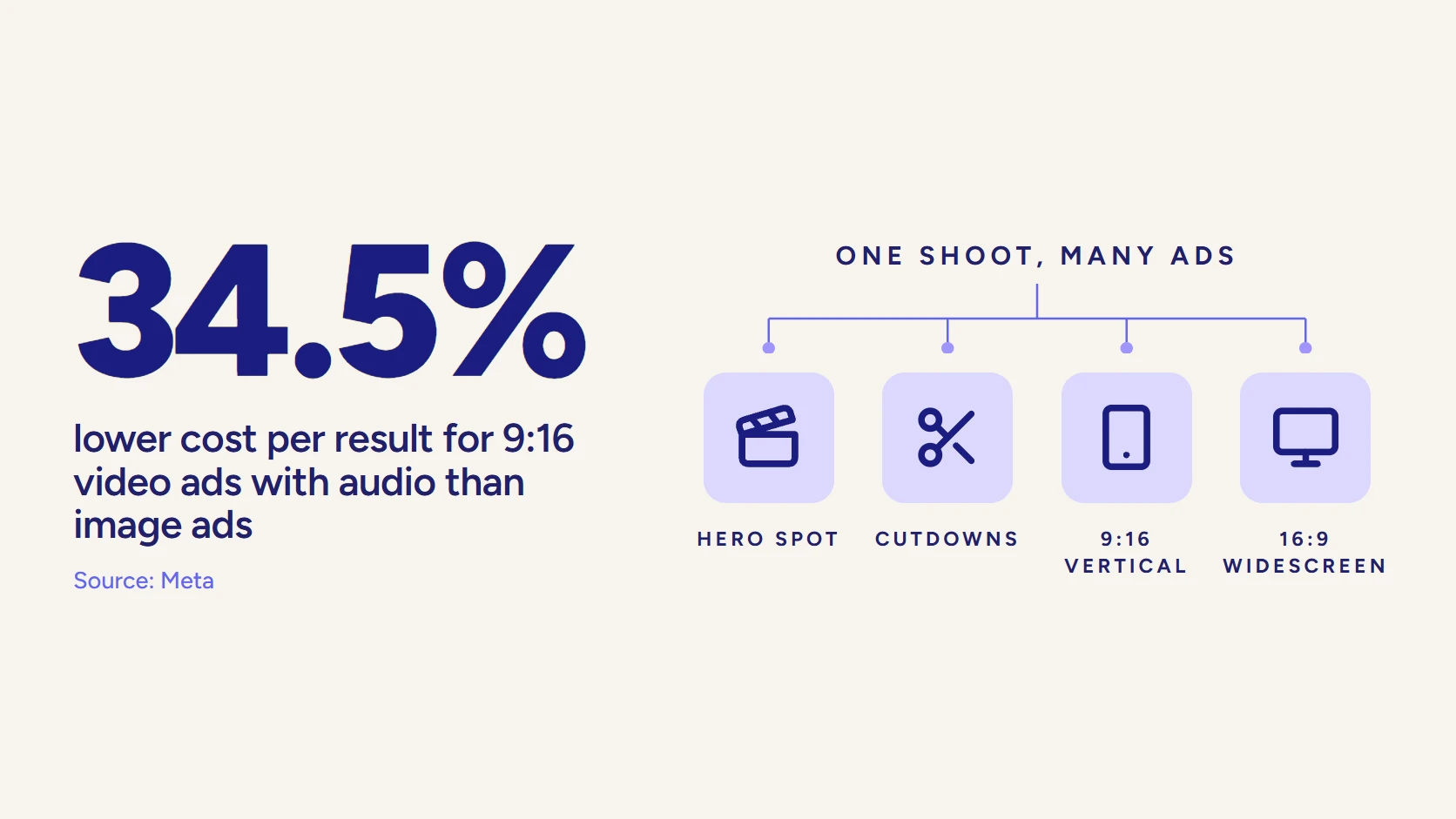
Distribution is the other launch discipline generalists skip. A launch does not live on one channel, so every hero asset should ship with short-form cutdowns sized for LinkedIn, YouTube, and paid retargeting, plus vertical variants for social.
Plan those cutdowns before the shoot and you change how the footage gets framed and lit, because a wide cinematic composition rarely survives a crop to nine-by-sixteen. Skip the planning and you pay for a reshoot two weeks after launch to feed a channel nobody accounted for. Timing punishes teams that leave the plan loose, since most premium projects run 30 to 45 days from kickoff to final delivery and a launch usually has to hit a date inside that window with every asset finished at once. Lock the plan early and the date holds, because when the Blueprint names the assets, the message, and the deliverables before the shoot, the launch calendar stays put instead of slipping while the team relitigates the edit.
Video that has to work?
Book a discovery call with LocalEyes Video Production and start from the goal, not the brief.
What Does the Production Process Look Like, From Kickoff to Delivery?
Every premium project moves through the same four phases, and knowing them shows you where your input matters and where a strong partner earns the fee. The steps below run from kickoff to final delivery.
From kickoff to delivery: the four phases
- Pre-productionThe Blueprint stage: goal, audience, message, script, shot list, casting, locations, and permits, with a schedule everyone signs off on.
- ProductionThe shoot, run by a full crew: director, director of photography, gaffer, sound recordist, and a producer keeping the day on schedule and budget.
- Post-productionEditing sets the story while color grading, sound design, and motion graphics finish it. The phase teams underestimate most.
- DeliveryChannel-ready cutdowns, vertical and square variants, captioned social edits, and the aspect ratios each platform needs.
Pre-production is where the project is won or lost, since this is the Blueprint stage that fixes goal, audience, message, script, shot list, casting, location scouting, permits, and a schedule everyone signs off on. Get it right and the shoot runs on rails instead of improvising against the clock.
Production is the shoot itself, and in Los Angeles that usually means a full crew rather than one person wearing every hat. A director guides performance, a director of photography and a gaffer shape the light, a sound recordist protects the audio, and a producer keeps the day on schedule and on budget.
Post-production is where much of the value gets built after the fact, as editing sets the story, color grading sets the mood, sound design and mix give it weight, and motion graphics carry anything a camera cannot. Teams underestimate this phase more than any other, because a polished ninety-second film hides weeks of editing, revisions, and finishing behind it, so build that time into the calendar or it quietly eats your launch date.
Delivery is the phase generalists treat as an afterthought and premium partners treat as the point, because the master file is only the start. What a marketing team actually needs is a set of channel-ready cutdowns, vertical and square variants, captioned social edits, and the aspect ratios each platform wants. Sequence matters more than teams expect, so plan the cutdowns and the distribution during pre-production rather than after the edit. Our breakdown of the full video production process and a working pre-production checklist go deeper on each phase.
How Do You Produce Executive and Leadership Content That Holds Up?
Executive content is the other place where a premium standard and secure handling earn their keep, because it puts the most senior, least available people in your company in front of a camera. A founder keynote, a leadership point-of-view film, an investor or all-hands message, or a thought-leadership series each leaves almost no margin for a clumsy shoot, and each often carries information that is not yet public.
Executives give you very little time and expect the room to be handled, so a premium partner walks in with a tight plan, a calm set, and a crew that has directed principals before. A busy leader then spends fifteen focused minutes on camera instead of an hour of trial and error, and the Blueprint matters here too, because it lets the executive review the message and the questions in advance and walk in prepared, which is the whole difference between a stiff read and a natural one.
Confidentiality carries the same weight it does on a launch. Executive content frequently touches strategy, financials, or roadmap material that is embargoed, so the handling standard does not change: confidentiality terms in place, tightly controlled access to footage, secure review, and a clear policy on what can ever appear publicly. For regulated verticals like finance and healthcare, that discipline is not optional, and a generalist vendor rarely has it built in.
Film Once, Cut Many
Here is the point of highest return, and most teams miss it, because a single leadership shoot treated as a system rather than a one-off yields far more than one film.
- A hero point-of-view film. The centerpiece that captures the leader’s argument in a polished, evergreen format.
- A run of short social cuts. Bite-size clips sized for the executive’s own LinkedIn and channels.
- Internal-communications versions. Edits aimed at employees for all-hands and alignment moments across the company.
- Evergreen clips for recruiting and brand. Footage that keeps working long after the shoot day for talent and culture.
That is how a marketing team gets a quarter of leadership presence out of a half-day of an executive’s time.
LocalEyes Video Production Los Angeles
See how LocalEyes Video Production Los Angeles builds performance video for B2B marketing teams.
Which Industries Rely on Premium Los Angeles Video Production?
The teams that spend the most on premium video here tend to share one trait: a product or a message that is hard to explain and expensive to get wrong. Four verticals stand out.
- SaaS and technology lead the list. Software is invisible and a launch has to make an interface feel real in about sixty seconds, which is where product video for B2B SaaS and motion graphics do their heaviest lifting.
- Healthcare and finance come next. Both operate under compliance and privacy constraints, so embargoed roadmap details and pre-earnings executive messages demand a confidentiality discipline a generalist rarely keeps in place.
- Education is a quieter but real category. LocalEyes Video Production’s enrollment work for USC’s Suzanne Dworak-Peck School, tied to a $2M-plus enrollment impact, is the kind of outcome an institution can take to a board.
- Consumer and DTC brands round it out. They use launch films and social-first cutdowns to move product in a crowded feed where attention is scarce.
Across all four the common thread holds: the video has a real job to do, and the partner gets chosen for judgment about that job, not for the lowest day rate on the market.
What Does Premium Los Angeles Video Production Cost?
Pricing in Los Angeles spans a wide range, and the range itself tells you what you are buying. Single-operator and small-crew shoots are quoted from around $1,000 to a few thousand dollars per day, typical projects run $5,000 to $25,000, and high-end commercial production is often quoted from roughly $7,500 and up. Push into real campaign territory and the picture shifts again, since premium branding and creative agencies in the market frequently set minimum engagements at $50,000 and up, which is closer to what a coordinated program actually costs.
Premium B2B campaign work in Los Angeles generally starts around $20,000 for a focused project and scales into $50,000 to $150,000 for multi-asset programs. Why does a campaign cost more than a single shoot? Because it is not a single shoot. It is a system of assets, each engineered for a stage of the funnel and cut into channel-ready variants, and LocalEyes Video Production packages that work in tiers so the investment maps to the asset set and the outcome rather than to camera days.
| Package | Investment | Best for |
|---|---|---|
| Brand campaign | $50K | Single hero film + channel cutdowns |
| Growth campaign | $75K | Hero plus supporting assets across the funnel |
| Multi-asset campaign | $100K | Several formats, multiple markets |
| Enterprise campaign | $150K | Full multi-market, multi-stage rollout |
Read those tiers by the job, not the sticker. A brand campaign is a single hero film with the cutdowns that make it work across channels, a growth campaign adds supporting assets so the story reaches more of the funnel, a multi-asset campaign covers several formats across more than one market, and an enterprise campaign is a full multi-market, multi-stage rollout. A blended engagement often lands in the $20,000 to $45,000 range once the specific asset set is defined.
What Moves a Quote Up or Down
What moves a quote is worth understanding before you compare two of them, because the same headline number can hide very different scope.
- The number of shoot days and crew size. More days and a larger team are the biggest single levers on any quote.
- On-camera talent and casting. Professional talent, auditions, and usage rights add real cost beyond the crew itself.
- Locations and permits involved. Each additional location carries its own permit, insurance, and logistics load.
- Animation and visual effects in post. Motion graphics and VFX are labor-intensive and scale the post budget quickly.
- The number of finished deliverables. Every cutdown, aspect ratio, and captioned variant is real editing time.
That is why two proposals can look far apart and describe nearly the same work, or look identical and hide very different scope. The only fair comparison lines up the deliverables, the shoot days, and the post complexity, then reads the price against that list rather than against the headline number. Yes, you can always find a cheaper crew, but a $6,000 shoot that produces a video nobody in the funnel watches is more expensive than a $60,000 campaign that sources pipeline, so cost per result is the number that matters, not the invoice. To keep that honest, measure video marketing ROI against the outcome you set at kickoff, and fold the spend into a real video marketing strategy rather than treating each shoot as a standalone line item.
Should You Hire a Freelancer, Build In-House, or Bring In a Partner?
For a high-stakes launch, this is the real fork in the road, and each option fits a different kind of job. The honest answer is that all three have a place, and the mistake is using the cheapest one for the moment that matters most. The table below lines the three up against the job each does best.
| What you get | Freelancer / small crew | In-house team | Production partner |
|---|---|---|---|
| Best for | Volume and speed | High, predictable volume | High-stakes launches and campaigns |
| Strategy | You bring it | Limited by headcount | The Video Blueprint you own |
| Range of formats | Narrow, fixed | Whatever the team can staff | Full multi-format, multi-market |
| Secure handling | Ad hoc | Internal only | Confidentiality and chain of custody |
| Multi-market | Not typically | Rarely | 10 US markets, one standard |
- A freelancer fits volume and speed. A steady run of social clips, a recurring series, or a simple talking-head where the stakes are low and the format is fixed is exactly where camera time as a commodity pays off.
- An in-house team fits predictable volume. It earns its keep once the workload is heavy enough to keep it busy every week, though a team of two rarely covers strategy, a cinematic launch film, motion graphics, and a multi-city shoot at once.
- A partner fits the launch you cannot miss. When the outcome carries real weight and the asset set is broad, the Blueprint, the secure handling, and one standard across every city become the reason the number moves.
So here is the move: match the option to the stakes, with freelancers for the routine, in-house for the predictable, and a partner for the launch you cannot afford to miss. If that launch is already on the calendar, it is worth a conversation before you book the next available crew.
What Proof Should a Premium Partner Show, and How Is One Standard Held Across Markets?
In a market this crowded, proof is the tiebreaker. Every Los Angeles vendor page claims high-end, award-winning, high-quality work, so the only useful signal is the proof you can verify, and those are the things a generalist cannot manufacture.
- Recognized awards, not self-styled ones. A real award survives a quick independent search rather than living only on a company homepage.
- A large body of real reviews. Third-party platforms like Clutch, Google, and DesignRush show ratings a company cannot edit.
- Named clients you can check. A Fortune-tier logo holds up when you go looking for the actual work behind it.
- Outcomes tied to business results. Numbers attached to pipeline or enrollment beat any cinematic sizzle reel every time.
Verify the signals off the vendor’s own website, because if a claim lives only on the company’s homepage you should read it as marketing rather than proof.
LocalEyes at a glance
Those outcome numbers are the entire point. A 90 percent sales increase for NewAir and a $2M-plus enrollment impact for USC are not reel highlights but results, and results are what a marketing leader is accountable for. Anchor clients like Zapier, Harvard, and Amazon-tier organizations tell you the work holds up under real scrutiny, in the verticals where a B2B team actually operates. If you want to see how the market’s other LA houses stack up, our roundup of commercial production companies in Los Angeles lays out the field.
One Standard Held Across Every Market
The last differentiator matters most for teams that operate beyond Los Angeles. Many launches and executive programs span markets, and the risk in a multi-city shoot is that quality drifts from one city to the next as different local crews interpret the brief their own way. LocalEyes Video Production Los Angeles runs a distributed crew with centralized producers across 10 US markets, so The LocalEyes Production Standard is applied the same way everywhere. The Los Angeles shoot, the New York shoot, and the Chicago shoot all come back looking like one brand made them, because one standard governed all three.
That is the whole argument for choosing a partner over a crew in a flooded market. Los Angeles will always hand you more camera options than you can evaluate, but what is scarce is a team that starts from your objective, hands you a plan you own, protects your unreleased work like it matters, prices to the result, and holds a single premium standard across every asset and every city. If you have a launch or an executive program on the calendar, that is the moment to talk with a team built that way rather than book the next available crew.
Video that has to work?
Book a discovery call with LocalEyes Video Production and start from the goal, not the brief.
Frequently Asked Questions
How much does video production cost in Los Angeles?
What should I look for in a Los Angeles video production company?
How long does a corporate video take to produce?
Do you work with B2B and SaaS companies?
Can you handle multi-city or national shoots from Los Angeles?

Founder at LocalEyes Video Production | Inc. 5000 CEO | Emmy Award Winning Producer