Fast answer
Key Takeaways
- TV commercial production runs backward from the air date: clearance, delivery specs, and post each claim fixed weeks before a camera is booked.
- Network clearance starts at the script stage, because broadcast standards editors review the storyboard, the rough cut, and the final spot before it airs.
- Linear and CTV masters differ: CTV platforms reject slates and leaders, while both expect loudness near -24 LKFS under the ATSC A/85 practice.
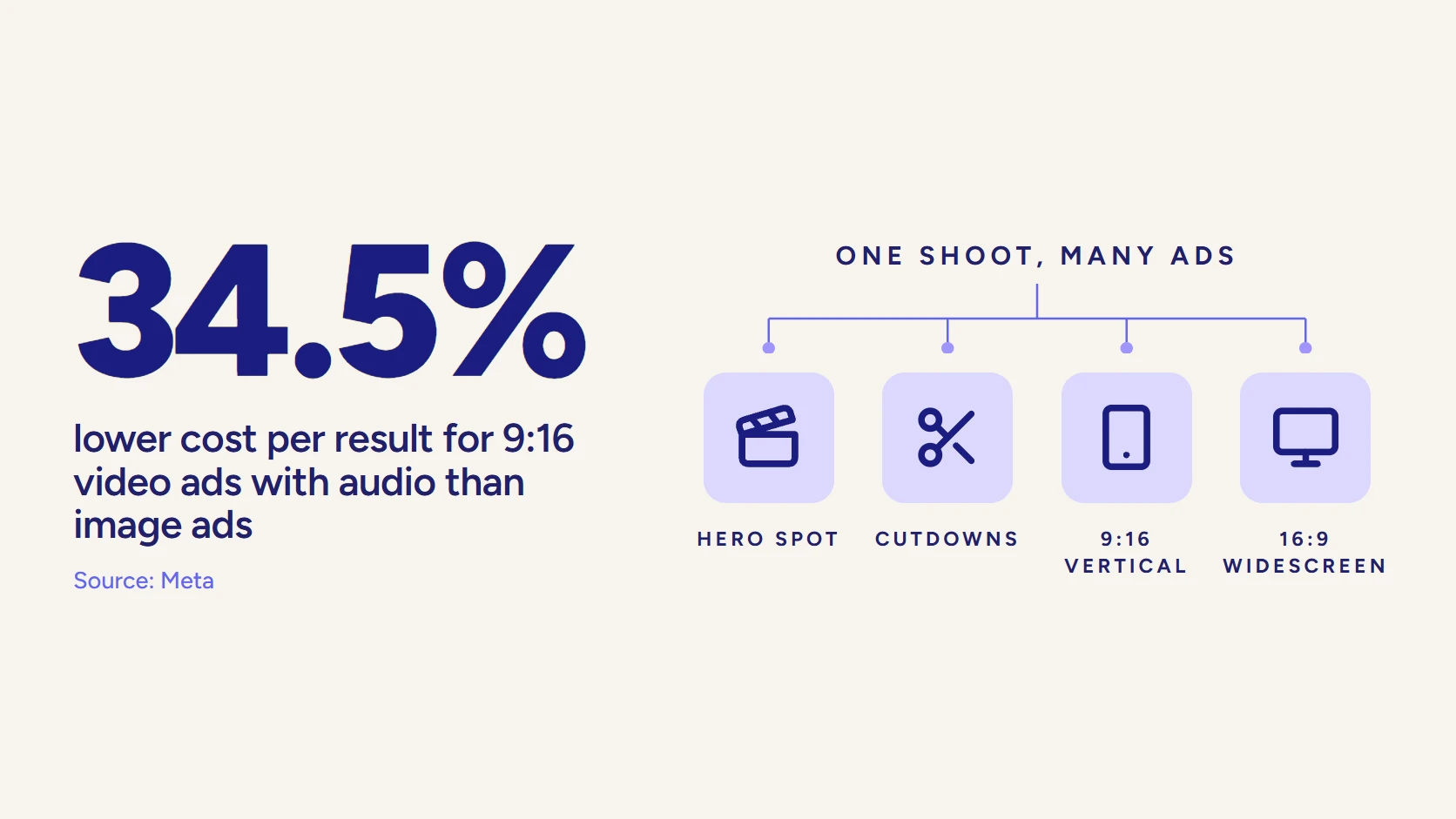
- Plan every cutdown before the shoot. A :15, a :06 bumper, and a vertical social version need their own coverage on set.
- LocalEyes Video Production scopes commercial work by deliverable; most projects land between $15,000 and $30,000, with scoped projects starting around $10,000.
It is 6:00 a.m. on a Monday, and a 30-second spot is about to run for the first time. The work that decides whether it plays cleanly, at the right volume, with the right code on the right network, finished weeks ago.
That is the part of TV commercial production most buyers never see.
A commercial looks like a creative project from the outside and runs like a logistics project on the inside. The air date is fixed first, and every stage before it inherits a deadline: the master has to clear the network, the network needs a rough cut, the rough cut needs a shoot, the shoot needs cast talent, and the talent needs a script someone approved. Miss one link and the media buy, which usually costs more than the production, sits waiting on a file.
So this guide shows the whole timeline once, at a glance, and then runs the clock in reverse. It starts on air day and walks back to the brief, stage by stage, before covering the choice between linear TV and streaming and how to pick the company that builds it.
What Is TV Commercial Production?
TV commercial production is the end-to-end process of turning a campaign idea into a cleared, broadcast-ready spot and its versions: the brief and script, pre-production and casting, the shoot, post-production, and the technical delivery and network approval that let it air on linear TV or connected TV (CTV). The word that separates it from other video work is cleared. A brand film can go live when you like it. A commercial goes live when a network says yes.
A TV commercial production company is the team that owns that whole chain. At minimum it covers:
- Creative development. Concept, script, and storyboard, often alongside an agency or an in-house brand team.
- Pre-production. Casting, locations, crew, schedules, and the shot list that protects every version you owe.
- Production. Director, director of photography, lighting, sound, art, and the day or days of the shoot.
- Post-production. Edit, color, sound mix, graphics, and legal supers.
- Delivery. Masters built to each outlet’s specs, identified with codes, and ready for clearance.
If you are still deciding whether you need a commercial or a broader ad, our breakdown of commercials versus advertisements draws the line, and the guide to types of commercials maps the formats.
What Does the TV Commercial Timeline Look Like at a Glance?
Read forward, the job has seven stages. Most commercials fall in an 8 to 12 week window from concept to delivery, simpler spots can finish in about 6 weeks, the shoot itself usually takes 1 to 3 days, and post-production takes 2 to 4 weeks.
TV commercial production, brief to air
- Brief and creativeGoal, audience, one message, mandatory elements, channels, and the air date.
- Script, storyboard, and first clearanceScript approved internally, then submitted with the storyboard for network review.
- Pre-production and castingCast, crew, locations, shot list, and the versioning map for every cutdown.
- The shootTypically 1 to 3 days, covering the hero spot and every version it feeds.
- Post-productionEdit, color, sound mix to loudness spec, graphics, and legal supers.
- Rough cut clearanceRough cut and as-recorded script reviewed by the network before the final lock.
- Delivery and final approvalCoded broadcast and CTV masters, social versions, and final network sign-off.
The stages overlap more than the list suggests. Casting runs while locations are scouted, and clearance review runs while the edit is refined. What does not overlap is approval: a script the network has not seen, or a cut the client has not signed, holds everything behind it. For how the same logic applies to non-broadcast projects, see our broader video production timeline.
Now the detail, in reverse. Each stage below exists because of the one after it, so the walk starts on air day.
What Has to Be True on Air Day?
Three things, and none of them is creative. The spot has to be identified, it has to be built to spec, and it has to be approved.
The Spot Carries a Code
Every commercial asset airing in the US is tracked by an Ad-ID, a code issued through a registry run by the American Association of Advertising Agencies and the Association of National Advertisers. Codes are 11 characters for standard-definition ads and 12 for high-definition ones, and the registry describes the system as working the way a UPC works for a product. The practical point for a marketer: each version of your spot gets its own code, so a :30, a :15, and a revised :30 are three separate assets as far as a network is concerned.
The Master Matches the Outlet
Linear broadcast and CTV want slightly different files, and a production company that treats them as one deliverable will be re-exporting on the day before launch.
| Delivery item | Linear broadcast | CTV and streaming |
|---|---|---|
| Identifier | Ad-ID per version | Ad-ID per version |
| Loudness | ATSC A/85, about -24 LKFS | -24 LUFS, plus or minus 2 |
| Lengths | :30 and :15 standard | :15 or :30 on most platforms |
| Approval | Network standards and practices | Platform ad policy review |
Loudness is the spec that catches the most teams. Under FCC rules in effect since December 13, 2012, TV stations and cable and satellite providers must keep commercials no louder than the programs around them, using the ATSC A/85 recommended practice to measure it. Streaming platforms mirror the same measurement: one major CTV ad platform asks for -24 LUFS, plus or minus 2, and accepts only :15 and :30 spots with no slates, leaders, or countdowns.
A spot mixed hot for a sizzle reel will be turned down by the network’s equipment, or rejected outright. That is a mix decision, made in post, weeks before anyone notices.
Why Does Clearance Start Before the Camera Rolls?
Because the network gets a vote at three points, and the first one comes before production. Broadcast networks run standards and practices departments whose editors review advertising before it airs, and the process is staged rather than a single final check.
- Script or storyboard. Before the shoot, the advertiser or agency submits the script or storyboard with a list of target networks.
- Rough cut. Before the final is locked, a rough cut and an as-recorded script go in so the network can flag audio or visual concerns.
- Final spot. The network reviews the finished commercial to confirm earlier concerns were resolved, then approves it.
Each submission can take networks 3 to 5 business days to review, and any revision to an approved final needs a new Ad-ID or ISCI number and a complete new clearance cycle.
What slows clearance down is rarely taste. It is claim substantiation: the network asks you to prove a comparative claim, a statistic, or a performance promise in the spot. For a B2B brand that says “cuts onboarding time in half,” the proof has to exist on paper before the rough cut goes in, which means legal and product marketing belong in the script review, not the final one.
What Happens in Post-Production?
Post is the stage buyers underestimate twice: once on time, once on scope. It is often the longest single phase of the project, and its length depends on complexity far more than on the running time of the spot.
Picture: Edit, Color, and Graphics
The editor builds the cut to the frame, because 30 seconds leaves no room for a slow first beat. Then the colorist sets the look, and the graphics team adds the end card, product supers, and the legal text the clearance process asked for. Our post-production workflow guide walks the order of operations, and the primer on color grading explains what the grade actually changes.
Sound: The Mix That Has to Pass
Music, voiceover, and effects are mixed to the loudness target from the first pass, not normalized at the end. A good mixer delivers a broadcast mix and separate stems, so a later cutdown or a language version does not mean rebuilding the track.
Delivery: One Edit, Many Masters
- The hero :30 built to the broadcast spec.
- The CTV :30 and :15 without slates or leaders.
- Digital and social versions in vertical and square framings, captioned for sound-off feeds.
- Textless and stems for future edits and localization.
How Do You Plan Cutdowns Before the Shoot?
A :06 bumper ad or a vertical cut is not a trim of the :30, because it needs its own opening image and framing that only the shoot can capture. Write a versioning map into pre-production, listing every length, aspect ratio, and channel next to the shots it depends on.
What Happens on the Shoot Days?
The shoot is the shortest stage on the calendar and the densest, because a few days have to capture the hero spot and every version it feeds, which is why a shoot day is scheduled down to the setup.
Picture the monitor area, called video village, where the director, the agency, and the client watch playback. The decisions made there are the expensive ones: whether a take is good enough, whether a line reading changes the claim the network approved, whether the product shot has enough frames for the :15. A production company earns its fee in that tent by keeping the client’s notes, the approved script, and the versioning map in the same conversation.
Two crafts decide how the spot looks on a large television: light and coverage. Our guides to cinematic lighting techniques and to capturing B-roll footage show what a crew is building between takes.
Who Is on a Commercial Crew?
Crew size scales with the concept, but the core roles on a broadcast shoot are consistent:
- Director. Owns performance and the story, and translates the storyboard into takes.
- Producer. Owns the budget, the schedule, and every release and permit.
- Director of photography. Owns the image: camera, lenses, and the lighting plan with the gaffer.
- Production sound mixer. Records clean dialogue, because a bad location track is the hardest thing to fix in post.
- Art and wardrobe. Build the world on screen, including clearing any logo or artwork that appears in frame.
- Script supervisor. Tracks continuity and confirms each approved line and claim was captured as written.
That last role matters more on a commercial than almost anywhere else. If a line drifts from the cleared script on the day, the rough cut can bounce at the network.
Video that has to work?
Plan your next video project with LocalEyes Video Production and start from the goal, not the brief.
How Do Casting and Talent Rights Shape the Timeline?
Casting is a creative decision with a contract attached. On-camera talent is cast for performance, but the terms you sign decide where and for how long the spot can run, and for how much.
Union talent is the clearest example. Under the 2025 SAG-AFTRA commercials contracts, holding fees fall due every 13 weeks from the first production day, and the maximum period of use runs 2 years from a start point set 10 business days after the first production day. That structure is why a buyer who plans a 3-month flight and then extends it for a year sees the talent line grow.
- Ask for usage in writing. Linear, streaming, digital, and social can be priced separately.
- Match usage to the media plan. Buying more term than the flight wastes money; buying less forces a renegotiation mid-campaign.
- Clear everything else too. Music, locations, visible logos, and artwork all need releases before clearance, not after.
What Does Pre-Production Lock In?
Pre-production is where the schedule stops being a wish. It converts an approved script into decisions a crew can execute: the storyboard, the shot list, locations, the cast, the crew, the equipment, and the call sheets.
Think of it as a contract between the creative and the calendar. A storyboard tells the network and the client what they are approving, and it tells the director of photography how many setups a day can hold. Our walkthrough on how to storyboard shows the working version, and the pre-production checklist lists what should be signed before the first call time.
The one-line test: if a question can still be asked on set, pre-production is not finished.
Where Does It All Start?
With a brief that names one job. A strong commercial brief states the business goal, the audience, the single thing the viewer should remember, the mandatory elements (product, offer, claim, legal line), the channels, and the air date. Everything else in this article is downstream of those six lines.
Then the script. Thirty seconds holds roughly one idea, told in a beginning, a turn, and an end card, and every extra message dilutes the one that matters. Our guide on how to write a commercial script covers structure and timing. For reference points, the best commercials of all time share that discipline far more than they share budgets.
What a B2B Spot Should Say
Consumer spots can sell a feeling and stop there. A B2B commercial usually has a harder job, because the viewer is one member of a buying group and the purchase happens months later, far from the screen.
So give the spot one of three jobs, and only one:
- Name recognition. Make the brand familiar before a salesperson calls, with a distinctive mnemonic the viewer can recall.
- Category framing. Teach the problem you solve in a way that makes your answer feel inevitable.
- A single proof point. One customer result or one product truth, stated plainly and ready for substantiation.
A consistent brand character helps with all three. Our look at brand archetype examples shows how recognizable brands keep one voice across years of spots.
Should the Spot Be Live Action, Animation, or Both?
Pick the format from the message, not the mood board. Live action wins when the proof is human: a customer, a team, a product in a real environment. Animation and motion graphics win when the product is invisible, such as software, data, or a process inside a machine, and the viewer needs to see how it works.
Most modern commercials blend the two. A live-action spot with a motion graphics layer can show a real person using a product while the screen explains what is happening underneath, and the graphics layer also carries the supers and end card the network needs. The trade-off is time: animation and visual effects extend post, so a mixed spot needs its graphics scope fixed in pre-production. Our comparison of 2D, 3D, motion graphics, and CGI explains the options, and the guide on when a B2B brand needs a motion graphics studio covers who should build them.
Should Your Spot Run on Linear TV, CTV, or Both?
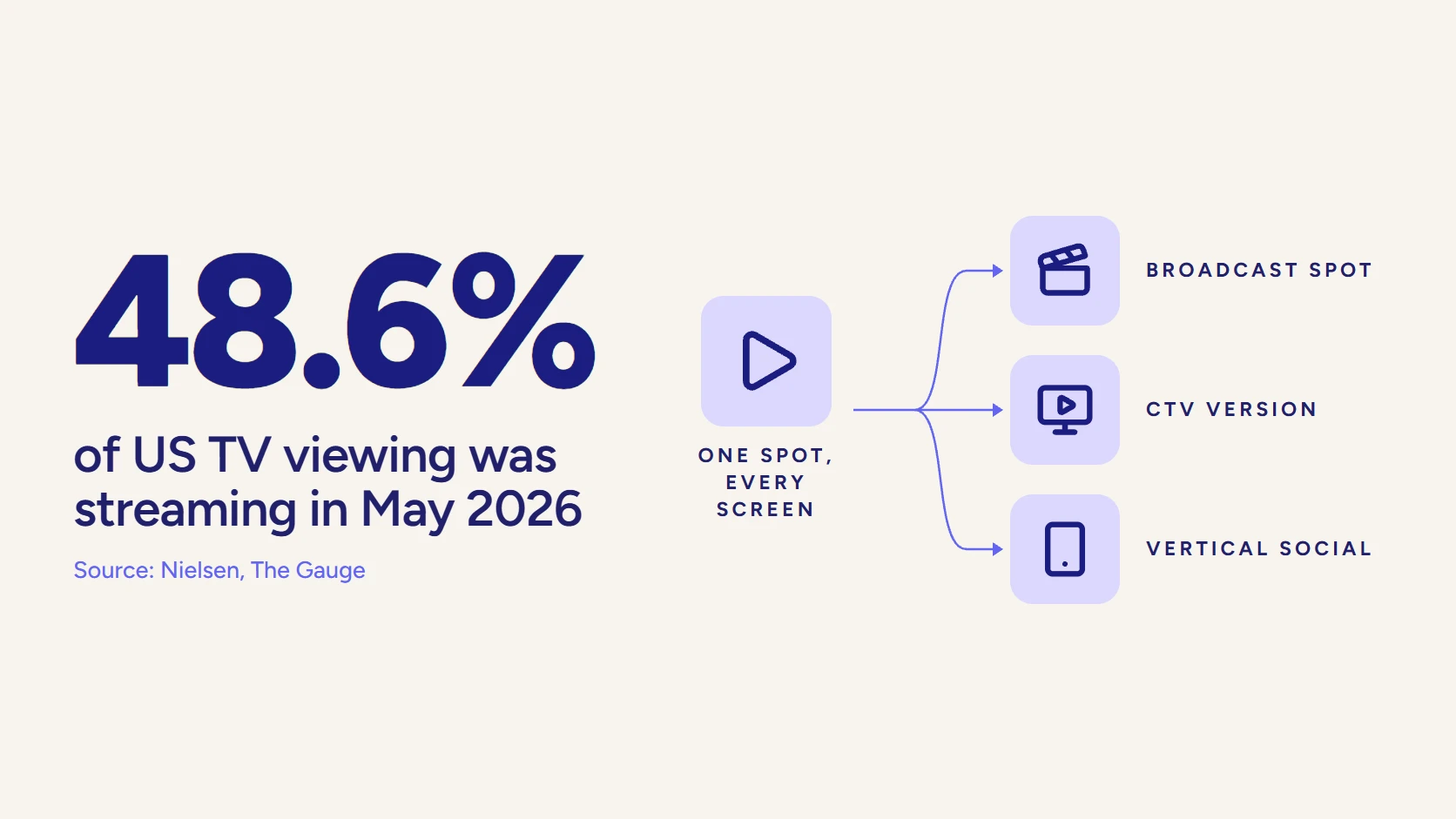
The audience has already split, so for most brands the answer is both, with different jobs. In May 2026, streaming reached 48.6% of US TV viewing, a record, against 20.4% for cable and 19.2% for broadcast.
Money is moving the same way. US digital video ad spend is forecast to pass $80 billion in 2026, and digital video is expected to exceed 60% of total TV and video ad spend for the first time.
What Changes in Production
- Linear TV buys scale and credibility on a fixed schedule, with the strictest clearance and loudness rules.
- CTV and streaming buy the same big screen with audience targeting, which makes versioning by segment worth planning.
- Both need a master that respects each outlet’s specs, which is why delivery belongs in the brief.
For a B2B brand the targeting argument usually wins: CTV lets a spot reach a job function or an industry instead of a daypart. Our B2B commercial production guide covers that media side in depth, and the piece on measuring TV advertising covers what to track once it airs.
Versioning by Audience
Targeting only pays off if the creative changes with the audience. A spot bought against three industries can carry three different opening lines or three different customer shots, all captured in one shoot if the versioning map asks for them. Serving one generic cut to every segment wastes the targeting you paid for, a point our piece on why programmatic video ads need better creative makes in detail.
What Should You Send a Production Company Before the First Call?
The fastest projects start with a short packet, not a blank page. Send these and the first conversation becomes a scoping call instead of a discovery call:
- The air date and flight length. The fixed point every stage is scheduled back from.
- The channel list. Linear networks, CTV platforms, social, and any out-of-home screens.
- The versions you already know you need. Lengths, aspect ratios, and languages.
- The claim and its proof. Anything the spot asserts, with the document that backs it.
- Brand guidelines and past spots. What to repeat, and what the brand has outgrown.
- Who approves. The names of every person who signs the script, the cut, and the final.
The last item decides more schedules than any other. A spot with one approver moves; a spot with an unnamed committee waits.
How Much Does TV Commercial Production Cost?
Making the spot and airing it are separate bills: NBCUniversal sold Super Bowl LX slots at an average of $8 million per 30 seconds, and that bought airtime, not a single frame. Production cost moves with shoot days, talent usage, effects, and the number of versions, and LocalEyes Video Production scopes it by deliverable, with most projects landing between $15,000 and $30,000. Our guide to TV commercial production cost walks the budget line by line.
How Do You Choose a TV Commercial Production Company?
Judge them on the stages this guide walked through, not on the reel alone. A reel shows taste. It does not show whether the spot cleared on time.
Green flags and red flags in a commercial production partner
Green flags
- Clearance submissions are built into the schedule
- A written versioning map before the shoot
- Named owner for broadcast and CTV delivery
- Talent usage priced to your media plan
Red flags
- A quote with no line for usage or music
- Cutdowns treated as a post-production afterthought
- One master file for every outlet
- No plan for claim substantiation
Five questions sort a partner from a crew quickly:
- Who owns delivery? Ask which person builds the broadcast and CTV masters and checks loudness.
- How do they handle clearance? A partner schedules the storyboard and rough cut submissions into the plan.
- Is the versioning map written down? Ask to see one from a past campaign.
- What does the quote include? Talent usage, music licensing, and revisions are where cheap quotes grow.
- Can they shoot where you need? Multi-market brands need one standard across cities.
Our guide on hiring a video ad production company goes deeper on the vetting, and if your spot is headed for Southern California, the tips for filming commercials in Los Angeles cover permits and logistics.
Why Do B2B Brands Produce Commercials With LocalEyes Video Production?
Because a commercial is rarely the only asset a B2B team needs from a shoot. LocalEyes Video Production has produced 4,000 videos in 8 years across 10 US markets, with Emmy recognition, 500+ five-star reviews, and an NPS above 95.
Two of our own commercials show the range a production company has to cover. The first is a :31 spot for the Community College of Aurora, the standard broadcast length this guide has been building toward.
The second, for Coach Cat, runs 2 minutes and 53 seconds, well past the :30 and :15 lengths a network break is built around. A spot that long needs its own cutdowns before it fits a standard broadcast slot, which is exactly what a versioning map plans for.
A commercial rarely ships alone, either: one coordinated production should feed a hero spot, its cutdowns, and the digital versions around it. See our video ad production services and the full range of video production services, or read more about the team.
Bring your air date and your channel list. We will build the schedule backward from there.
Video that has to work?
Plan your next video project with LocalEyes Video Production and start from the goal, not the brief.
Frequently Asked Questions
What Is TV Commercial Production?
What Does a TV Commercial Production Company Do?
How Long Does It Take to Produce a TV Commercial?
How Much Does TV Commercial Production Cost?
What Is the Difference Between a CTV Ad and a TV Commercial?
Do TV Commercials Need Network Approval?
What Is an Ad-ID Code?
Can One Shoot Produce Both a TV Spot and Social Videos?

Founder at LocalEyes Video Production | Inc. 5000 CEO | Emmy Award Winning Producer